 Add to Chrome
 Add to Firefox
 Add to Edge
Multimodal 3D LUT Generation via StatLUT with Statistical Features for Photorealistic Style Transfer
Jul 09, 2026
Photorealistic Style Transfer (PST) aims to transfer the color and tonal style of a reference to a content image while strictly preserving its structural integrity. However, existing deep learning-based methods inherently suffer from semantic entanglement caused by pre-trained image encoders, leading to unnatural spatial distortions. Moreover, current pixel-level mapping paradigms often ignore color gamut topology, resulting in color banding, while also lacking the multimodal capability for intuitive text-driven control. To address these bottlenecks, we propose StatLUT, an innovative multimodal framework for 3D LUT generation. First, we bypass traditional encoders and introduce a Lab-Extractor to derive spatially-agnostic statistical features, fundamentally decoupling color distributions from structural semantics to ensure artifact-free rendering. Second, we formulate LUT generation as a Transformer-based Seq2Seq translation task, utilizing a Multi-dimensional Residual Mapper (MR-Mapper) to predict topologically smooth 3D LUTs. Finally, to break the single-modal barrier, we propose the H-Diffuser, a lightweight Diffusion Transformer that directly synthesizes statistical features from natural language prompts, enabling flexible text-driven color grading. Extensive experiments on standard benchmarks demonstrate that StatLUT significantly outperforms state-of-the-art methods in both visual quality and quantitative metrics, pioneering a highly robust and flexible paradigm for multimodal photorealistic style transfer.

The Fourth Challenge on Image Super-Resolution ($\times$4) at NTIRE 2026: Benchmark Results and Method Overview
Apr 16, 2026This paper presents the NTIRE 2026 image super-resolution ($\times$4) challenge, one of the associated competitions of the NTIRE 2026 Workshop at CVPR 2026. The challenge aims to reconstruct high-resolution (HR) images from low-resolution (LR) inputs generated through bicubic downsampling with a $\times$4 scaling factor. The objective is to develop effective super-resolution solutions and analyze recent advances in the field. To reflect the evolving objectives of image super-resolution, the challenge includes two tracks: (1) a restoration track, which emphasizes pixel-wise fidelity and ranks submissions based on PSNR; and (2) a perceptual track, which focuses on visual realism and evaluates results using a perceptual score. A total of 194 participants registered for the challenge, with 31 teams submitting valid entries. This report summarizes the challenge design, datasets, evaluation protocol, main results, and methods of participating teams. The challenge provides a unified benchmark and offers insights into current progress and future directions in image super-resolution.
The Second Challenge on Real-World Face Restoration at NTIRE 2026: Methods and Results
Apr 12, 2026This paper provides a review of the NTIRE 2026 challenge on real-world face restoration, highlighting the proposed solutions and the resulting outcomes. The challenge focuses on generating natural and realistic outputs while maintaining identity consistency. Its goal is to advance state-of-the-art solutions for perceptual quality and realism, without imposing constraints on computational resources or training data. Performance is evaluated using a weighted image quality assessment (IQA) score and employs the AdaFace model as an identity checker. The competition attracted 96 registrants, with 10 teams submitting valid models; ultimately, 9 teams achieved valid scores in the final ranking. This collaborative effort advances the performance of real-world face restoration while offering an in-depth overview of the latest trends in the field.
Acquire and then Adapt: Squeezing out Text-to-Image Model for Image Restoration
Apr 21, 2025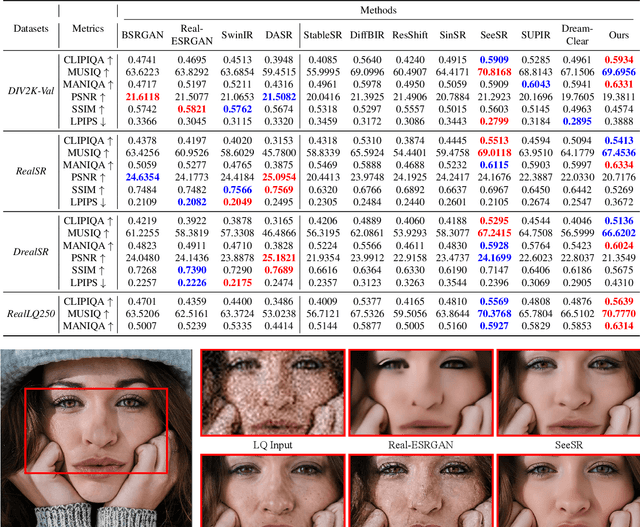
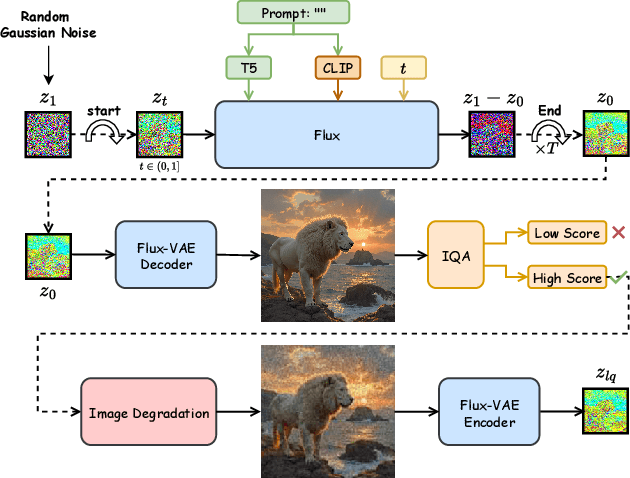
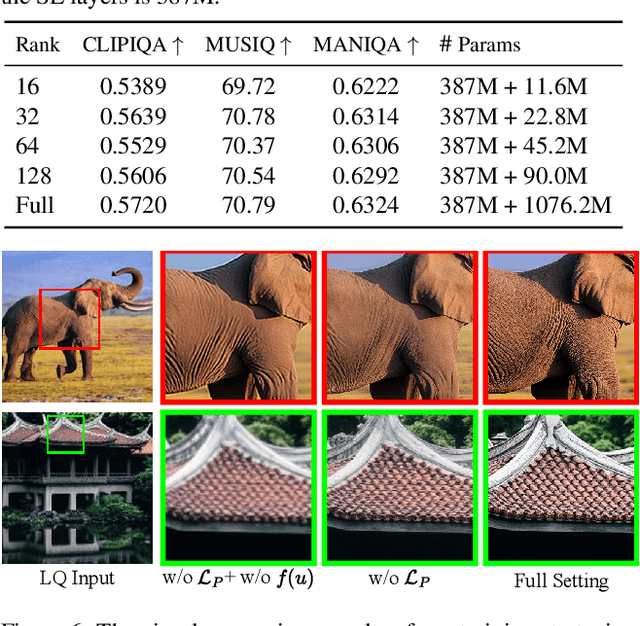
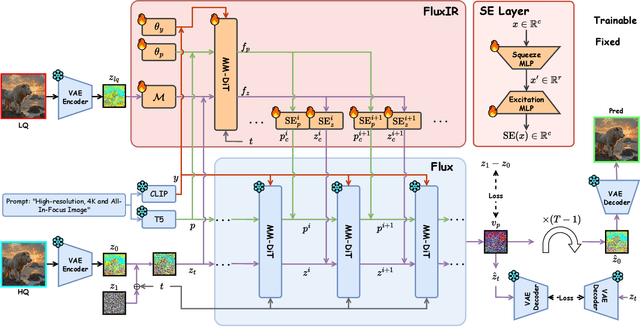
Recently, pre-trained text-to-image (T2I) models have been extensively adopted for real-world image restoration because of their powerful generative prior. However, controlling these large models for image restoration usually requires a large number of high-quality images and immense computational resources for training, which is costly and not privacy-friendly. In this paper, we find that the well-trained large T2I model (i.e., Flux) is able to produce a variety of high-quality images aligned with real-world distributions, offering an unlimited supply of training samples to mitigate the above issue. Specifically, we proposed a training data construction pipeline for image restoration, namely FluxGen, which includes unconditional image generation, image selection, and degraded image simulation. A novel light-weighted adapter (FluxIR) with squeeze-and-excitation layers is also carefully designed to control the large Diffusion Transformer (DiT)-based T2I model so that reasonable details can be restored. Experiments demonstrate that our proposed method enables the Flux model to adapt effectively to real-world image restoration tasks, achieving superior scores and visual quality on both synthetic and real-world degradation datasets - at only about 8.5\% of the training cost compared to current approaches.