 Add to Chrome
 Add to Firefox
 Add to Edge
Multimodal 3D LUT Generation via StatLUT with Statistical Features for Photorealistic Style Transfer
Jul 09, 2026
Photorealistic Style Transfer (PST) aims to transfer the color and tonal style of a reference to a content image while strictly preserving its structural integrity. However, existing deep learning-based methods inherently suffer from semantic entanglement caused by pre-trained image encoders, leading to unnatural spatial distortions. Moreover, current pixel-level mapping paradigms often ignore color gamut topology, resulting in color banding, while also lacking the multimodal capability for intuitive text-driven control. To address these bottlenecks, we propose StatLUT, an innovative multimodal framework for 3D LUT generation. First, we bypass traditional encoders and introduce a Lab-Extractor to derive spatially-agnostic statistical features, fundamentally decoupling color distributions from structural semantics to ensure artifact-free rendering. Second, we formulate LUT generation as a Transformer-based Seq2Seq translation task, utilizing a Multi-dimensional Residual Mapper (MR-Mapper) to predict topologically smooth 3D LUTs. Finally, to break the single-modal barrier, we propose the H-Diffuser, a lightweight Diffusion Transformer that directly synthesizes statistical features from natural language prompts, enabling flexible text-driven color grading. Extensive experiments on standard benchmarks demonstrate that StatLUT significantly outperforms state-of-the-art methods in both visual quality and quantitative metrics, pioneering a highly robust and flexible paradigm for multimodal photorealistic style transfer.

Detail Preserving Depth Estimation from a Single Image Using Attention Guided Networks
Sep 03, 2018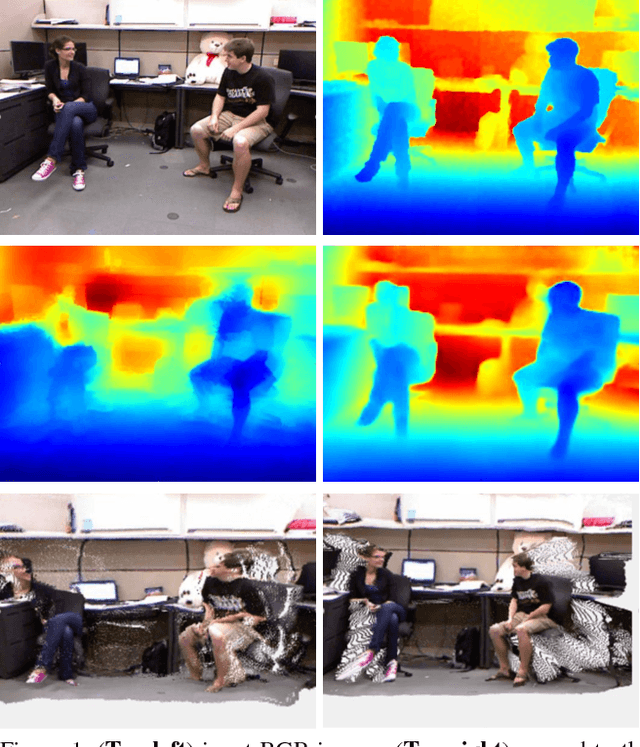
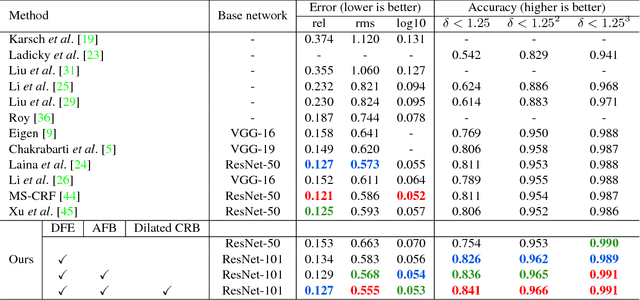
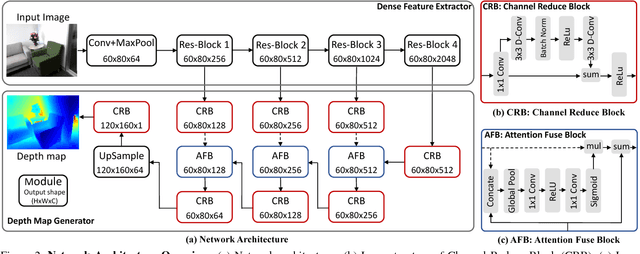
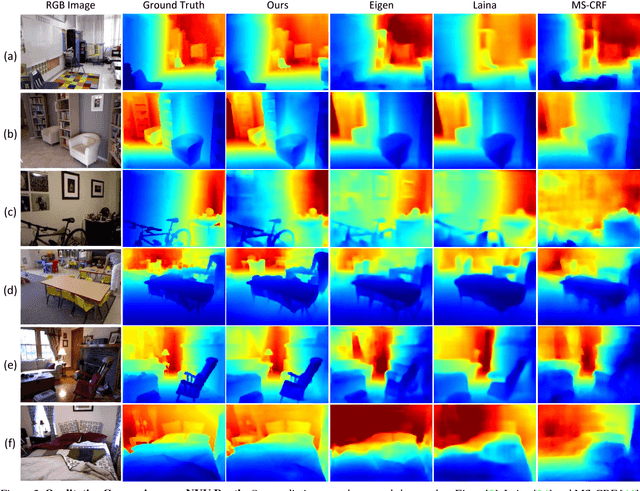
Convolutional Neural Networks have demonstrated superior performance on single image depth estimation in recent years. These works usually use stacked spatial pooling or strided convolution to get high-level information which are common practices in classification task. However, depth estimation is a dense prediction problem and low-resolution feature maps usually generate blurred depth map which is undesirable in application. In order to produce high quality depth map, say clean and accurate, we propose a network consists of a Dense Feature Extractor (DFE) and a Depth Map Generator (DMG). The DFE combines ResNet and dilated convolutions. It extracts multi-scale information from input image while keeping the feature maps dense. As for DMG, we use attention mechanism to fuse multi-scale features produced in DFE. Our Network is trained end-to-end and does not need any post-processing. Hence, it runs fast and can predict depth map in about 15 fps. Experiment results show that our method is competitive with the state-of-the-art in quantitative evaluation, but can preserve better structural details of the scene depth.