 Add to Chrome
 Add to Firefox
 Add to Edge
Knowledge-Geometry Decoupling: Refreshable Pretrained Transfer for Streaming Recommendation
Aug 06, 2026
Industrial recommenders increasingly adopt the pretrain-then-transfer paradigm, yet behavioral distribution drift raises two questions: what to learn from behavior sequences, and how to transfer the learned knowledge while the pretrained model is continually refreshed. To resolve them, we propose Knowledge-Geometry Decoupling (KGD). For what to learn, conventional next-token prediction treats adjacency as dependency and may encode spurious transitions across unrelated sessions. We introduce Behavioral Multi-Token Prediction (BMTP) to retain only collaboratively or semantically related future items as supervision, yielding cleaner and more transferable behavioral knowledge. For how to transfer, pretrained knowledge and task-specific geometry impose conflicting optimization demands on shared parameters. To handle it, KGD assigns them to separate parameter sets: a refreshable encoder owns behavioral knowledge, while a task learner reads contextualized encoder states through read-only cross-attention and writes task-specific geometry through Anchored Calibration Residual (ACR) orthogonal to the pretrained embedding. The decoupled ownership enables continual knowledge refresh without task-gradient interference or invalidating downstream adaptation. KGD improves over strong pretrain-transfer baselines by 4-12% on eight public benchmarks and sustains its advantage over a 90-day production stream where baselines show no gains. KGD has been fully deployed in Shopee. In a live A/B test on Shopee Homepage Search, it increases GMV per user by 1.75% and advertising revenue by 1.53%, demonstrating its high practical value. We provide the core implementation of KGD at https://github.com/FuCongResearchSquad/KGD4REC.

Rethinking PPG-based Sleep Staging: Datasets, Metrics, and Benchmarks
Aug 02, 2026Automated sleep staging assigns discrete stage labels to successive time epochs throughout an overnight recording; conventionally each window spans at least 30 seconds, reflecting the minimum temporal resolution of the clinical scoring standard. Wearable photoplethysmography (PPG) has attracted sustained interest as an ambulatory alternative to laboratory-based polysomnography, which relies on electroencephalography (EEG) and other recording modalities that are impractical outside clinical environments. Yet PPG-based staging trails EEG-based methods by a substantial margin, and we argue this gap largely reflects a mismatch between signal and task. Within a stable stage, PPG's inter-stage feature differences are more subtle than those in EEG; yet at stage boundaries, PPG's principal cardiovascular features, heart rate variability and pulse morphology, shift sharply within seconds. The conventional practice of assigning one label to each 30-second epoch therefore suppresses feature that is concentrated near boundaries. We address this gap in two steps. First, we develop a label expansion pipeline based on Hidden Semi-Markov Models that converts coarse epoch labels into sec-level annotations. To assess whether these expanded labels are reliable enough for downstream supervision, we validate them on a separate expert-reviewed dataset and through an auxiliary sleep-wake task whose labels are independent of the expansion pipeline. Second, we use the resulting sec-level supervision on MESA to improve conventional four-class epoch-level staging across four architecturally diverse baselines by 3.7--5.7\,pp in accuracy against the original epoch labels, with supplementary zero-shot evaluation on CFS showing that the transfer benefit persists under cohort and annotation-protocol shift.
OneRank: Unified Transformer-Native Ranking Architecture for Multi-Task Recommendation
Jun 15, 2026Multi-task learning (MTL) is essential in recommender systems to enable complementary learning among diverse user feedback. While modern industrial practices have shifted from DNNs to Transformer-centric architectures to strengthen sequence modeling and scaling capacity, they still decouple feature encoding from multi-task prediction, treating the Transformer as a task-agnostic encoder. This design fundamentally limits the performance and scalability by (1) creating an information bottleneck under heterogeneous task objectives, (2) inducing gradient interference that leads to the seesaw phenomenon, and (3) forcing a dataflow transition in which attention-based, context-adaptive representation learning is converted to static feed-forward task prediction with incompatible information read-write dynamics. We propose OneRank, a Transformer-native multi-task ranking framework that eliminates encoder-predictor separation and introduces task-private channels for forward representation learning and backward optimization, enabling task-specialized learning while reducing inter-task interference. In the forward pass, OneRank learns task-specific representations bottom-up through task-conditioned information selection, candidate-aware contextualization, and controlled cross-task interaction. In the backward pass, cross-task gradient detachment isolates task-private parameter updates from shared knowledge extraction modules, preventing negative transfer. We further replace static task-specific MLP scorers with dynamic matching-based scoring for context-aware personalized ranking. By internalizing multi-task reasoning within the Transformer stack, OneRank establishes a unified and scalable architectural paradigm. Offline and online experiments on large-scale industrial datasets show that OneRank significantly outperforms state-of-the-art baselines while maintaining computational efficiency.
ManCAR: Manifold-Constrained Latent Reasoning with Adaptive Test-Time Computation for Sequential Recommendation
Feb 23, 2026Sequential recommendation increasingly employs latent multi-step reasoning to enhance test-time computation. Despite empirical gains, existing approaches largely drive intermediate reasoning states via target-dominant objectives without imposing explicit feasibility constraints. This results in latent drift, where reasoning trajectories deviate into implausible regions. We argue that effective recommendation reasoning should instead be viewed as navigation on a collaborative manifold rather than free-form latent refinement. To this end, we propose ManCAR (Manifold-Constrained Adaptive Reasoning), a principled framework that grounds reasoning within the topology of a global interaction graph. ManCAR constructs a local intent prior from the collaborative neighborhood of a user's recent actions, represented as a distribution over the item simplex. During training, the model progressively aligns its latent predictive distribution with this prior, forcing the reasoning trajectory to remain within the valid manifold. At test time, reasoning proceeds adaptively until the predictive distribution stabilizes, avoiding over-refinement. We provide a variational interpretation of ManCAR to theoretically validate its drift-prevention and adaptive test-time stopping mechanisms. Experiments on seven benchmarks demonstrate that ManCAR consistently outperforms state-of-the-art baselines, achieving up to a 46.88% relative improvement w.r.t. NDCG@10. Our code is available at https://github.com/FuCongResearchSquad/ManCAR.
Rethinking Generative Recommender Tokenizer: Recsys-Native Encoding and Semantic Quantization Beyond LLMs
Feb 02, 2026Semantic ID (SID)-based recommendation is a promising paradigm for scaling sequential recommender systems, but existing methods largely follow a semantic-centric pipeline: item embeddings are learned from foundation models and discretized using generic quantization schemes. This design is misaligned with generative recommendation objectives: semantic embeddings are weakly coupled with collaborative prediction, and generic quantization is inefficient at reducing sequential uncertainty for autoregressive modeling. To address these, we propose ReSID, a recommendation-native, principled SID framework that rethinks representation learning and quantization from the perspective of information preservation and sequential predictability, without relying on LLMs. ReSID consists of two components: (i) Field-Aware Masked Auto-Encoding (FAMAE), which learns predictive-sufficient item representations from structured features, and (ii) Globally Aligned Orthogonal Quantization (GAOQ), which produces compact and predictable SID sequences by jointly reducing semantic ambiguity and prefix-conditional uncertainty. Theoretical analysis and extensive experiments across ten datasets show the effectiveness of ReSID. ReSID consistently outperforms strong sequential and SID-based generative baselines by an average of over 10%, while reducing tokenization cost by up to 122x. Code is available at https://github.com/FuCongResearchSquad/ReSID.
Reveal Hidden Pitfalls and Navigate Next Generation of Vector Similarity Search from Task-Centric Views
Dec 15, 2025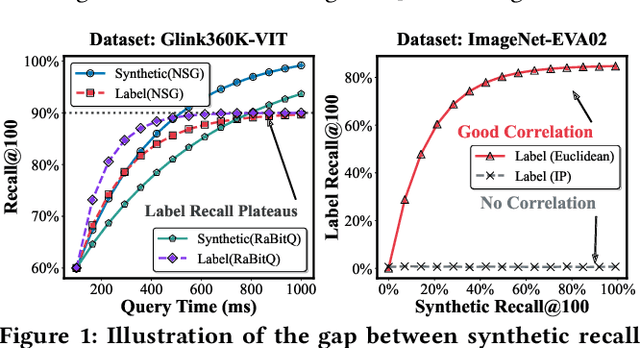

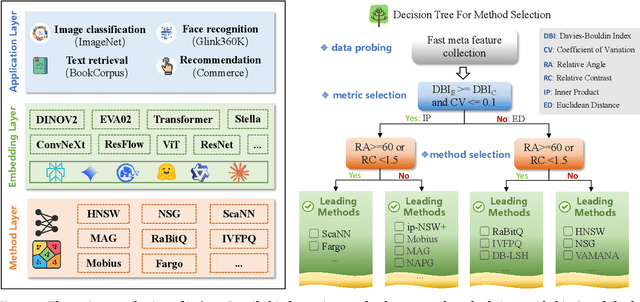
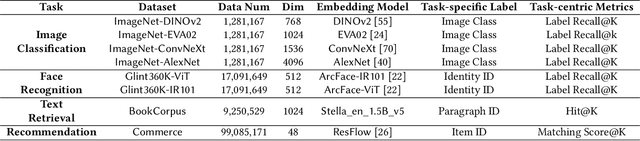
Vector Similarity Search (VSS) in high-dimensional spaces is rapidly emerging as core functionality in next-generation database systems for numerous data-intensive services -- from embedding lookups in large language models (LLMs), to semantic information retrieval and recommendation engines. Current benchmarks, however, evaluate VSS primarily on the recall-latency trade-off against a ground truth defined solely by distance metrics, neglecting how retrieval quality ultimately impacts downstream tasks. This disconnect can mislead both academic research and industrial practice. We present Iceberg, a holistic benchmark suite for end-to-end evaluation of VSS methods in realistic application contexts. From a task-centric view, Iceberg uncovers the Information Loss Funnel, which identifies three principal sources of end-to-end performance degradation: (1) Embedding Loss during feature extraction; (2) Metric Misuse, where distances poorly reflect task relevance; (3) Data Distribution Sensitivity, highlighting index robustness across skews and modalities. For a more comprehensive assessment, Iceberg spans eight diverse datasets across key domains such as image classification, face recognition, text retrieval, and recommendation systems. Each dataset, ranging from 1M to 100M vectors, includes rich, task-specific labels and evaluation metrics, enabling assessment of retrieval algorithms within the full application pipeline rather than in isolation. Iceberg benchmarks 13 state-of-the-art VSS methods and re-ranks them based on application-level metrics, revealing substantial deviations from traditional rankings derived purely from recall-latency evaluations. Building on these insights, we define a set of task-centric meta-features and derive an interpretable decision tree to guide practitioners in selecting and tuning VSS methods for their specific workloads.
Tensor Decomposition Networks for Fast Machine Learning Interatomic Potential Computations
Jul 01, 2025$\rm{SO}(3)$-equivariant networks are the dominant models for machine learning interatomic potentials (MLIPs). The key operation of such networks is the Clebsch-Gordan (CG) tensor product, which is computationally expensive. To accelerate the computation, we develop tensor decomposition networks (TDNs) as a class of approximately equivariant networks whose CG tensor products are replaced by low-rank tensor decompositions, such as the CANDECOMP/PARAFAC (CP) decomposition. With the CP decomposition, we prove (i) a uniform bound on the induced error of $\rm{SO}(3)$-equivariance, and (ii) the universality of approximating any equivariant bilinear map. To further reduce the number of parameters, we propose path-weight sharing that ties all multiplicity-space weights across the $O(L^3)$ CG paths into a single path without compromising equivariance, where $L$ is the maximum angular degree. The resulting layer acts as a plug-and-play replacement for tensor products in existing networks, and the computational complexity of tensor products is reduced from $O(L^6)$ to $O(L^4)$. We evaluate TDNs on PubChemQCR, a newly curated molecular relaxation dataset containing 105 million DFT-calculated snapshots. We also use existing datasets, including OC20, and OC22. Results show that TDNs achieve competitive performance with dramatic speedup in computations.
Embed Progressive Implicit Preference in Unified Space for Deep Collaborative Filtering
May 28, 2025Embedding-based collaborative filtering, often coupled with nearest neighbor search, is widely deployed in large-scale recommender systems for personalized content selection. Modern systems leverage multiple implicit feedback signals (e.g., clicks, add to cart, purchases) to model user preferences comprehensively. However, prevailing approaches adopt a feedback-wise modeling paradigm, which (1) fails to capture the structured progression of user engagement entailed among different feedback and (2) embeds feedback-specific information into disjoint spaces, making representations incommensurable, increasing system complexity, and leading to suboptimal retrieval performance. A promising alternative is Ordinal Logistic Regression (OLR), which explicitly models discrete ordered relations. However, existing OLR-based recommendation models mainly focus on explicit feedback (e.g., movie ratings) and struggle with implicit, correlated feedback, where ordering is vague and non-linear. Moreover, standard OLR lacks flexibility in handling feedback-dependent covariates, resulting in suboptimal performance in real-world systems. To address these limitations, we propose Generalized Neural Ordinal Logistic Regression (GNOLR), which encodes multiple feature-feedback dependencies into a unified, structured embedding space and enforces feedback-specific dependency learning through a nested optimization framework. Thus, GNOLR enhances predictive accuracy, captures the progression of user engagement, and simplifies the retrieval process. We establish a theoretical comparison with existing paradigms, demonstrating how GNOLR avoids disjoint spaces while maintaining effectiveness. Extensive experiments on ten real-world datasets show that GNOLR significantly outperforms state-of-the-art methods in efficiency and adaptability.
Stitching Inner Product and Euclidean Metrics for Topology-aware Maximum Inner Product Search
Apr 21, 2025Maximum Inner Product Search (MIPS) is a fundamental challenge in machine learning and information retrieval, particularly in high-dimensional data applications. Existing approaches to MIPS either rely solely on Inner Product (IP) similarity, which faces issues with local optima and redundant computations, or reduce the MIPS problem to the Nearest Neighbor Search under the Euclidean metric via space projection, leading to topology destruction and information loss. Despite the divergence of the two paradigms, we argue that there is no inherent binary opposition between IP and Euclidean metrics. By stitching IP and Euclidean in the design of indexing and search algorithms, we can significantly enhance MIPS performance. Specifically, this paper explores the theoretical and empirical connections between these two metrics from the MIPS perspective. Our investigation, grounded in graph-based search, reveals that different indexing and search strategies offer distinct advantages for MIPS, depending on the underlying data topology. Building on these insights, we introduce a novel graph-based index called Metric-Amphibious Graph (MAG) and a corresponding search algorithm, Adaptive Navigation with Metric Switch (ANMS). To facilitate parameter tuning for optimal performance, we identify three statistical indicators that capture essential data topology properties and correlate strongly with parameter tuning. Extensive experiments on 12 real-world datasets demonstrate that MAG outperforms existing state-of-the-art methods, achieving up to 4x search speedup while maintaining adaptability and scalability.
MedCT: A Clinical Terminology Graph for Generative AI Applications in Healthcare
Jan 11, 2025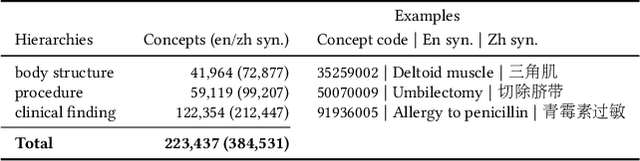

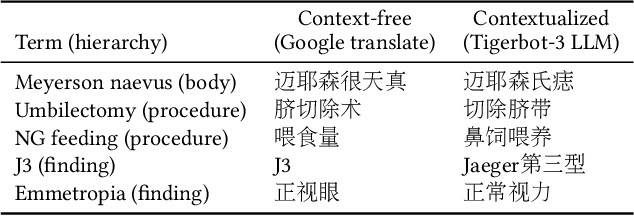

We introduce the world's first clinical terminology for the Chinese healthcare community, namely MedCT, accompanied by a clinical foundation model MedBERT and an entity linking model MedLink. The MedCT system enables standardized and programmable representation of Chinese clinical data, successively stimulating the development of new medicines, treatment pathways, and better patient outcomes for the populous Chinese community. Moreover, the MedCT knowledge graph provides a principled mechanism to minimize the hallucination problem of large language models (LLMs), therefore achieving significant levels of accuracy and safety in LLM-based clinical applications. By leveraging the LLMs' emergent capabilities of generativeness and expressiveness, we were able to rapidly built a production-quality terminology system and deployed to real-world clinical field within three months, while classical terminologies like SNOMED CT have gone through more than twenty years development. Our experiments show that the MedCT system achieves state-of-the-art (SOTA) performance in semantic matching and entity linking tasks, not only for Chinese but also for English. We also conducted a longitudinal field experiment by applying MedCT and LLMs in a representative spectrum of clinical tasks, including electronic health record (EHR) auto-generation and medical document search for diagnostic decision making. Our study shows a multitude of values of MedCT for clinical workflows and patient outcomes, especially in the new genre of clinical LLM applications. We present our approach in sufficient engineering detail, such that implementing a clinical terminology for other non-English societies should be readily reproducible. We openly release our terminology, models and algorithms, along with real-world clinical datasets for the development.