 Add to Chrome
 Add to Firefox
 Add to Edge
The Barron-Lipschitz Energy Gap and Depth Separation Phenomena in Scientific Machine Learning
Jul 28, 2026
We illustrate in several examples that even neural networks of infinite width (specifically, Barron functions) may encounter substantial obstacles when used as a model class for problems in the calculus of variations. An instance of practical relevance concerns the bending, stretching and folding of a thin elastic shell with anchored or clamped boundary conditions where elastic energy could be reduced by folding along a circular line, but the neural networks can only describe straight folds along entire lines. Conversely, we show that there is no gap between the energy that Barron functions and Lipschitz functions can achieve for a large class of integral first-order functionals.

Elliptic Regularity Theory in Barron Spaces and Applications to the Deep Ritz Method
Jul 27, 2026We prove that harmonic functions with Dirichlet boundary data in Barron space, a function class tailored to wide ReLU networks with a single hidden layer and suitably bounded weights, are generally neither Lipschitz continuous nor in the Sobolev class $H^2$. A fortiori, they are not in any function class in which the norm controls the Lipschitz constant, which rules out not only Barron space regularity, but also regularity in function classes for deeper ReLU networks with bounded coefficients. They can, however, be approximated to accuracy $\sim \varepsilon$ by Barron functions of low norm $\sim |\log\varepsilon|$ in various Lebesgue and Sobolev norms (with at most two derivatives). The positive result holds on very simple domains: Half-spaces in arbitrary dimension and rectangular domains in two dimensions. As an application of this regularity theory, we obtain a priori error estimates for Deep Ritz neural PDE solvers.
Momentum-based minimization of the Ginzburg-Landau functional on Euclidean spaces and graphs
Dec 31, 2024
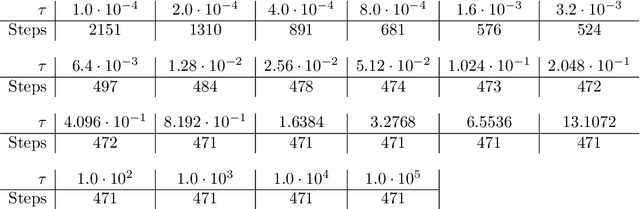
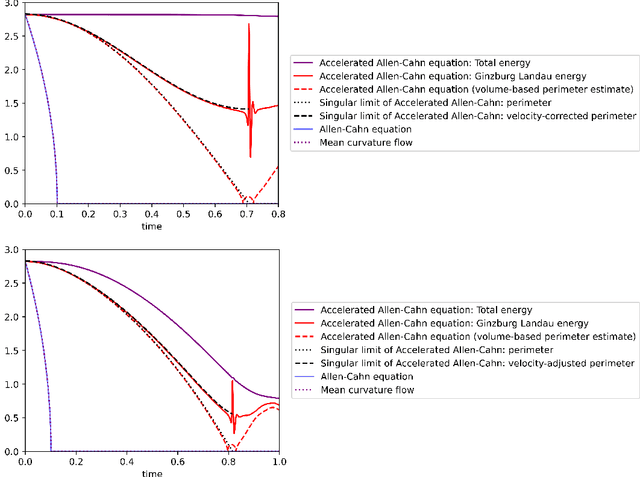
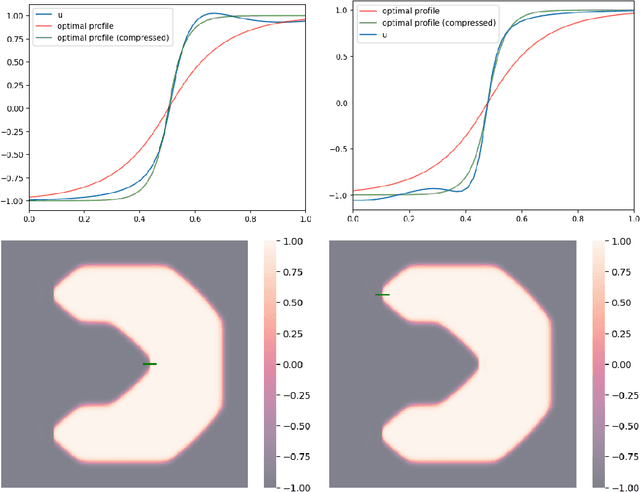
We study the momentum-based minimization of a diffuse perimeter functional on Euclidean spaces and on graphs with applications to semi-supervised classification tasks in machine learning. While the gradient flow in the task at hand is a parabolic partial differential equation, the momentum-method corresponds to a damped hyperbolic PDE, leading to qualitatively and quantitatively different trajectories. Using a convex-concave splitting-based FISTA-type time discretization, we demonstrate empirically that momentum can lead to faster convergence if the time step size is large but not too large. With large time steps, the PDE analysis offers only limited insight into the geometric behavior of solutions and typical hyperbolic phenomena like loss of regularity are not be observed in sample simulations.
Solving the Poisson Equation with Dirichlet data by shallow ReLU$^α$-networks: A regularity and approximation perspective
Dec 10, 2024For several classes of neural PDE solvers (Deep Ritz, PINNs, DeepONets), the ability to approximate the solution or solution operator to a partial differential equation (PDE) hinges on the abilitiy of a neural network to approximate the solution in the spatial variables. We analyze the capacity of neural networks to approximate solutions to an elliptic PDE assuming that the boundary condition can be approximated efficiently. Our focus is on the Laplace operator with Dirichlet boundary condition on a half space and on neural networks with a single hidden layer and an activation function that is a power of the popular ReLU activation function.
Nesterov acceleration in benignly non-convex landscapes
Oct 10, 2024While momentum-based optimization algorithms are commonly used in the notoriously non-convex optimization problems of deep learning, their analysis has historically been restricted to the convex and strongly convex setting. In this article, we partially close this gap between theory and practice and demonstrate that virtually identical guarantees can be obtained in optimization problems with a `benign' non-convexity. We show that these weaker geometric assumptions are well justified in overparametrized deep learning, at least locally. Variations of this result are obtained for a continuous time model of Nesterov's accelerated gradient descent algorithm (NAG), the classical discrete time version of NAG, and versions of NAG with stochastic gradient estimates with purely additive noise and with noise that exhibits both additive and multiplicative scaling.
SineNet: Learning Temporal Dynamics in Time-Dependent Partial Differential Equations
Mar 28, 2024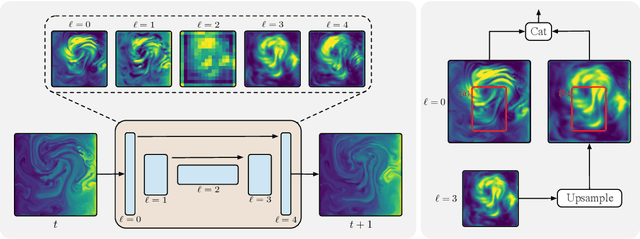

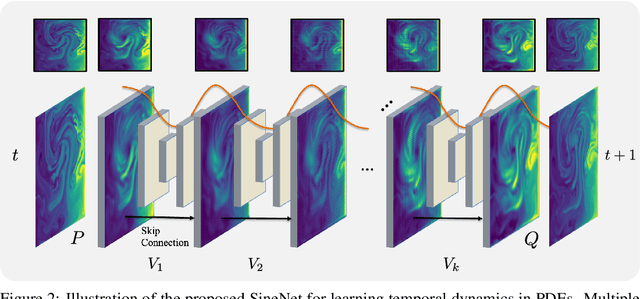

We consider using deep neural networks to solve time-dependent partial differential equations (PDEs), where multi-scale processing is crucial for modeling complex, time-evolving dynamics. While the U-Net architecture with skip connections is commonly used by prior studies to enable multi-scale processing, our analysis shows that the need for features to evolve across layers results in temporally misaligned features in skip connections, which limits the model's performance. To address this limitation, we propose SineNet, consisting of multiple sequentially connected U-shaped network blocks, referred to as waves. In SineNet, high-resolution features are evolved progressively through multiple stages, thereby reducing the amount of misalignment within each stage. We furthermore analyze the role of skip connections in enabling both parallel and sequential processing of multi-scale information. Our method is rigorously tested on multiple PDE datasets, including the Navier-Stokes equations and shallow water equations, showcasing the advantages of our proposed approach over conventional U-Nets with a comparable parameter budget. We further demonstrate that increasing the number of waves in SineNet while maintaining the same number of parameters leads to a monotonically improved performance. The results highlight the effectiveness of SineNet and the potential of our approach in advancing the state-of-the-art in neural PDE solver design. Our code is available as part of AIRS (https://github.com/divelab/AIRS).
Minimum norm interpolation by perceptra: Explicit regularization and implicit bias
Nov 10, 2023We investigate how shallow ReLU networks interpolate between known regions. Our analysis shows that empirical risk minimizers converge to a minimum norm interpolant as the number of data points and parameters tends to infinity when a weight decay regularizer is penalized with a coefficient which vanishes at a precise rate as the network width and the number of data points grow. With and without explicit regularization, we numerically study the implicit bias of common optimization algorithms towards known minimum norm interpolants.
A qualitative difference between gradient flows of convex functions in finite- and infinite-dimensional Hilbert spaces
Oct 26, 2023We consider gradient flow/gradient descent and heavy ball/accelerated gradient descent optimization for convex objective functions. In the gradient flow case, we prove the following: 1. If $f$ does not have a minimizer, the convergence $f(x_t)\to \inf f$ can be arbitrarily slow. 2. If $f$ does have a minimizer, the excess energy $f(x_t) - \inf f$ is integrable/summable in time. In particular, $f(x_t) - \inf f = o(1/t)$ as $t\to\infty$. 3. In Hilbert spaces, this is optimal: $f(x_t) - \inf f$ can decay to $0$ as slowly as any given function which is monotone decreasing and integrable at $\infty$, even for a fixed quadratic objective. 4. In finite dimension (or more generally, for all gradient flow curves of finite length), this is not optimal: We prove that there are convex monotone decreasing integrable functions $g(t)$ which decrease to zero slower than $f(x_t)-\inf f$ for the gradient flow of any convex function on $\mathbb R^d$. For instance, we show that any gradient flow $x_t$ of a convex function $f$ in finite dimension satisfies $\liminf_{t\to\infty} \big(t\cdot \log^2(t)\cdot \big\{f(x_t) -\inf f\big\}\big)=0$. This improves on the commonly reported $O(1/t)$ rate and provides a sharp characterization of the energy decay law. We also note that it is impossible to establish a rate $O(1/(t\phi(t))$ for any function $\phi$ which satisfies $\lim_{t\to\infty}\phi(t) = \infty$, even asymptotically. Similar results are obtained in related settings for (1) discrete time gradient descent, (2) stochastic gradient descent with multiplicative noise and (3) the heavy ball ODE. In the case of stochastic gradient descent, the summability of $\mathbb E[f(x_n) - \inf f]$ is used to prove that $f(x_n)\to \inf f$ almost surely - an improvement on the convergence almost surely up to a subsequence which follows from the $O(1/n)$ decay estimate.
Group Equivariant Fourier Neural Operators for Partial Differential Equations
Jun 09, 2023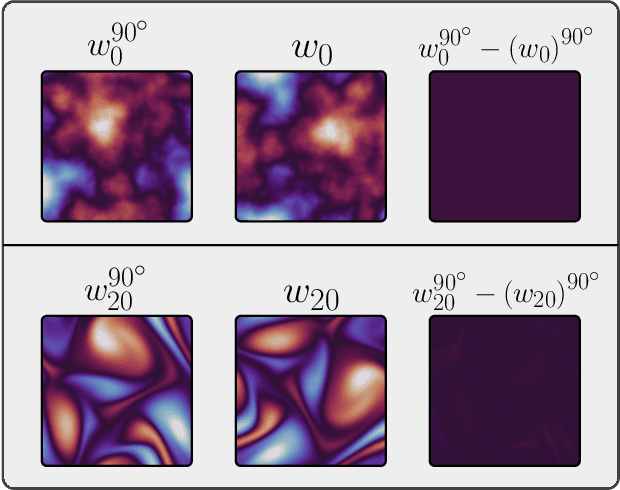
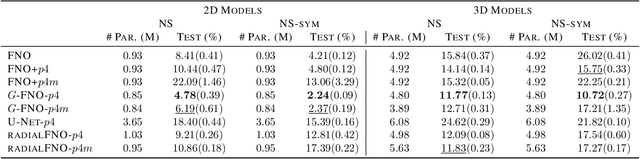
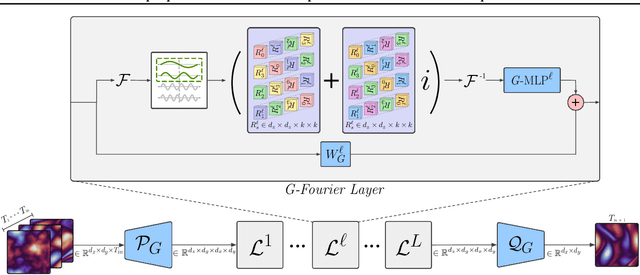
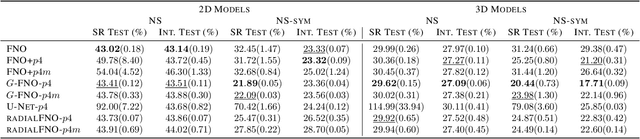
We consider solving partial differential equations (PDEs) with Fourier neural operators (FNOs), which operate in the frequency domain. Since the laws of physics do not depend on the coordinate system used to describe them, it is desirable to encode such symmetries in the neural operator architecture for better performance and easier learning. While encoding symmetries in the physical domain using group theory has been studied extensively, how to capture symmetries in the frequency domain is under-explored. In this work, we extend group convolutions to the frequency domain and design Fourier layers that are equivariant to rotations, translations, and reflections by leveraging the equivariance property of the Fourier transform. The resulting $G$-FNO architecture generalizes well across input resolutions and performs well in settings with varying levels of symmetry. Our code is publicly available as part of the AIRS library (https://github.com/divelab/AIRS).
Achieving acceleration despite very noisy gradients
Feb 10, 2023We present a novel momentum-based first order optimization method (AGNES) which provably achieves acceleration for convex minimization, even if the stochastic noise in the gradient estimates is many orders of magnitude larger than the gradient itself. Here we model the noise as having a variance which is proportional to the magnitude of the underlying gradient. We argue, based upon empirical evidence, that this is appropriate for mini-batch gradients in overparameterized deep learning. Furthermore, we demonstrate that the method achieves competitive performance in the training of CNNs on MNIST and CIFAR-10.