 Add to Chrome
 Add to Firefox
 Add to Edge
RADIO1D: Elastic Representations for Condensed Vision Modeling
Jul 03, 2026
This paper challenges the assumption that vision-language models (VLMs) require fixed patch-based 2D vision features. Analyzing fine-tuned vision encoders, we find that representations become increasingly abstract and less spatially coherent during VLM training. Notably, models trained with image-text alignment (such as SigLIP2) develop a small number of specialized tokens that effectively summarize global image content. Building on this, we introduce RADIO1D, which compresses images into a compact, variable-length 1D token sequence using multi-teacher knowledge distillation and an autoencoder design. The resulting representations exhibit strong hierarchical summarization, enabling accurate scene understanding - even with a single token - and support improved composition-aware image retrieval. In VLMs, RADIO1D provides flexible accuracy-efficiency tradeoffs through adjustable token counts, delivering competitive performance on diverse multimodal benchmarks with lower computational overhead and better accuracy.

Fully convolutional Siamese neural networks for buildings damage assessment from satellite images
Oct 31, 2021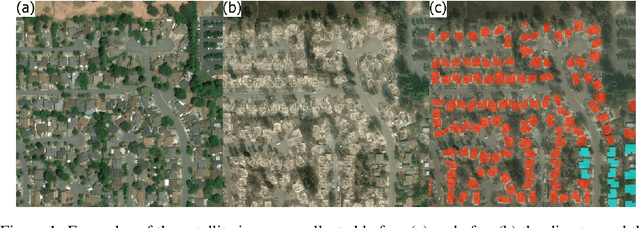
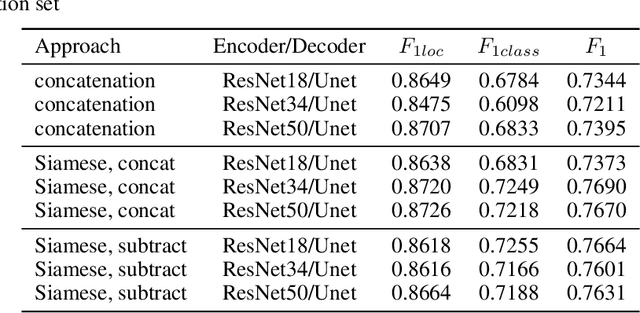
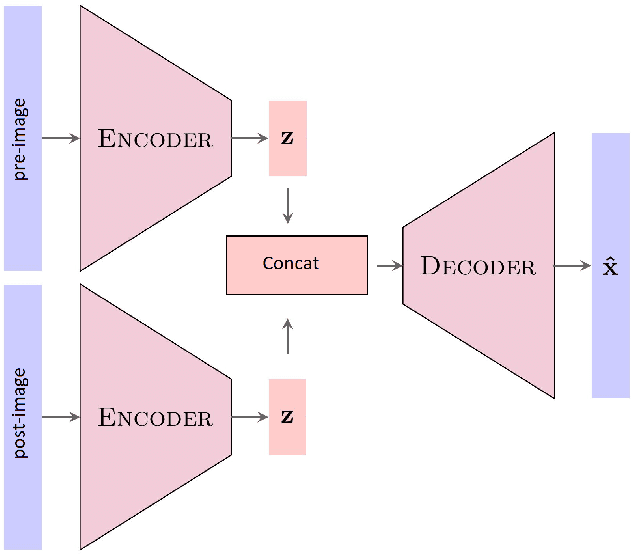
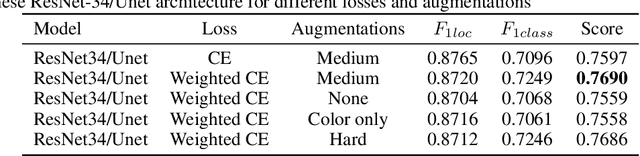
Damage assessment after natural disasters is needed to distribute aid and forces to recovery from damage dealt optimally. This process involves acquiring satellite imagery for the region of interest, localization of buildings, and classification of the amount of damage caused by nature or urban factors to buildings. In case of natural disasters, this means processing many square kilometers of the area to judge whether a particular building had suffered from the damaging factors. In this work, we develop a computational approach for an automated comparison of the same region's satellite images before and after the disaster, and classify different levels of damage in buildings. Our solution is based on Siamese neural networks with encoder-decoder architecture. We include an extensive ablation study and compare different encoders, decoders, loss functions, augmentations, and several methods to combine two images. The solution achieved one of the best results in the Computer Vision for Building Damage Assessment competition.
Albumentations: fast and flexible image augmentations
Sep 18, 2018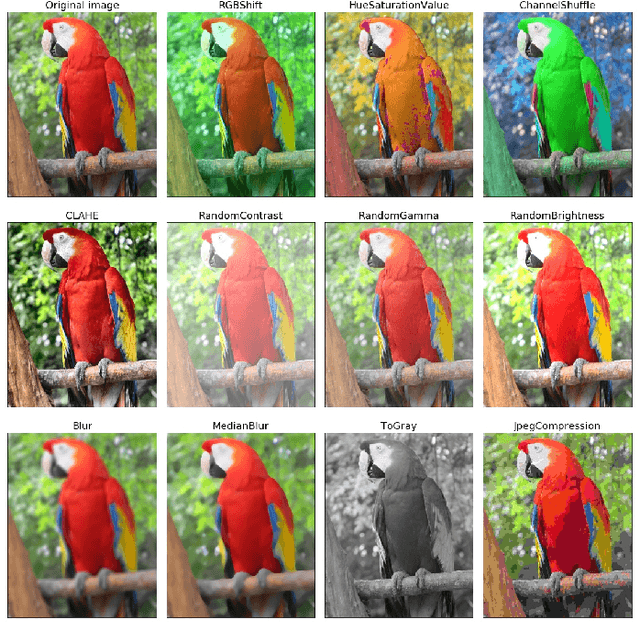
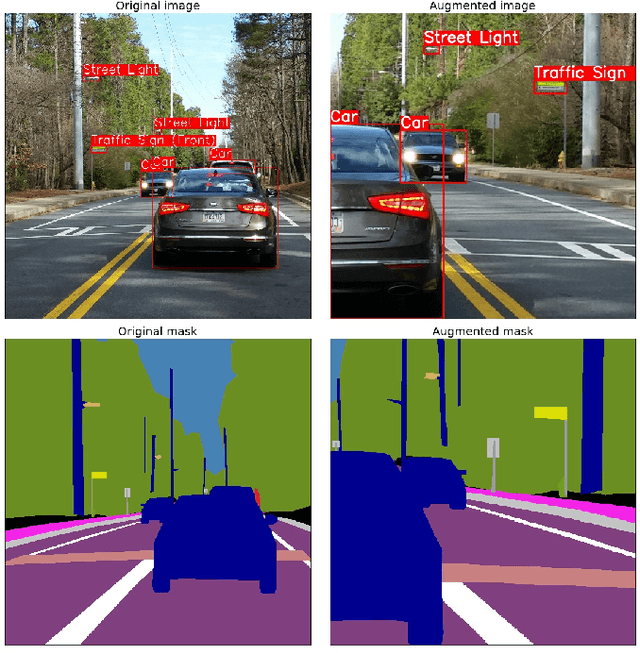
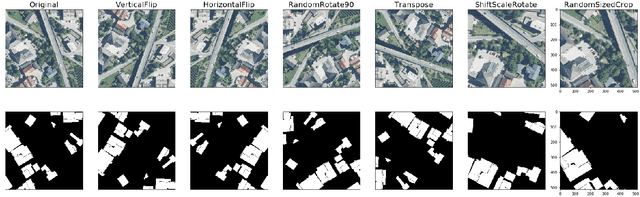
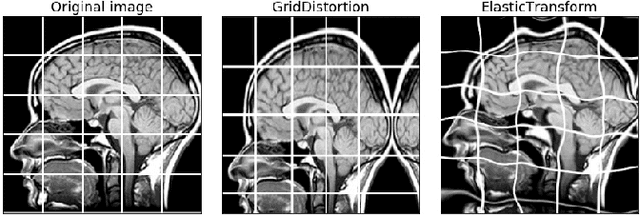
Data augmentation is a commonly used technique for increasing both the size and the diversity of labeled training sets by leveraging input transformations that preserve output labels. In computer vision domain, image augmentations have become a common implicit regularization technique to combat overfitting in deep convolutional neural networks and are ubiquitously used to improve performance. While most deep learning frameworks implement basic image transformations, the list is typically limited to some variations and combinations of flipping, rotating, scaling, and cropping. Moreover, the image processing speed varies in existing tools for image augmentation. We present Albumentations, a fast and flexible library for image augmentations with many various image transform operations available, that is also an easy-to-use wrapper around other augmentation libraries. We provide examples of image augmentations for different computer vision tasks and show that Albumentations is faster than other commonly used image augmentation tools on the most of commonly used image transformations. The source code for Albumentations is made publicly available online at https://github.com/albu/albumentations