 Add to Chrome
 Add to Firefox
 Add to Edge
BLASST: Dynamic BLocked Attention Sparsity via Softmax Thresholding
Dec 12, 2025
The growing demand for long-context inference capabilities in Large Language Models (LLMs) has intensified the computational and memory bottlenecks inherent to the standard attention mechanism. To address this challenge, we introduce BLASST, a drop-in sparse attention method that dynamically prunes the attention matrix without any pre-computation or proxy scores. Our method uses a fixed threshold and existing information from online softmax to identify negligible attention scores, skipping softmax computation, Value block loading, and the subsequent matrix multiplication. This fits seamlessly into existing FlashAttention kernel designs with negligible latency overhead. The approach is applicable to both prefill and decode stages across all attention variants (MHA, GQA, MQA, and MLA), providing a unified solution for accelerating long-context inference. We develop an automated calibration procedure that reveals a simple inverse relationship between optimal threshold and context length, enabling robust deployment across diverse scenarios. Maintaining high accuracy, we demonstrate a 1.62x speedup for prefill at 74.7% sparsity and a 1.48x speedup for decode at 73.2% sparsity on modern GPUs. Furthermore, we explore sparsity-aware training as a natural extension, showing that models can be trained to be inherently more robust to sparse attention patterns, pushing the accuracy-sparsity frontier even further.

The Sparsity Roofline: Understanding the Hardware Limits of Sparse Neural Networks
Sep 30, 2023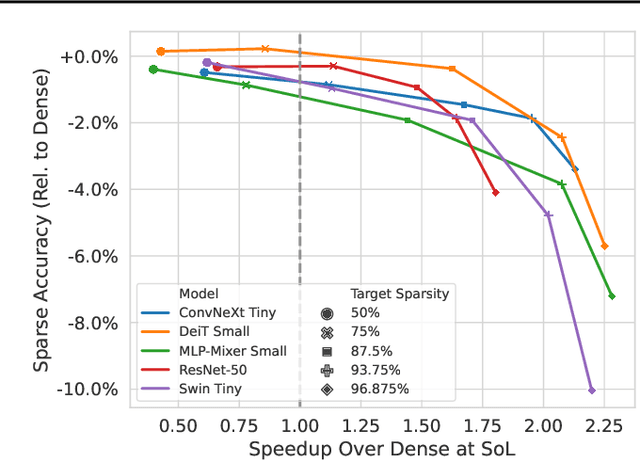
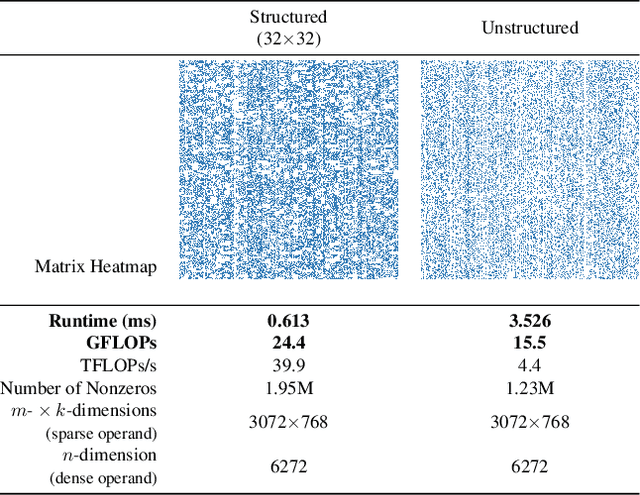
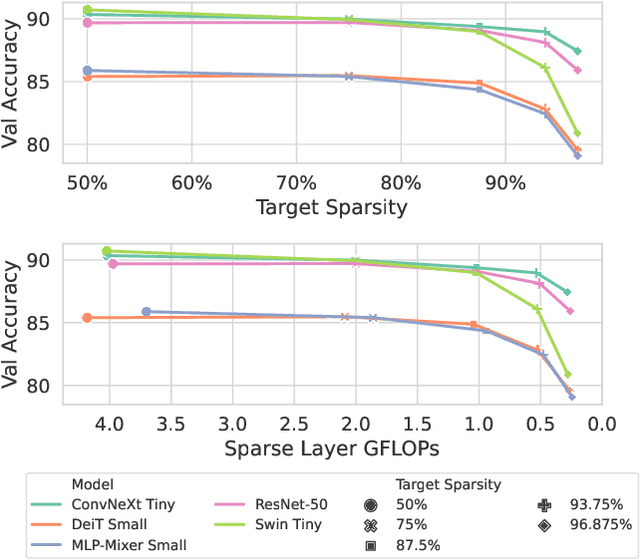
We introduce the Sparsity Roofline, a visual performance model for evaluating sparsity in neural networks. The Sparsity Roofline jointly models network accuracy, sparsity, and predicted inference speedup. Our approach does not require implementing and benchmarking optimized kernels, and the predicted speedup is equal to what would be measured when the corresponding dense and sparse kernels are equally well-optimized. We achieve this through a novel analytical model for predicting sparse network performance, and validate the predicted speedup using several real-world computer vision architectures pruned across a range of sparsity patterns and degrees. We demonstrate the utility and ease-of-use of our model through two case studies: (1) we show how machine learning researchers can predict the performance of unimplemented or unoptimized block-structured sparsity patterns, and (2) we show how hardware designers can predict the performance implications of new sparsity patterns and sparse data formats in hardware. In both scenarios, the Sparsity Roofline helps performance experts identify sparsity regimes with the highest performance potential.