 Add to Chrome
 Add to Firefox
 Add to Edge
SLAP: Selective Local Vision-Language Alignment for Fish Re-Identification via Partial Optimal Transport
Aug 09, 2026
Individual fish re-identification (ReID) is a fine-grained recognition problem in which identity-discriminative cues are often localized to specific body regions rather than distributed uniformly across the animal. Nevertheless, recent CLIP-based ReID methods rely predominantly on global image-text alignment, allowing background and weakly discriminative regions to contribute to cross-modal supervision. We propose a selective local vision-language alignment framework that establishes localized correspondences between visual patch embeddings and multiple identity-aware prompt embeddings through Partial Optimal Transport (POT). Rather than enforcing exhaustive correspondence, POT enables selective matching between visual patches and prompt embeddings, allowing the model to emphasize the strongest cross-modal correspondences while avoiding forced alignment of weakly matching regions, thereby yielding more discriminative visual representations for retrieval. The framework is trained end-to-end, while only the adapted visual encoder is retained during inference. Experiments on the longitudinal Symphodus melops dataset demonstrate consistent improvements over recent CLIP-based ReID methods under both closed-set and open-set evaluation protocols. Additional evaluations on other datasets further demonstrate the generalization capability of the proposed method across diverse marine ReID benchmarks.

Parameter-Efficient Vision-Language Adaptation with Continuous Metadata Conditioning for Animal Re-Identification
Jul 10, 2026Long-term animal re-identification (ReID) must remain robust to gradual morphological evolution and seasonal appearance shifts. Although recent vision-language models provide strong pretrained visual representations, adapting them to longitudinal ecological settings remains challenging, particularly under identity and temporal distribution shifts. We present a parameter-efficient CLIP adaptation framework for animal ReID and introduce a continuous metadata-conditioning mechanism that incorporates numerical attributes directly into the prompt representation during training. While low-rank visual adaptation, prompt-based supervision, and cross-modal alignment provide the adaptation framework, the proposed metadata-conditioning strategy constitutes the primary methodological contribution. By preserving the continuous structure of numerical metadata rather than discretizing it into textual categories, the proposed approach enables smooth modulation of the embedding space during training while maintaining a purely visual inference pipeline. Experiments on a seven-year longitudinal fish dataset and multiple wildlife benchmarks demonstrate improved performance under closed-set, open-set, and time-aware evaluation protocols. The results demonstrate that continuous metadata conditioning improves robustness to longitudinal appearance variation and temporal distribution shifts, while parameter-efficient adaptation enables a purely visual inference pipeline without requiring metadata at test time. Code and evaluation splits can be found at: https://github.com/AnilOsmanTur/MetaPrompt-ReID.
AffineLens: Capturing the Continuous Piecewise Affine Functions of Neural Networks
May 07, 2026Piecewise affine neural networks (PANNs) provide a principled geometric perspective on neural network expressivity by characterizing the input--output map as a continuous piecewise affine (CPA) function whose complexity is governed by the number, arrangement, and shapes of its affine regions. However, existing interpretability and expressivity analyses often rely on indirect proxies (e.g., activation statistics or theoretical upper bounds) and rarely offer practical, accurate tools for enumerating and visualizing the induced region partition under realistic architectures and bounded input domains. In this work, we present AffineLens, a unified framework for computing the hyperplane arrangements and polyhedral structures underlying PANNs. Given a calibrated (bounded) input polytope, AffineLens identifies the subset of neuron-induced hyperplanes that intersect the domain, enumerates the resulting affine sub-regions in a layer-wise manner, and returns provably non-empty maximal CPA regions together with interior representatives. The framework further provides visualizations of region partitioning and decision boundaries, enabling qualitative inspection alongside quantitative region counts. By exploiting the affine restriction property of CPA networks under fixed activation patterns, AffineLens supports a broad class of modern components, including batch normalization, pooling, residual connections, multilayer perceptrons, and convolutional layers. Finally, we use AffineLens to perform a systematic empirical study of architectural expressivity, comparing networks through region complexity metrics and revealing how design choices influence the geometry of learned functions.
Training-Time Batch Normalization Reshapes Local Partition Geometry in Piecewise-Affine Networks
May 06, 2026Batch normalization (BN) is central to modern deep networks, but its effect on the realized function during training remains less understood than its optimization benefits. We study training-time BN in continuous piecewise-affine (CPA) networks through the geometry of switching hyperplanes and the induced affine-region partition. Conditioned on a mini-batch, we show that BN defines for each neuron a reference hyperplane through the batch centroid, and that breakpoint-switching hyperplanes are parallel translates whose offsets are expressed in batch-standardized coordinates and are independent of the raw bias. This yields an exact criterion for when a switching hyperplane intersects a local $\ell_\infty$ window and motivates a local region-density functional based on exact affine-region counts. Under explicit sufficient conditions, we show that BN increases expected local partition refinement in ReLU and more general piecewise-affine networks, and that this mechanism transfers locally through depth inside parent affine regions where the upstream representation map is an affine embedding. These results provide a function-level geometric account of training-time BN as a batch-conditional recentering mechanism near the data.
Geometry-Conditioned Diffusion for Occlusion-Robust In-Bed Pose Estimation
Apr 26, 2026Robust in-bed human pose estimation under blanket occlusion remains challenging due to the scarcity of reliable labeled training data for heavily covered poses. Existing approaches rely on multi-modal sensing or image-to-image translation frameworks that remain conditioned on visible source imagery, limiting scalability and pose diversity. In this work, we reformulate occlusion-aware augmentation as a geometry-conditioned generative modeling task. We conduct a systematic comparison of deterministic masking, unpaired translation, paired diffusion-based translation, and a proposed pose-conditioned Latent Diffusion Model (Pose-LDM). Unlike image-guided methods, Pose-LDM synthesizes blanket-covered images directly from skeletal keypoints, eliminating dependence on paired supervision and pixel-level source-image conditioning while enabling generation from arbitrary pose inputs. All augmentation strategies are evaluated through their impact on downstream pose estimation under a fixed backbone. Pose- LDM achieves the highest strict localization accuracy under severe occlusion while maintaining overall detection performance comparable to paired diffusion models, approaching the performance of fully supervised training. These results demonstrate that geometry-conditioned diffusion provides an effective and supervision-efficient pathway toward occlusion-robust inbed pose estimation without modifying the sensing pipeline. The code is available at: github.com/navidTerraNova/ GeoDiffPose.
HAC: Parameter-Efficient Hyperbolic Adaptation of CLIP for Zero-Shot VQA
Apr 26, 2026Recent advances in representation learning have shown that hyperbolic geometry can offer a more expressive alternative to the Euclidean embeddings used in CLIP models, capturing hierarchical structures and leading to better-organized representations. However, current hyperbolic CLIP variants are trained entirely from scratch, which is computationally expensive and resource-intensive. In this work, we propose HAC (Hyperbolic Adaptation of CLIP), a parameter-efficient framework that enables pretrained CLIP models to transition into hyperbolic space via lightweight fine-tuning. We apply HAC to Visual Question Answering (VQA), where models must interpret visual elements and align them with textual queries. Notably, HAC's training is performed on a dataset with no overlap with any VQA benchmark, resulting in a strict zero-shot evaluation paradigm that underscores HAC's task-agnostic adaptability. We evaluate HAC across a diverse suite of VQA benchmarks spanning General, Reasoning, and OCR categories. Both HAC-S (small) and HAC-B (medium) consistently surpass Euclidean baselines and prior hyperbolic approaches, with HAC-B delivering up to a +1.9 point average improvement over CLIP-B on reasoning-intensive tasks. Our code is available at https://github.com/fdibiton/HAC
Discriminator-Guided Adaptive Diffusion for Source-Free Test-Time Adaptation under Image Corruptions
Apr 26, 2026In this work, we study Source-Free Unsupervised Domain Adaptation under corruption-induced domain shifts, where performance degradation is caused by natural image corruptions that go beyond additive noise, including blur, weather effects, and digital artifacts. We propose a diffusion-based, input-level adaptation framework that operates entirely at test time and keeps all source-trained models frozen, explicitly targeting robustness to corrupted target inputs. Our method leverages a source-trained diffusion model as a generative prior and introduces a discriminator-guided adaptive diffusion strategy that dynamically controls the amount of perturbation applied to each test sample. Rather than relying on a fixed diffusion depth, the discriminator determines, on a per-image basis, when sufficient forward diffusion has been applied to suppress corruption-specific artifacts, with each corruption type effectively defining a distinct target domain. This adaptive stopping mechanism applies only the necessary amount of noise to remove domainspecific corruption while preserving class-discriminative structure. The reverse diffusion process then reconstructs a source-aligned image, optionally stabilized through structural guidance, which is classified using a frozen source-trained classifier. We evaluate the proposed approach across a broad spectrum of corruption-induced target domains, covering 15 diverse corruption types, and demonstrate more balanced robustness with competitive or improved performance across non-noise corruptions. Additional analyses reveal how the adaptive diffusion schedule responds to different corruption characteristics, highlighting the practicality, generality, and robustness of the proposed framework. The code is publicly available at https://github.com/fmolivato/dgadiffusion/.
Towards Unconstrained Human-Object Interaction
Apr 15, 2026Human-Object Interaction (HOI) detection is a longstanding computer vision problem concerned with predicting the interaction between humans and objects. Current HOI models rely on a vocabulary of interactions at training and inference time, limiting their applicability to static environments. With the advent of Multimodal Large Language Models (MLLMs), it has become feasible to explore more flexible paradigms for interaction recognition. In this work, we revisit HOI detection through the lens of MLLMs and apply them to in-the-wild HOI detection. We define the Unconstrained HOI (U-HOI) task, a novel HOI domain that removes the requirement for a predefined list of interactions at both training and inference. We evaluate a range of MLLMs on this setting and introduce a pipeline that includes test-time inference and language-to-graph conversion to extract structured interactions from free-form text. Our findings highlight the limitations of current HOI detectors and the value of MLLMs for U-HOI. Code will be available at https://github.com/francescotonini/anyhoi
Lifelong Imitation Learning with Multimodal Latent Replay and Incremental Adjustment
Mar 12, 2026We introduce a lifelong imitation learning framework that enables continual policy refinement across sequential tasks under realistic memory and data constraints. Our approach departs from conventional experience replay by operating entirely in a multimodal latent space, where compact representations of visual, linguistic, and robot's state information are stored and reused to support future learning. To further stabilize adaptation, we introduce an incremental feature adjustment mechanism that regularizes the evolution of task embeddings through an angular margin constraint, preserving inter-task distinctiveness. Our method establishes a new state of the art in the LIBERO benchmarks, achieving 10-17 point gains in AUC and up to 65% less forgetting compared to previous leading methods. Ablation studies confirm the effectiveness of each component, showing consistent gains over alternative strategies. The code is available at: https://github.com/yfqi/lifelong_mlr_ifa.
Dynamic Scoring with Enhanced Semantics for Training-Free Human-Object Interaction Detection
Jul 23, 2025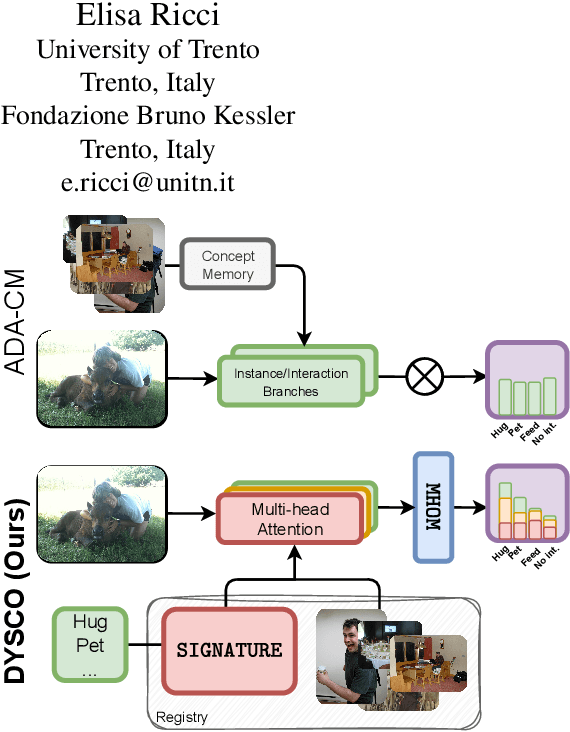
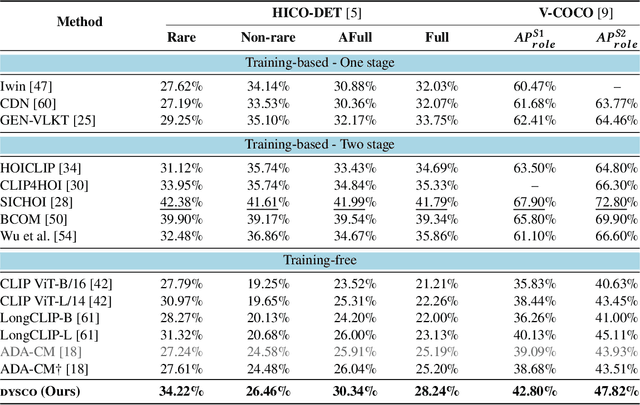
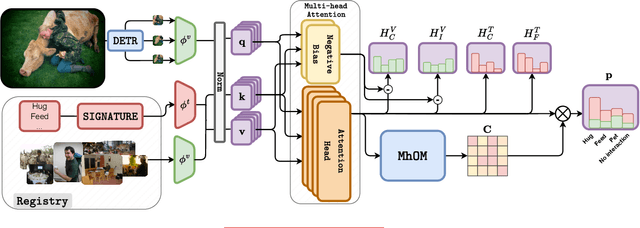
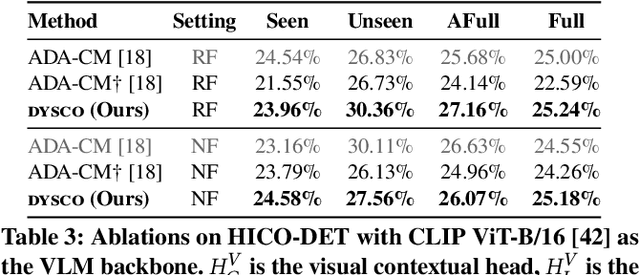
Human-Object Interaction (HOI) detection aims to identify humans and objects within images and interpret their interactions. Existing HOI methods rely heavily on large datasets with manual annotations to learn interactions from visual cues. These annotations are labor-intensive to create, prone to inconsistency, and limit scalability to new domains and rare interactions. We argue that recent advances in Vision-Language Models (VLMs) offer untapped potential, particularly in enhancing interaction representation. While prior work has injected such potential and even proposed training-free methods, there remain key gaps. Consequently, we propose a novel training-free HOI detection framework for Dynamic Scoring with enhanced semantics (DYSCO) that effectively utilizes textual and visual interaction representations within a multimodal registry, enabling robust and nuanced interaction understanding. This registry incorporates a small set of visual cues and uses innovative interaction signatures to improve the semantic alignment of verbs, facilitating effective generalization to rare interactions. Additionally, we propose a unique multi-head attention mechanism that adaptively weights the contributions of the visual and textual features. Experimental results demonstrate that our DYSCO surpasses training-free state-of-the-art models and is competitive with training-based approaches, particularly excelling in rare interactions. Code is available at https://github.com/francescotonini/dysco.