 Add to Chrome
 Add to Firefox
 Add to Edge
Geometry-Conditioned Diffusion for Occlusion-Robust In-Bed Pose Estimation
Apr 26, 2026
Robust in-bed human pose estimation under blanket occlusion remains challenging due to the scarcity of reliable labeled training data for heavily covered poses. Existing approaches rely on multi-modal sensing or image-to-image translation frameworks that remain conditioned on visible source imagery, limiting scalability and pose diversity. In this work, we reformulate occlusion-aware augmentation as a geometry-conditioned generative modeling task. We conduct a systematic comparison of deterministic masking, unpaired translation, paired diffusion-based translation, and a proposed pose-conditioned Latent Diffusion Model (Pose-LDM). Unlike image-guided methods, Pose-LDM synthesizes blanket-covered images directly from skeletal keypoints, eliminating dependence on paired supervision and pixel-level source-image conditioning while enabling generation from arbitrary pose inputs. All augmentation strategies are evaluated through their impact on downstream pose estimation under a fixed backbone. Pose- LDM achieves the highest strict localization accuracy under severe occlusion while maintaining overall detection performance comparable to paired diffusion models, approaching the performance of fully supervised training. These results demonstrate that geometry-conditioned diffusion provides an effective and supervision-efficient pathway toward occlusion-robust inbed pose estimation without modifying the sensing pipeline. The code is available at: github.com/navidTerraNova/ GeoDiffPose.

Understanding Deep Architectures by Visual Summaries
Jul 18, 2018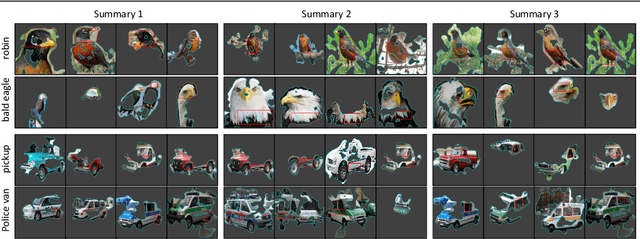
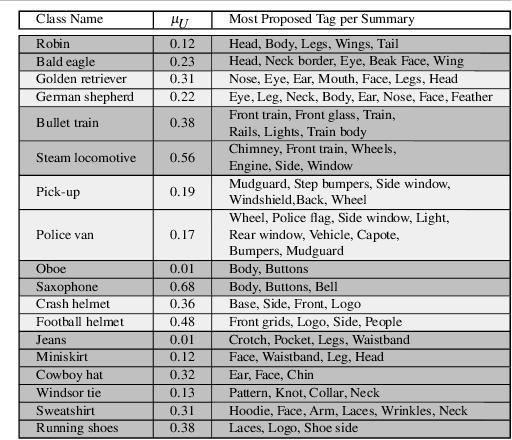

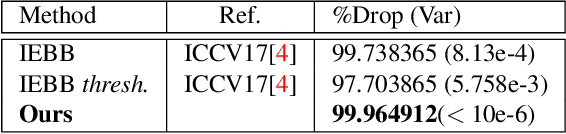
In deep learning, visualization techniques extract the salient patterns exploited by deep networks for image classification, focusing on single images; no effort has been spent in investigating whether these patterns are systematically related to precise semantic entities over multiple images belonging to a same class, thus failing to capture the very understanding of the image class the network has realized. This paper goes in this direction, presenting a visualization framework which produces a group of clusters or summaries, each one formed by crisp salient image regions focusing on a particular part that the network has exploited with high regularity to decide for a given class. The approach is based on a sparse optimization step providing sharp image saliency masks that are clustered together by means of a semantic flow similarity measure. The summaries communicate clearly what a network has exploited of a particular image class, and this is proved through automatic image tagging and with a user study. Beyond the deep network understanding, summaries are also useful for many quantitative reasons: their number is correlated with ability of a network to classify (more summaries, better performances), and they can be used to improve the classification accuracy of a network through summary-driven specializations.