 Add to Chrome
 Add to Firefox
 Add to Edge
SICAGE: Speaker-Independent Culture-Aware Gesture Generation using TED4C-L Dataset
Jun 29, 2026
Recent co-speech gesture generation methods often overlook cultural differences, limiting their effectiveness in human-agent interaction. Moreover, culture-conditioned models are rarely evaluated under speaker-disjoint splits, so apparent "cultural" behavior may be confounded with speaker-specific gesturing style. We introduce SICAGE, a modular framework for culture-aware co-speech gesture generation that conditions motion synthesis models on speaker-independent cultural representations. SICAGE learns these representations from audio and text by treating each speaker as a separate domain while imposing invariance across speakers. This encourages representations to remain culture-discriminative while reducing dependence on speaker identity. The resulting cultural embeddings condition a multimodal generator to produce culturally appropriate gestures. We instantiate this idea with two domain generalization approaches: adversarial learning and Fishr regularization. We further introduce ALaDiT, a real-time diffusion-based gesture generator designed to efficiently incorporate the learned cultural embeddings. To validate our method, we built TED4C-L, a 106-hour multimodal dataset of 764 TED speakers from four cultural groups. Experiments show that SICAGE improves motion realism, diversity, beat synchronization, semantic relevance, and cultural consistency.

VT-DUDA: Visual Token Conditioning for Diffusion-guided Unsupervised Domain Adaptation
Jun 19, 2026Unsupervised domain adaptation (UDA) aims to learn a target-domain classifier from labeled source data and unlabeled target data under distribution shift. Recent diffusion-based UDA methods approach this problem by synthesizing labeled target-style images and training on the resulting synthetic data. However, their performance depends heavily on the conditioning design: class prompts provide only coarse guidance, while domain adaptation modules mainly control appearance, which may leave target-style synthesis insufficiently specified. We propose VT-DUDA, a visual-token conditioning framework for diffusion-guided UDA. Instead of relying only on text prompts, VT-DUDA uses source images to provide additional instance-level visual context for target-style synthesis. Specifically, VT-DUDA maps each source image to a compact sequence of visual tokens and forms a hybrid conditioning context by concatenating these tokens with the corresponding text embeddings along the cross-attention context dimension of a latent diffusion model. This provides instance-dependent conditioning beyond text alone, while synthesis is performed with the target-domain adapter branch. Because guidance is represented explicitly as a token sequence, the same interface also permits inference-time manipulation of the conditioning signal through token selection and token-strength adjustment. The proposed method preserves the standard diffusion objective and can be integrated into existing adapter-based diffusion frameworks without modifying the backbone. Across Office-31, Office-Home, and VisDA-2017, VT-DUDA improves average target-domain accuracy over strong discriminative and diffusion-based UDA baselines. The results suggest that, in generation-based UDA, a stronger conditioning interface can improve the downstream usefulness of synthetic target-style data.
Distribution Alignment for One-Shot Federated Learning via Optimal Transport
Jun 15, 2026One-Shot Federated Learning (OSFL) addresses extreme communication regimes in which clients interact with the server only once, amplifying the impact of heterogeneous client data distributions. In particular, the interaction of domain shift and label shift across clients induces misaligned feature representations that cannot be corrected through iterative optimization. Existing OSFL methods rely on distillation, server-side generation or ensemble-based aggregation, but assume aligned representations or address domain and label shift separately. We introduce SLOT-Align (Single-round, Learning-free Optimal Transport Alignment), a geometry-aware feature harmonization framework for OSFL. SLOT-Align uses a shared frozen encoder to extract compact feature statistics, constructs a global reference via Bures-Wasserstein barycenters, and aligns local representations using closed-form geodesic optimal transport maps. The method is computationally efficient and can be combined with existing OSFL pipelines relying on frozen encoders without modifying their training procedures. Extensive experiments across multiple benchmarks, pretrained backbones, and OSFL methods show that SLOT-Align consistently improves accuracy and robustness under joint domain and label shift.
AffineLens: Capturing the Continuous Piecewise Affine Functions of Neural Networks
May 07, 2026Piecewise affine neural networks (PANNs) provide a principled geometric perspective on neural network expressivity by characterizing the input--output map as a continuous piecewise affine (CPA) function whose complexity is governed by the number, arrangement, and shapes of its affine regions. However, existing interpretability and expressivity analyses often rely on indirect proxies (e.g., activation statistics or theoretical upper bounds) and rarely offer practical, accurate tools for enumerating and visualizing the induced region partition under realistic architectures and bounded input domains. In this work, we present AffineLens, a unified framework for computing the hyperplane arrangements and polyhedral structures underlying PANNs. Given a calibrated (bounded) input polytope, AffineLens identifies the subset of neuron-induced hyperplanes that intersect the domain, enumerates the resulting affine sub-regions in a layer-wise manner, and returns provably non-empty maximal CPA regions together with interior representatives. The framework further provides visualizations of region partitioning and decision boundaries, enabling qualitative inspection alongside quantitative region counts. By exploiting the affine restriction property of CPA networks under fixed activation patterns, AffineLens supports a broad class of modern components, including batch normalization, pooling, residual connections, multilayer perceptrons, and convolutional layers. Finally, we use AffineLens to perform a systematic empirical study of architectural expressivity, comparing networks through region complexity metrics and revealing how design choices influence the geometry of learned functions.
Training-Time Batch Normalization Reshapes Local Partition Geometry in Piecewise-Affine Networks
May 06, 2026Batch normalization (BN) is central to modern deep networks, but its effect on the realized function during training remains less understood than its optimization benefits. We study training-time BN in continuous piecewise-affine (CPA) networks through the geometry of switching hyperplanes and the induced affine-region partition. Conditioned on a mini-batch, we show that BN defines for each neuron a reference hyperplane through the batch centroid, and that breakpoint-switching hyperplanes are parallel translates whose offsets are expressed in batch-standardized coordinates and are independent of the raw bias. This yields an exact criterion for when a switching hyperplane intersects a local $\ell_\infty$ window and motivates a local region-density functional based on exact affine-region counts. Under explicit sufficient conditions, we show that BN increases expected local partition refinement in ReLU and more general piecewise-affine networks, and that this mechanism transfers locally through depth inside parent affine regions where the upstream representation map is an affine embedding. These results provide a function-level geometric account of training-time BN as a batch-conditional recentering mechanism near the data.
Discriminator-Guided Adaptive Diffusion for Source-Free Test-Time Adaptation under Image Corruptions
Apr 26, 2026In this work, we study Source-Free Unsupervised Domain Adaptation under corruption-induced domain shifts, where performance degradation is caused by natural image corruptions that go beyond additive noise, including blur, weather effects, and digital artifacts. We propose a diffusion-based, input-level adaptation framework that operates entirely at test time and keeps all source-trained models frozen, explicitly targeting robustness to corrupted target inputs. Our method leverages a source-trained diffusion model as a generative prior and introduces a discriminator-guided adaptive diffusion strategy that dynamically controls the amount of perturbation applied to each test sample. Rather than relying on a fixed diffusion depth, the discriminator determines, on a per-image basis, when sufficient forward diffusion has been applied to suppress corruption-specific artifacts, with each corruption type effectively defining a distinct target domain. This adaptive stopping mechanism applies only the necessary amount of noise to remove domainspecific corruption while preserving class-discriminative structure. The reverse diffusion process then reconstructs a source-aligned image, optionally stabilized through structural guidance, which is classified using a frozen source-trained classifier. We evaluate the proposed approach across a broad spectrum of corruption-induced target domains, covering 15 diverse corruption types, and demonstrate more balanced robustness with competitive or improved performance across non-noise corruptions. Additional analyses reveal how the adaptive diffusion schedule responds to different corruption characteristics, highlighting the practicality, generality, and robustness of the proposed framework. The code is publicly available at https://github.com/fmolivato/dgadiffusion/.
HAC: Parameter-Efficient Hyperbolic Adaptation of CLIP for Zero-Shot VQA
Apr 26, 2026Recent advances in representation learning have shown that hyperbolic geometry can offer a more expressive alternative to the Euclidean embeddings used in CLIP models, capturing hierarchical structures and leading to better-organized representations. However, current hyperbolic CLIP variants are trained entirely from scratch, which is computationally expensive and resource-intensive. In this work, we propose HAC (Hyperbolic Adaptation of CLIP), a parameter-efficient framework that enables pretrained CLIP models to transition into hyperbolic space via lightweight fine-tuning. We apply HAC to Visual Question Answering (VQA), where models must interpret visual elements and align them with textual queries. Notably, HAC's training is performed on a dataset with no overlap with any VQA benchmark, resulting in a strict zero-shot evaluation paradigm that underscores HAC's task-agnostic adaptability. We evaluate HAC across a diverse suite of VQA benchmarks spanning General, Reasoning, and OCR categories. Both HAC-S (small) and HAC-B (medium) consistently surpass Euclidean baselines and prior hyperbolic approaches, with HAC-B delivering up to a +1.9 point average improvement over CLIP-B on reasoning-intensive tasks. Our code is available at https://github.com/fdibiton/HAC
Lifelong Imitation Learning with Multimodal Latent Replay and Incremental Adjustment
Mar 12, 2026We introduce a lifelong imitation learning framework that enables continual policy refinement across sequential tasks under realistic memory and data constraints. Our approach departs from conventional experience replay by operating entirely in a multimodal latent space, where compact representations of visual, linguistic, and robot's state information are stored and reused to support future learning. To further stabilize adaptation, we introduce an incremental feature adjustment mechanism that regularizes the evolution of task embeddings through an angular margin constraint, preserving inter-task distinctiveness. Our method establishes a new state of the art in the LIBERO benchmarks, achieving 10-17 point gains in AUC and up to 65% less forgetting compared to previous leading methods. Ablation studies confirm the effectiveness of each component, showing consistent gains over alternative strategies. The code is available at: https://github.com/yfqi/lifelong_mlr_ifa.
MADPOT: Medical Anomaly Detection with CLIP Adaptation and Partial Optimal Transport
Jul 09, 2025Medical anomaly detection (AD) is challenging due to diverse imaging modalities, anatomical variations, and limited labeled data. We propose a novel approach combining visual adapters and prompt learning with Partial Optimal Transport (POT) and contrastive learning (CL) to improve CLIP's adaptability to medical images, particularly for AD. Unlike standard prompt learning, which often yields a single representation, our method employs multiple prompts aligned with local features via POT to capture subtle abnormalities. CL further enforces intra-class cohesion and inter-class separation. Our method achieves state-of-the-art results in few-shot, zero-shot, and cross-dataset scenarios without synthetic data or memory banks. The code is available at https://github.com/mahshid1998/MADPOT.
Diffusing DeBias: a Recipe for Turning a Bug into a Feature
Feb 13, 2025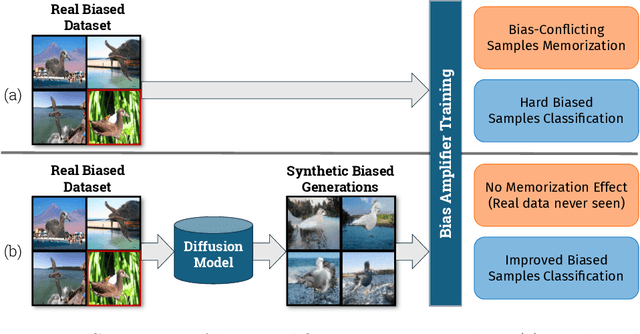
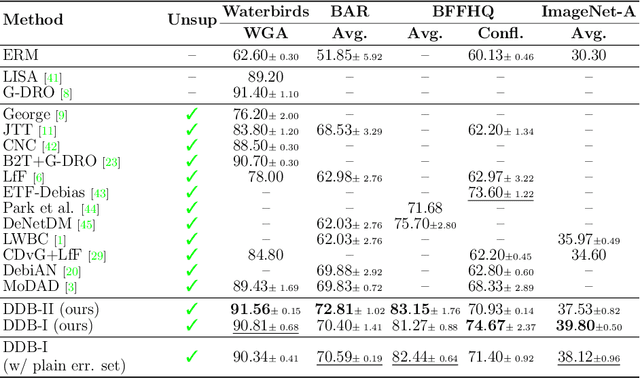
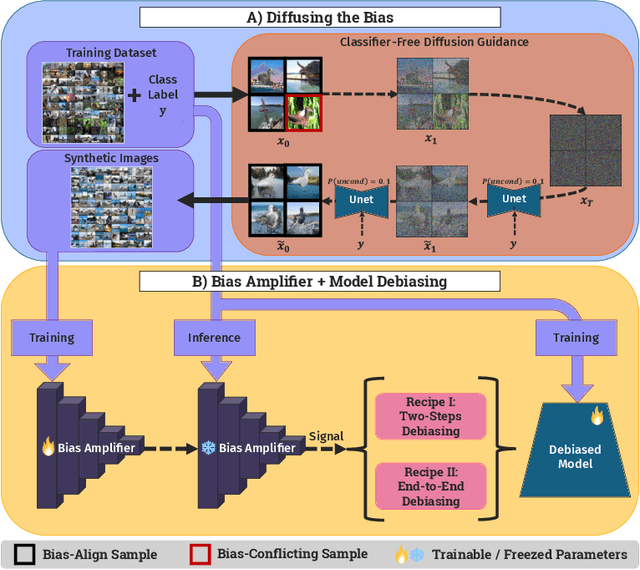

Deep learning model effectiveness in classification tasks is often challenged by the quality and quantity of training data which, whenever containing strong spurious correlations between specific attributes and target labels, can result in unrecoverable biases in model predictions. Tackling these biases is crucial in improving model generalization and trust, especially in real-world scenarios. This paper presents Diffusing DeBias (DDB), a novel approach acting as a plug-in for common methods in model debiasing while exploiting the inherent bias-learning tendency of diffusion models. Our approach leverages conditional diffusion models to generate synthetic bias-aligned images, used to train a bias amplifier model, to be further employed as an auxiliary method in different unsupervised debiasing approaches. Our proposed method, which also tackles the common issue of training set memorization typical of this type of tech- niques, beats current state-of-the-art in multiple benchmark datasets by significant margins, demonstrating its potential as a versatile and effective tool for tackling dataset bias in deep learning applications.