 Add to Chrome
 Add to Firefox
 Add to Edge
Zero-Shot Temporal Action Localization Through Textual Guidance
May 21, 2026
Zero-shot temporal action localization (ZS-TAL) consists of classifying and localizing actions in untrimmed videos, where action classes are unseen at training time. Existing work uses Vision and Language Models (VLMs), taking advantage of their strong zero-shot transfer capabilities. Yet, these models face evident challenges with fine-grained action classification, making it difficult to directly use them to distinguish between the presence and absence of an action. Most current methods for ZS-TAL address these challenges by training models on large-scale video datasets, which require annotated data and often result in limited generalization performance. Recently, approaches discarding the use of labeled data have emerged as an alternative. Following this direction, we propose a novel approach, ``Textual Guidance for finer localization of actions in videos'' (TEGU), that compensates for the lack of supervision from training data by exploiting rich textual information derived from large language models and structured text extracted from captions. This additional linguistic context can improve fine-grained discrimination by providing richer cues about fine-grained action differences within videos. We validate the effectiveness of the proposed method by conducting experiments on the THUMOS14 and the ActivityNet-v1.3 datasets. Our results show that, by exploiting rich textual information for improved action localization, TEGU outperforms state-of-the-art ZS-TAL approaches that do not involve training

Training-Free Semantic Multi-Object Tracking with Vision-Language Models
Apr 15, 2026Semantic Multi-Object Tracking (SMOT) extends multi-object tracking with semantic outputs such as video summaries, instance-level captions, and interaction labels, aiming to move from trajectories to human-interpretable descriptions of dynamic scenes. Existing SMOT systems are trained end-to-end, coupling progress to expensive supervision, limiting the ability to rapidly adapt to new foundation models and new interactions. We propose TF-SMOT, a training-free SMOT pipeline that composes pretrained components for detection, mask-based tracking, and video-language generation. TF-SMOT combines D-FINE and the promptable SAM2 segmentation tracker to produce temporally consistent tracklets, uses contour grounding to generate video summaries and instance captions with InternVideo2.5, and aligns extracted interaction predicates to BenSMOT WordNet synsets via gloss-based semantic retrieval with LLM disambiguation. On BenSMOT, TF-SMOT achieves state-of-the-art tracking performance within the SMOT setting and improves summary and caption quality compared to prior art. Interaction recognition, however, remains challenging under strict exact-match evaluation on the fine-grained and long-tailed WordNet label space; our analysis and ablations indicate that semantic overlap and label granularity substantially affect measured performance.
Towards Unconstrained Human-Object Interaction
Apr 15, 2026Human-Object Interaction (HOI) detection is a longstanding computer vision problem concerned with predicting the interaction between humans and objects. Current HOI models rely on a vocabulary of interactions at training and inference time, limiting their applicability to static environments. With the advent of Multimodal Large Language Models (MLLMs), it has become feasible to explore more flexible paradigms for interaction recognition. In this work, we revisit HOI detection through the lens of MLLMs and apply them to in-the-wild HOI detection. We define the Unconstrained HOI (U-HOI) task, a novel HOI domain that removes the requirement for a predefined list of interactions at both training and inference. We evaluate a range of MLLMs on this setting and introduce a pipeline that includes test-time inference and language-to-graph conversion to extract structured interactions from free-form text. Our findings highlight the limitations of current HOI detectors and the value of MLLMs for U-HOI. Code will be available at https://github.com/francescotonini/anyhoi
From Weights to Concepts: Data-Free Interpretability of CLIP via Singular Vector Decomposition
Mar 25, 2026As vision-language models are deployed at scale, understanding their internal mechanisms becomes increasingly critical. Existing interpretability methods predominantly rely on activations, making them dataset-dependent, vulnerable to data bias, and often restricted to coarse head-level explanations. We introduce SITH (Semantic Inspection of Transformer Heads), a fully data-free, training-free framework that directly analyzes CLIP's vision transformer in weight space. For each attention head, we decompose its value-output matrix into singular vectors and interpret each one via COMP (Coherent Orthogonal Matching Pursuit), a new algorithm that explains them as sparse, semantically coherent combinations of human-interpretable concepts. We show that SITH yields coherent, faithful intra-head explanations, validated through reconstruction fidelity and interpretability experiments. This allows us to use SITH for precise, interpretable weight-space model edits that amplify or suppress specific concepts, improving downstream performance without retraining. Furthermore, we use SITH to study model adaptation, showing how fine-tuning primarily reweights a stable semantic basis rather than learning entirely new features.
Dynamic Scoring with Enhanced Semantics for Training-Free Human-Object Interaction Detection
Jul 23, 2025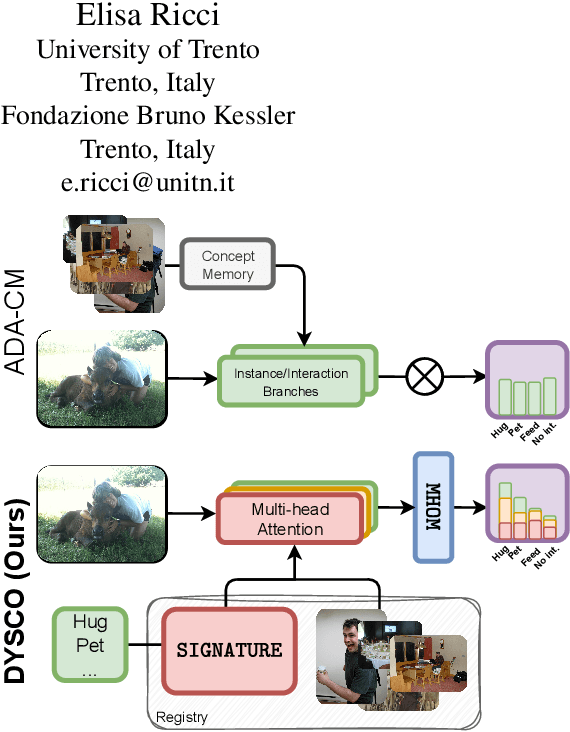
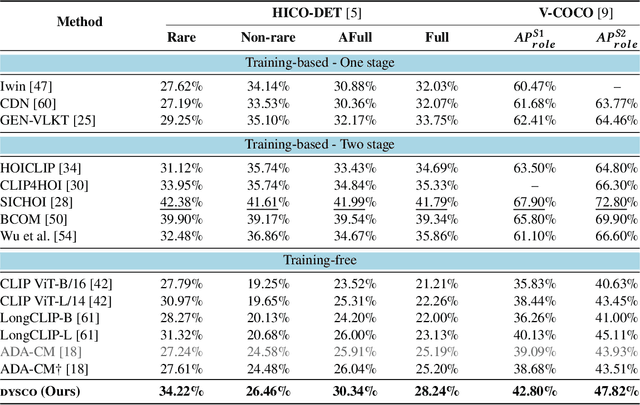
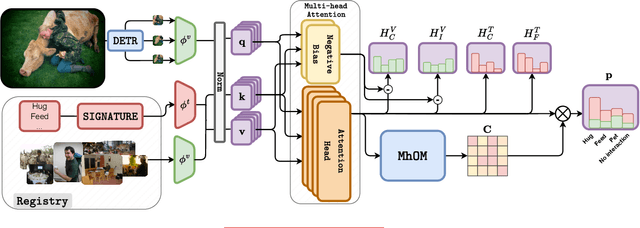
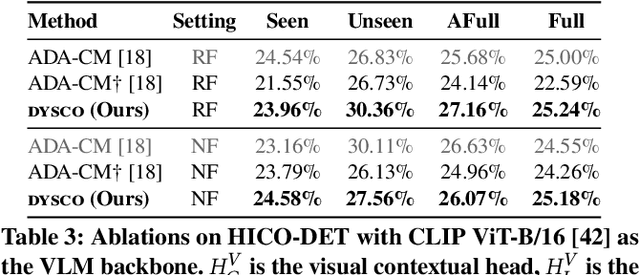
Human-Object Interaction (HOI) detection aims to identify humans and objects within images and interpret their interactions. Existing HOI methods rely heavily on large datasets with manual annotations to learn interactions from visual cues. These annotations are labor-intensive to create, prone to inconsistency, and limit scalability to new domains and rare interactions. We argue that recent advances in Vision-Language Models (VLMs) offer untapped potential, particularly in enhancing interaction representation. While prior work has injected such potential and even proposed training-free methods, there remain key gaps. Consequently, we propose a novel training-free HOI detection framework for Dynamic Scoring with enhanced semantics (DYSCO) that effectively utilizes textual and visual interaction representations within a multimodal registry, enabling robust and nuanced interaction understanding. This registry incorporates a small set of visual cues and uses innovative interaction signatures to improve the semantic alignment of verbs, facilitating effective generalization to rare interactions. Additionally, we propose a unique multi-head attention mechanism that adaptively weights the contributions of the visual and textual features. Experimental results demonstrate that our DYSCO surpasses training-free state-of-the-art models and is competitive with training-based approaches, particularly excelling in rare interactions. Code is available at https://github.com/francescotonini/dysco.
AL-GTD: Deep Active Learning for Gaze Target Detection
Sep 27, 2024


Gaze target detection aims at determining the image location where a person is looking. While existing studies have made significant progress in this area by regressing accurate gaze heatmaps, these achievements have largely relied on access to extensive labeled datasets, which demands substantial human labor. In this paper, our goal is to reduce the reliance on the size of labeled training data for gaze target detection. To achieve this, we propose AL-GTD, an innovative approach that integrates supervised and self-supervised losses within a novel sample acquisition function to perform active learning (AL). Additionally, it utilizes pseudo-labeling to mitigate distribution shifts during the training phase. AL-GTD achieves the best of all AUC results by utilizing only 40-50% of the training data, in contrast to state-of-the-art (SOTA) gaze target detectors requiring the entire training dataset to achieve the same performance. Importantly, AL-GTD quickly reaches satisfactory performance with 10-20% of the training data, showing the effectiveness of our acquisition function, which is able to acquire the most informative samples. We provide a comprehensive experimental analysis by adapting several AL methods for the task. AL-GTD outperforms AL competitors, simultaneously exhibiting superior performance compared to SOTA gaze target detectors when all are trained within a low-data regime. Code is available at https://github.com/francescotonini/al-gtd.
Lost and Found: Overcoming Detector Failures in Online Multi-Object Tracking
Jul 16, 2024Multi-object tracking (MOT) endeavors to precisely estimate the positions and identities of multiple objects over time. The prevailing approach, tracking-by-detection (TbD), first detects objects and then links detections, resulting in a simple yet effective method. However, contemporary detectors may occasionally miss some objects in certain frames, causing trackers to cease tracking prematurely. To tackle this issue, we propose BUSCA, meaning `to search', a versatile framework compatible with any online TbD system, enhancing its ability to persistently track those objects missed by the detector, primarily due to occlusions. Remarkably, this is accomplished without modifying past tracking results or accessing future frames, i.e., in a fully online manner. BUSCA generates proposals based on neighboring tracks, motion, and learned tokens. Utilizing a decision Transformer that integrates multimodal visual and spatiotemporal information, it addresses the object-proposal association as a multi-choice question-answering task. BUSCA is trained independently of the underlying tracker, solely on synthetic data, without requiring fine-tuning. Through BUSCA, we showcase consistent performance enhancements across five different trackers and establish a new state-of-the-art baseline across three different benchmarks. Code available at: https://github.com/lorenzovaquero/BUSCA.
Depth Estimation and Image Restoration by Deep Learning from Defocused Images
Feb 21, 2023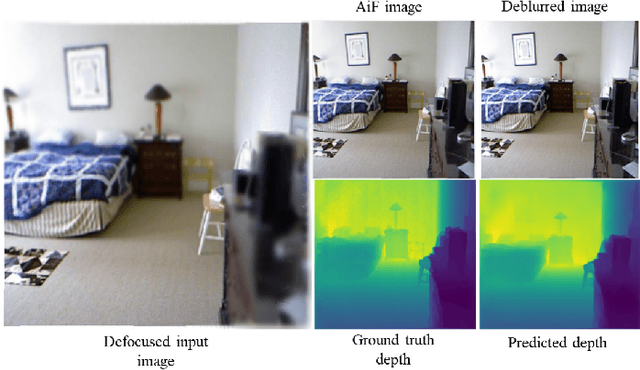
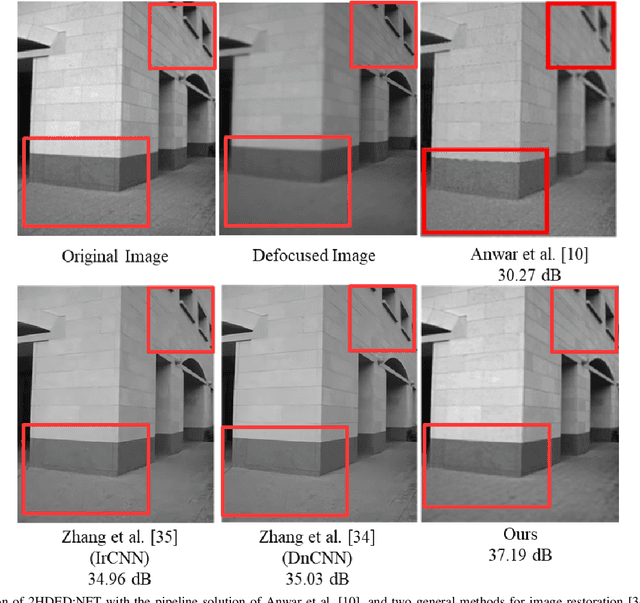
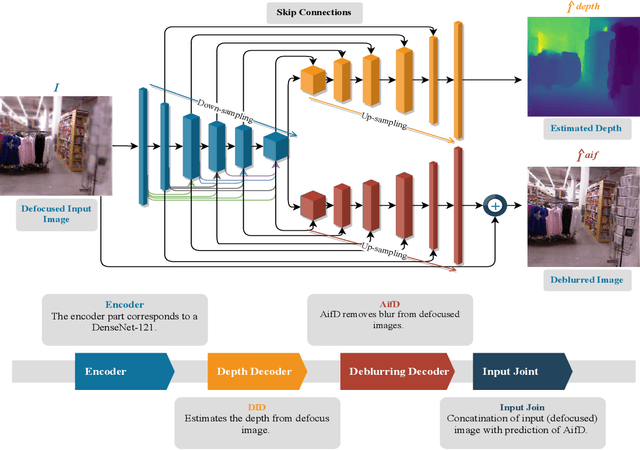
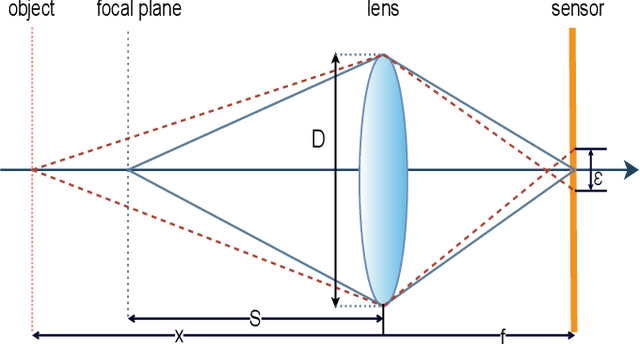
Monocular depth estimation and image deblurring are two fundamental tasks in computer vision, given their crucial role in understanding 3D scenes. Performing any of them by relying on a single image is an ill-posed problem. The recent advances in the field of deep convolutional neural networks (DNNs) have revolutionized many tasks in computer vision, including depth estimation and image deblurring. When it comes to using defocused images, the depth estimation and the recovery of the All-in-Focus (Aif) image become related problems due to defocus physics. In spite of this, most of the existing models treat them separately. There are, however, recent models that solve these problems simultaneously by concatenating two networks in a sequence to first estimate the depth or defocus map and then reconstruct the focused image based on it. We propose a DNN that solves the depth estimation and image deblurring in parallel. Our Two-headed Depth Estimation and Deblurring Network (2HDED:NET) extends a conventional Depth from Defocus (DFD) network with a deblurring branch that shares the same encoder as the depth branch. The proposed method has been successfully tested on two benchmarks, one for indoor and the other for outdoor scenes: NYU-v2 and Make3D. Extensive experiments with 2HDED:NET on these benchmarks have demonstrated superior or close performances to those of the state-of-the-art models for depth estimation and image deblurring.
Real-Time Siamese Multiple Object Tracker with Enhanced Proposals
Feb 10, 2022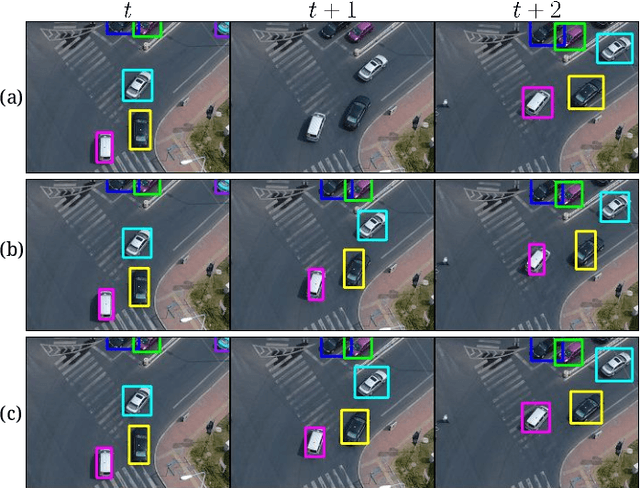
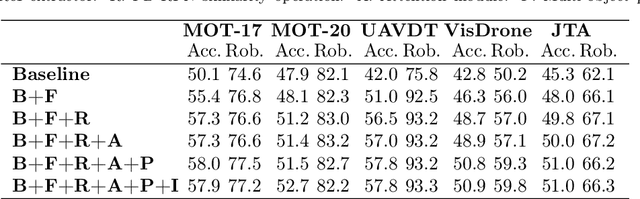
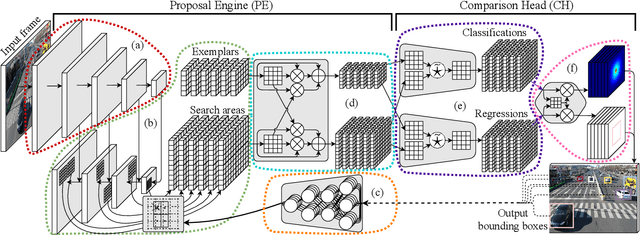
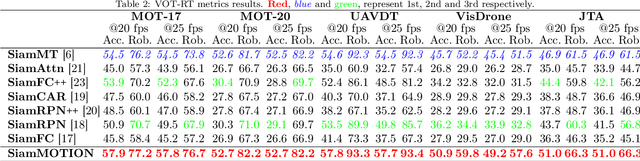
Maintaining the identity of multiple objects in real-time video is a challenging task, as it is not always possible to run a detector on every frame. Thus, motion estimation systems are often employed, which either do not scale well with the number of targets or produce features with limited semantic information. To solve the aforementioned problems and allow the tracking of dozens of arbitrary objects in real-time, we propose SiamMOTION. SiamMOTION includes a novel proposal engine that produces quality features through an attention mechanism and a region-of-interest extractor fed by an inertia module and powered by a feature pyramid network. Finally, the extracted tensors enter a comparison head that efficiently matches pairs of exemplars and search areas, generating quality predictions via a pairwise depthwise region proposal network and a multi-object penalization module. SiamMOTION has been validated on five public benchmarks, achieving leading performance against current state-of-the-art trackers.