 Add to Chrome
 Add to Firefox
 Add to Edge
SentiAvatar: Towards Expressive and Interactive Digital Humans
Apr 03, 2026
We present SentiAvatar, a framework for building expressive interactive 3D digital humans, and use it to create SuSu, a virtual character that speaks, gestures, and emotes in real time. Achieving such a system remains challenging, as it requires jointly addressing three key problems: the lack of large-scale, high-quality multimodal data, robust semantic-to-motion mapping, and fine-grained frame-level motion-prosody synchronization. To solve these problems, first, we build SuSuInterActs (21K clips, 37 hours), a dialogue corpus captured via optical motion capture around a single character with synchronized speech, full-body motion, and facial expressions. Second, we pre-train a Motion Foundation Model on 200K+ motion sequences, equipping it with rich action priors that go well beyond the conversation. We then propose an audio-aware plan-then-infill architecture that decouples sentence-level semantic planning from frame-level prosody-driven interpolation, so that generated motions are both semantically appropriate and rhythmically aligned with speech. Experiments show that SentiAvatar achieves state-of-the-art on both SuSuInterActs (R@1 43.64%, nearly 2 times the best baseline) and BEATv2 (FGD 4.941, BC 8.078), producing 6s of output in 0.3s with unlimited multi-turn streaming. The source code, model, and dataset are available at https://sentiavatar.github.io.

Pave the Way to Grasp Anything: Transferring Foundation Models for Universal Pick-Place Robots
Jun 25, 2023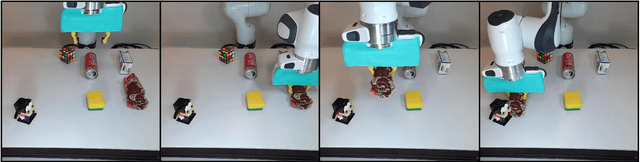
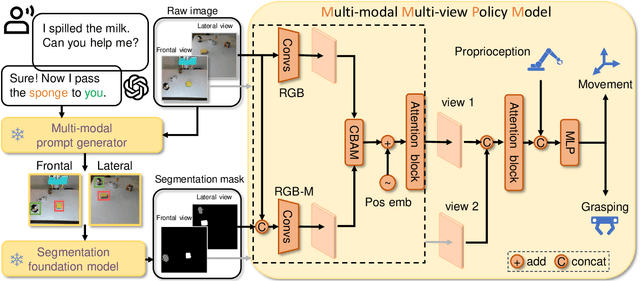
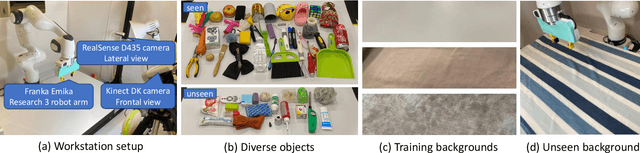
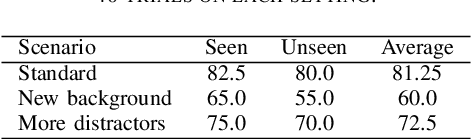
Improving the generalization capabilities of general-purpose robotic agents has long been a significant challenge actively pursued by research communities. Existing approaches often rely on collecting large-scale real-world robotic data, such as the RT-1 dataset. However, these approaches typically suffer from low efficiency, limiting their capability in open-domain scenarios with new objects, and diverse backgrounds. In this paper, we propose a novel paradigm that effectively leverages language-grounded segmentation masks generated by state-of-the-art foundation models, to address a wide range of pick-and-place robot manipulation tasks in everyday scenarios. By integrating precise semantics and geometries conveyed from masks into our multi-view policy model, our approach can perceive accurate object poses and enable sample-efficient learning. Besides, such design facilitates effective generalization for grasping new objects with similar shapes observed during training. Our approach consists of two distinct steps. First, we introduce a series of foundation models to accurately ground natural language demands across multiple tasks. Second, we develop a Multi-modal Multi-view Policy Model that incorporates inputs such as RGB images, semantic masks, and robot proprioception states to jointly predict precise and executable robot actions. Extensive real-world experiments conducted on a Franka Emika robot arm validate the effectiveness of our proposed paradigm. Real-world demos are shown in YouTube (https://www.youtube.com/watch?v=1m9wNzfp_4E ) and Bilibili (https://www.bilibili.com/video/BV178411Z7H2/ ).
AlphaBlock: Embodied Finetuning for Vision-Language Reasoning in Robot Manipulation
May 30, 2023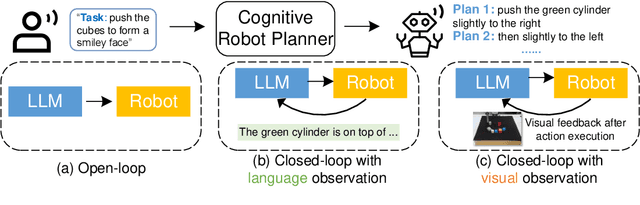

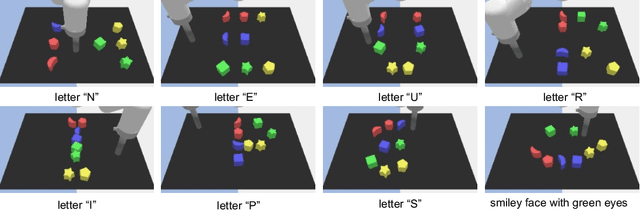
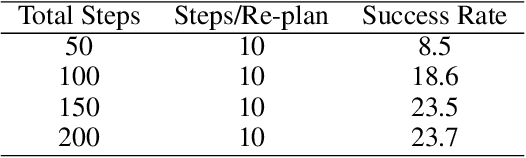
We propose a novel framework for learning high-level cognitive capabilities in robot manipulation tasks, such as making a smiley face using building blocks. These tasks often involve complex multi-step reasoning, presenting significant challenges due to the limited paired data connecting human instructions (e.g., making a smiley face) and robot actions (e.g., end-effector movement). Existing approaches relieve this challenge by adopting an open-loop paradigm decomposing high-level instructions into simple sub-task plans, and executing them step-by-step using low-level control models. However, these approaches are short of instant observations in multi-step reasoning, leading to sub-optimal results. To address this issue, we propose to automatically collect a cognitive robot dataset by Large Language Models (LLMs). The resulting dataset AlphaBlock consists of 35 comprehensive high-level tasks of multi-step text plans and paired observation sequences. To enable efficient data acquisition, we employ elaborated multi-round prompt designs that effectively reduce the burden of extensive human involvement. We further propose a closed-loop multi-modal embodied planning model that autoregressively generates plans by taking image observations as input. To facilitate effective learning, we leverage MiniGPT-4 with a frozen visual encoder and LLM, and finetune additional vision adapter and Q-former to enable fine-grained spatial perception for manipulation tasks. We conduct experiments to verify the superiority over existing open and closed-loop methods, and achieve a significant increase in success rate by 21.4% and 14.5% over ChatGPT and GPT-4 based robot tasks. Real-world demos are shown in https://www.youtube.com/watch?v=ayAzID1_qQk .
Text2Poster: Laying out Stylized Texts on Retrieved Images
Jan 06, 2023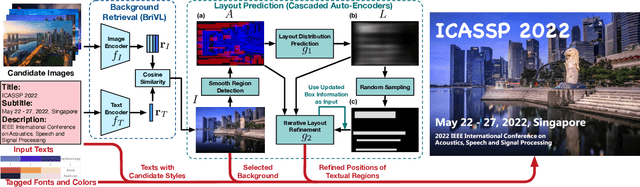
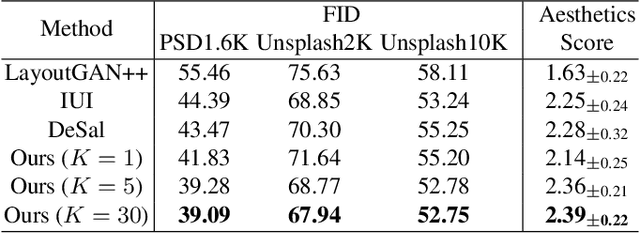
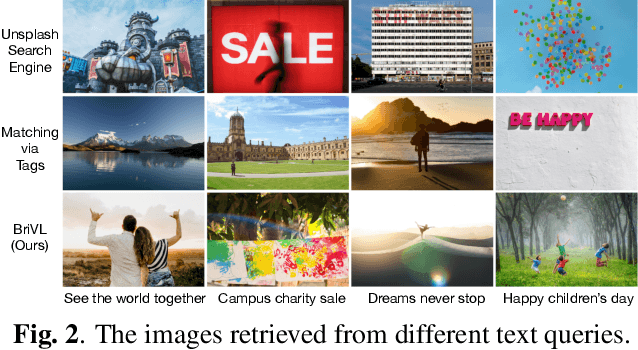
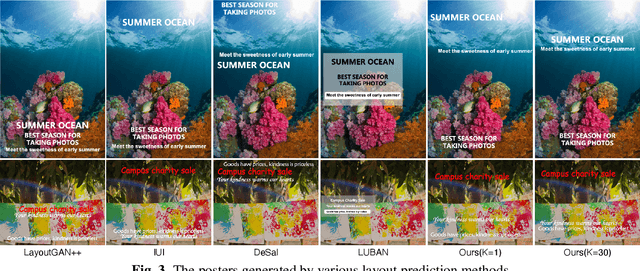
Poster generation is a significant task for a wide range of applications, which is often time-consuming and requires lots of manual editing and artistic experience. In this paper, we propose a novel data-driven framework, called \textit{Text2Poster}, to automatically generate visually-effective posters from textual information. Imitating the process of manual poster editing, our framework leverages a large-scale pretrained visual-textual model to retrieve background images from given texts, lays out the texts on the images iteratively by cascaded auto-encoders, and finally, stylizes the texts by a matching-based method. We learn the modules of the framework by weakly- and self-supervised learning strategies, mitigating the demand for labeled data. Both objective and subjective experiments demonstrate that our Text2Poster outperforms state-of-the-art methods, including academic research and commercial software, on the quality of generated posters.
WenLan: Bridging Vision and Language by Large-Scale Multi-Modal Pre-Training
Mar 19, 2021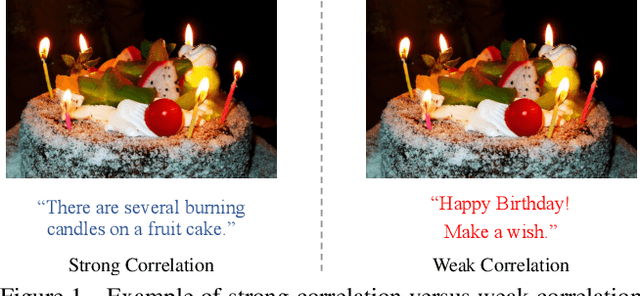
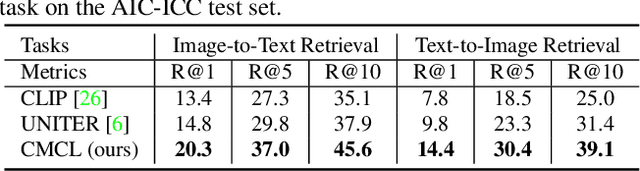
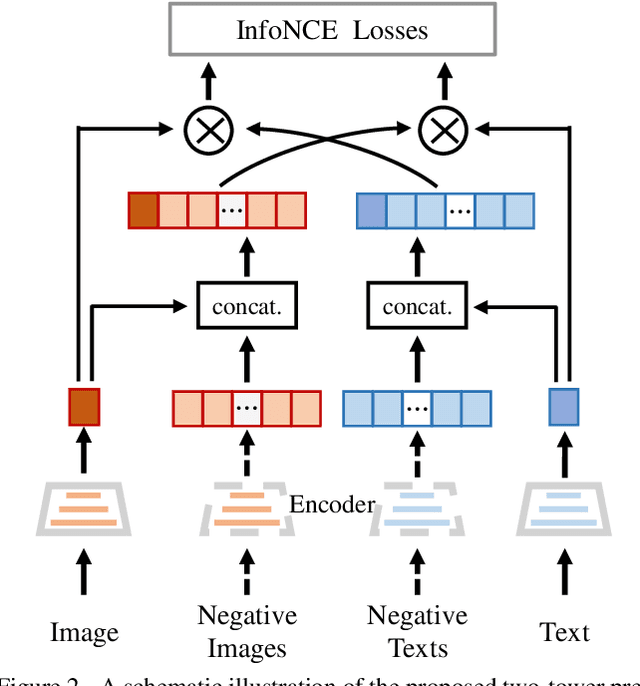
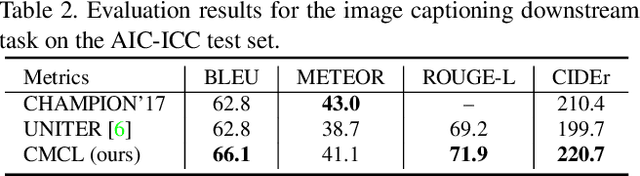
Multi-modal pre-training models have been intensively explored to bridge vision and language in recent years. However, most of them explicitly model the cross-modal interaction between image-text pairs, by assuming that there exists strong semantic correlation between the text and image modalities. Since this strong assumption is often invalid in real-world scenarios, we choose to implicitly model the cross-modal correlation for large-scale multi-modal pre-training, which is the focus of the Chinese project `WenLan' led by our team. Specifically, with the weak correlation assumption over image-text pairs, we propose a two-tower pre-training model called BriVL within the cross-modal contrastive learning framework. Unlike OpenAI CLIP that adopts a simple contrastive learning method, we devise a more advanced algorithm by adapting the latest method MoCo into the cross-modal scenario. By building a large queue-based dictionary, our BriVL can incorporate more negative samples in limited GPU resources. We further construct a large Chinese multi-source image-text dataset called RUC-CAS-WenLan for pre-training our BriVL model. Extensive experiments demonstrate that the pre-trained BriVL model outperforms both UNITER and OpenAI CLIP on various downstream tasks.