 Add to Chrome
 Add to Firefox
 Add to Edge
Context Rot in AI-Assisted Software Development: Repurposing Documentation Consistency for AI Configuration Artifacts
Jun 08, 2026
Developers increasingly provide AI coding assistants with persistent context through configuration files such as CLAUDE.md, AGENTS.md, and .cursorrules. These files describe code elements, architecture, and development conventions, forming the context that guides AI tool behavior across sessions. As software evolves, this context can become stale, a phenomenon we call context rot. While AI configuration artifacts are new, the underlying consistency problem connects to decades of software documentation research. Researchers have built tools to check consistency between documentation and code, spanning README files, code comments, API documentation, architecture descriptions, and installation instructions. We argue that this existing toolbox is an immediate starting point for detecting context rot, and we present a research roadmap mapping documentation consistency approaches to corresponding problems in this new setting. As preliminary evidence, applying an existing README/wiki consistency checker to a statistically representative sample of 356 repositories identifies stale code element references in 23.0% of repositories, showing that traditional documentation consistency tools can already surface context rot.

The Impact of Configuring Agentic AI Coding Tools on Build-vs-Buy Decisions: A Study Protocol
Jun 02, 2026Agentic AI coding tools write code with increasing autonomy and in doing so decide when to import a library and when to implement functionality from scratch. These decisions, whether to build functionality from scratch or buy into an external library, hereafter build-versus-buy, carry direct consequences for software security, licensing compliance, performance, and long-term maintainability. Yet no controlled experimental study has examined what governs build-versus-buy decisions in agentic AI coding tools. Configuration mechanisms, i.e., the means by which developers tailor agentic AI coding tool behavior to a project or workflow, are one of the primary means by which practitioners can influence these decisions. However, it is unclear which configuration mechanisms influence build-versus-buy decisions most effectively. We present a pre-registered protocol to study how configuration mechanisms alter build-versus-buy behavior in two popular agentic AI coding tools: Claude Code and OpenAI Codex. We will execute controlled programming tasks drawn from a benchmark of staged projects, each constructed around identifiable build-versus-buy points, and will manipulate the configuration supplied to each tool, ranging from no configuration, through context files with soft preferences and explicit prohibitions, to Skills (instructions that can be autonomously discovered), MCP-enabled library discovery tools, and permission controls, measuring which libraries the tool selects, whether it discloses newly introduced libraries, and whether those disclosures are complete and accurate. Nine pre-registered hypotheses structure the protocol. The resulting benchmark dataset and analysis pipeline will be released as a reusable artifact for evaluating build-versus-buy behavior in agentic AI coding tools.
On the Impact of AGENTS.md Files on the Efficiency of AI Coding Agents
Jan 28, 2026AI coding agents such as Codex and Claude Code are increasingly used to autonomously contribute to software repositories. However, little is known about how repository-level configuration artifacts affect operational efficiency of the agents. In this paper, we study the impact of AGENTS$.$md files on the runtime and token consumption of AI coding agents operating on GitHub pull requests. We analyze 10 repositories and 124 pull requests, executing agents under two conditions: with and without an AGENTS$.$md file. We measure wall-clock execution time and token usage during agent execution. Our results show that the presence of AGENTS$.$md is associated with a lower median runtime ($Δ28.64$%) and reduced output token consumption ($Δ16.58$%), while maintaining a comparable task completion behavior. Based on these results, we discuss immediate implications for the configuration and deployment of AI coding agents in practice, and outline a broader research agenda on the role of repository-level instructions in shaping the behavior, efficiency, and integration of AI coding agents in software development workflows.
Automated Query Reformulation for Efficient Search based on Query Logs From Stack Overflow
Feb 10, 2021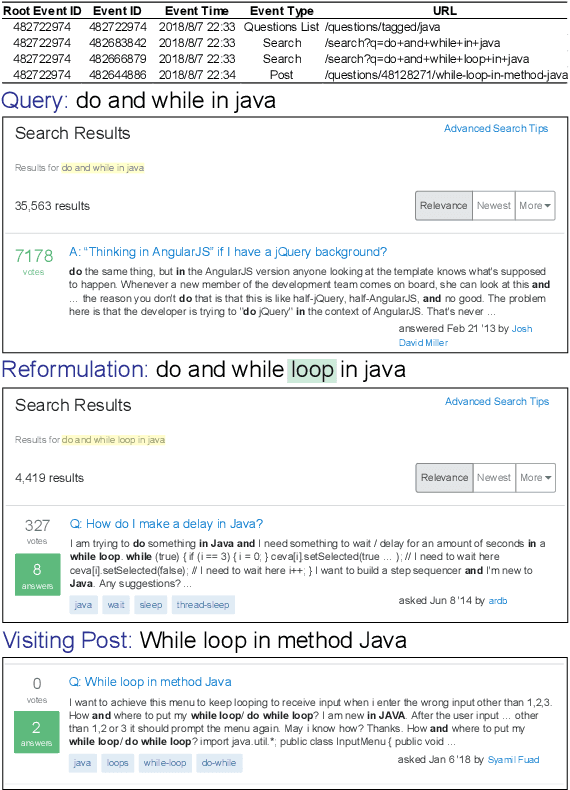
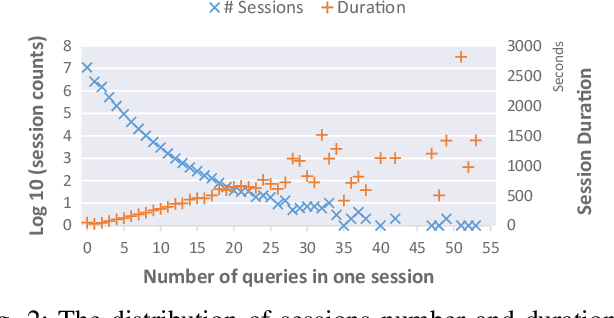
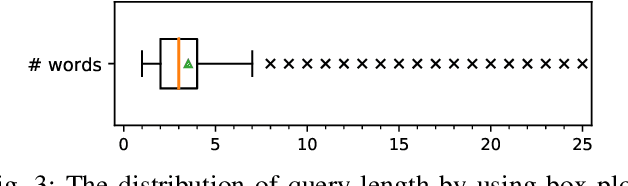
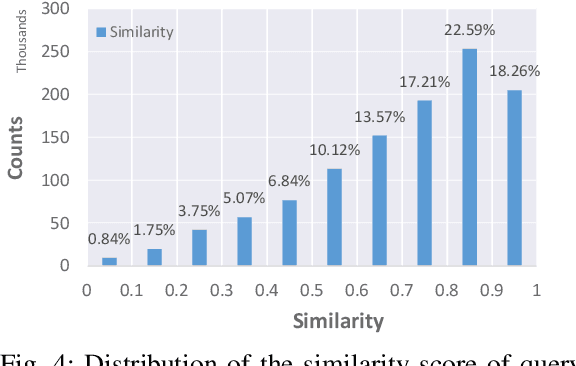
As a popular Q&A site for programming, Stack Overflow is a treasure for developers. However, the amount of questions and answers on Stack Overflow make it difficult for developers to efficiently locate the information they are looking for. There are two gaps leading to poor search results: the gap between the user's intention and the textual query, and the semantic gap between the query and the post content. Therefore, developers have to constantly reformulate their queries by correcting misspelled words, adding limitations to certain programming languages or platforms, etc. As query reformulation is tedious for developers, especially for novices, we propose an automated software-specific query reformulation approach based on deep learning. With query logs provided by Stack Overflow, we construct a large-scale query reformulation corpus, including the original queries and corresponding reformulated ones. Our approach trains a Transformer model that can automatically generate candidate reformulated queries when given the user's original query. The evaluation results show that our approach outperforms five state-of-the-art baselines, and achieves a 5.6% to 33.5% boost in terms of $\mathit{ExactMatch}$ and a 4.8% to 14.4% boost in terms of $\mathit{GLEU}$.
An Annotated Dataset of Stack Overflow Post Edits
May 06, 2020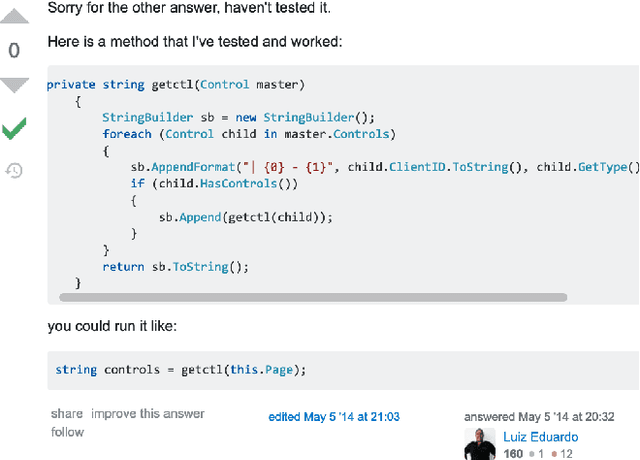
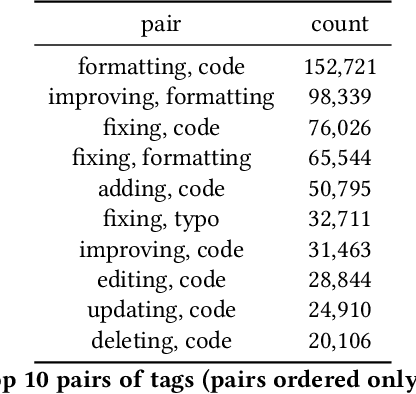
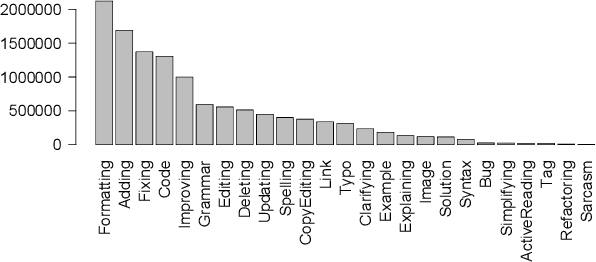
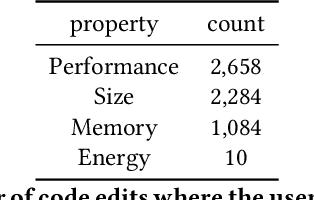
To improve software engineering, software repositories have been mined for code snippets and bug fixes. Typically, this mining takes place at the level of files or commits. To be able to dig deeper and to extract insights at a higher resolution, we hereby present an annotated dataset that contains over 7 million edits of code and text on Stack Overflow. Our preliminary study indicates that these edits might be a treasure trove for mining information about fine-grained patches, e.g., for the optimisation of non-functional properties.