 Add to Chrome
 Add to Firefox
 Add to Edge
Towards an Appropriate Level of Reliance on AI: A Preliminary Reliance-Control Framework for AI in Software Engineering
Apr 12, 2026
How software developers interact with Artificial Intelligence (AI)-powered tools, including Large Language Models (LLMs), plays a vital role in how these AI-powered tools impact them. While overreliance on AI may lead to long-term negative consequences (e.g., atrophy of critical thinking skills); underreliance might deprive software developers of potential gains in productivity and quality. Based on twenty-two interviews with software developers on using LLMs for software development, we propose a preliminary reliance-control framework where the level of control can be used as a way to identify AI overreliance and underreliance. We also use it to recommend future research to further explore the different control levels supported by the current and emergent LLM-driven tools. Our paper contributes to the emerging discourse on AI overreliance and provides an understanding of the appropriate degree of reliance as essential to developers making the most of these powerful technologies. Our findings can help practitioners, educators, and policymakers promote responsible and effective use of AI tools.

Walking the Tightrope of LLMs for Software Development: A Practitioners' Perspective
Nov 09, 2025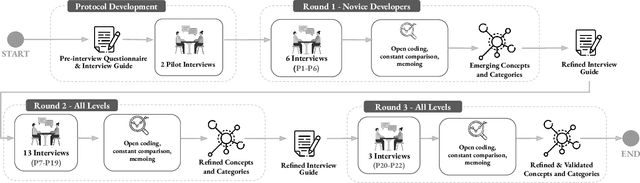
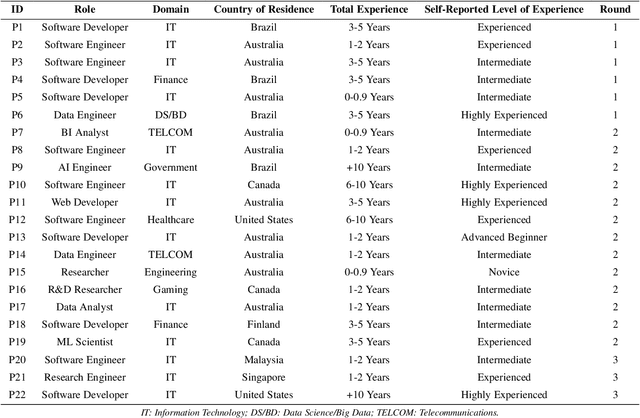
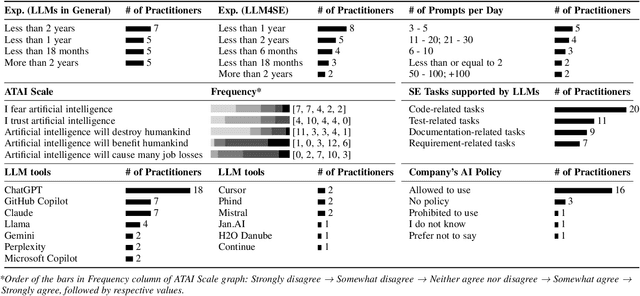
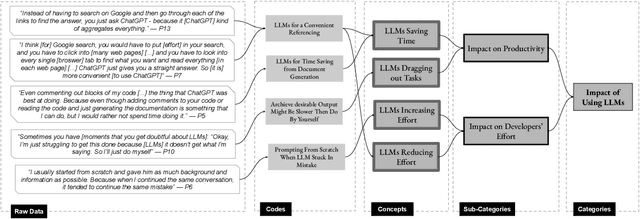
Background: Large Language Models emerged with the potential of provoking a revolution in software development (e.g., automating processes, workforce transformation). Although studies have started to investigate the perceived impact of LLMs for software development, there is a need for empirical studies to comprehend how to balance forward and backward effects of using LLMs. Objective: We investigated how LLMs impact software development and how to manage the impact from a software developer's perspective. Method: We conducted 22 interviews with software practitioners across 3 rounds of data collection and analysis, between October (2024) and September (2025). We employed socio-technical grounded theory (STGT) for data analysis to rigorously analyse interview participants' responses. Results: We identified the benefits (e.g., maintain software development flow, improve developers' mental model, and foster entrepreneurship) and disadvantages (e.g., negative impact on developers' personality and damage to developers' reputation) of using LLMs at individual, team, organisation, and society levels; as well as best practices on how to adopt LLMs. Conclusion: Critically, we present the trade-offs that software practitioners, teams, and organisations face in working with LLMs. Our findings are particularly useful for software team leaders and IT managers to assess the viability of LLMs within their specific context.
Junior Software Developers' Perspectives on Adopting LLMs for Software Engineering: a Systematic Literature Review
Mar 10, 2025Many studies exploring the adoption of Large Language Model-based tools for software development by junior developers have emerged in recent years. These studies have sought to understand developers' perspectives about using those tools, a fundamental pillar for successfully adopting LLM-based tools in Software Engineering. The aim of this paper is to provide an overview of junior software developers' perspectives and use of LLM-based tools for software engineering (LLM4SE). We conducted a systematic literature review (SLR) following guidelines by Kitchenham et al. on 56 primary studies, applying the definition for junior software developers as software developers with equal or less than five years of experience, including Computer Science/Software Engineering students. We found that the majority of the studies focused on comprehending the different aspects of integrating AI tools in SE. Only 8.9\% of the studies provide a clear definition for junior software developers, and there is no uniformity. Searching for relevant information is the most common task using LLM tools. ChatGPT was the most common LLM tool present in the studies (and experiments). A majority of the studies (83.9\%) report both positive and negative perceptions about the impact of adopting LLM tools. We also found and categorised advantages, challenges, and recommendations regarding LLM adoption. Our results indicate that developers are using LLMs not just for code generation, but also to improve their development skills. Critically, they are not just experiencing the benefits of adopting LLM tools, but they are also aware of at least a few LLM limitations, such as the generation of wrong suggestions, potential data leaking, and AI hallucination. Our findings offer implications for software engineering researchers, educators, and developers.