 Add to Chrome
 Add to Firefox
 Add to Edge
AI-Assisted Code Review as a Scaffold for Code Quality and Self-Regulated Learning: An Experience Report
Apr 25, 2026
Code review is central to software engineering education but hard to scale in capstone projects due to tight deadlines, uneven peer feedback, and limited prior experience. We investigate an LLM-as-reviewer integrated directly into GitHub pull requests (human-in-the-loop) across two cohorts (more than 100 students, 2023--2024). Using a mixed-methods design -- GitHub data, reflective reports, and a targeted survey -- we examine engagement and responsiveness as behavioral indicators of self-regulated learning processes. Quantitatively, the 2024 cohort produced more iterative activity (1176 vs. 581 PRs), while technical issues observed in 2023 (227 failed AI attempts) dropped to zero after tool and instructional refinements. Despite different adoption levels (93\% vs. 50\% of teams using the tool), responsiveness was stable: 32\% (2023) and 33\% (2024) of successfully AI-reviewed PRs were followed by subsequent commits on the same PR. Qualitatively, students used the LLM's structured comments to focus reviews and discuss code quality, while guidance reduced over-reliance. We contribute: (i) an in-workflow design for an AI reviewer that scaffolds learning while mitigating cognitive offloading; (ii) a repeated cross sectional comparison across two cohorts in authentic settings; (iii) a mixed-methods analysis combining objective GitHub metrics with student self-reports; and (iv) evidence-based pedagogical recommendations for responsible, student-led AI-assisted review.

Fine-grained Approaches for Confidence Calibration of LLMs in Automated Code Revision
Apr 08, 2026In today's AI-assisted software engineering landscape, developers increasingly depend on LLMs that are highly capable, yet inherently imperfect. The tendency of these models to produce incorrect outputs can reduce developer productivity. To this end, a canonical mitigation method is to provide calibrated confidence scores that faithfully reflect their likelihood of correctness at the instance-level. Such information allows users to make immediate decisions regarding output acceptance, abstain error-prone outputs, and better align their expectations with the model's capabilities. Since post-trained LLMs do not inherently produce well-calibrated confidence scores, researchers have developed post-hoc calibration methods, with global Platt-scaling of sequence-level confidence scores proving effective in many generative software engineering tasks but remaining unreliable or unexplored for automated code revision (ACR) tasks such as program repair, vulnerability repair, and code refinement. We hypothesise that the coarse-grained nature of this conventional method makes it ill-suited for ACR tasks, where correctness is often determined by local edit decisions and miscalibration can be sample-dependent, thereby motivating fine-grained confidence calibration. To address this, our study proposes local Platt-scaling applied separately to three different fine-grained confidence scores. Through experiments across 3 separate tasks and correctness metrics, as well as 14 different models of various sizes, we find that fine-grained confidence scores consistently achieve lower calibration error across a broader range of probability intervals, and this effect is further amplified when global Platt-scaling is applied. Our proposed approaches offer a practical solution to eliciting well-calibrated confidence scores, enabling more trustworthy and streamlined usage of imperfect models in ACR tasks.
Context-Augmented Code Generation Using Programming Knowledge Graphs
Jan 28, 2026Large Language Models (LLMs) excel at code generation but struggle with complex problems. Retrieval-Augmented Generation (RAG) mitigates this issue by integrating external knowledge, yet retrieval models often miss relevant context, and generation models hallucinate with irrelevant data. We propose Programming Knowledge Graph (PKG) for semantic representation and fine-grained retrieval of code and text. Our approach enhances retrieval precision through tree pruning and mitigates hallucinations via a re-ranking mechanism that integrates non-RAG solutions. Structuring external data into finer-grained nodes improves retrieval granularity. Evaluations on HumanEval and MBPP show up to 20% pass@1 accuracy gains and a 34% improvement over baselines on MBPP. Our findings demonstrate that our proposed PKG approach along with re-ranker effectively address complex problems while maintaining minimal negative impact on solutions that are already correct without RAG. The replication package is published at https://github.com/iamshahd/ProgrammingKnowledgeGraph
HalluJudge: A Reference-Free Hallucination Detection for Context Misalignment in Code Review Automation
Jan 27, 2026Large Language models (LLMs) have shown strong capabilities in code review automation, such as review comment generation, yet they suffer from hallucinations -- where the generated review comments are ungrounded in the actual code -- poses a significant challenge to the adoption of LLMs in code review workflows. To address this, we explore effective and scalable methods for a hallucination detection in LLM-generated code review comments without the reference. In this work, we design HalluJudge that aims to assess the grounding of generated review comments based on the context alignment. HalluJudge includes four key strategies ranging from direct assessment to structured multi-branch reasoning (e.g., Tree-of-Thoughts). We conduct a comprehensive evaluation of these assessment strategies across Atlassian's enterprise-scale software projects to examine the effectiveness and cost-efficiency of HalluJudge. Furthermore, we analyze the alignment between HalluJudge's judgment and developer preference of the actual LLM-generated code review comments in the real-world production. Our results show that the hallucination assessment in HalluJudge is cost-effective with an F1 score of 0.85 and an average cost of $0.009. On average, 67% of the HalluJudge assessments are aligned with the developer preference of the actual LLM-generated review comments in the online production. Our results suggest that HalluJudge can serve as a practical safeguard to reduce developers' exposure to hallucinated comments, fostering trust in AI-assisted code reviews.
AgenticSCR: An Autonomous Agentic Secure Code Review for Immature Vulnerabilities Detection
Jan 27, 2026Secure code review is critical at the pre-commit stage, where vulnerabilities must be caught early under tight latency and limited-context constraints. Existing SAST-based checks are noisy and often miss immature, context-dependent vulnerabilities, while standalone Large Language Models (LLMs) are constrained by context windows and lack explicit tool use. Agentic AI, which combine LLMs with autonomous decision-making, tool invocation, and code navigation, offer a promising alternative, but their effectiveness for pre-commit secure code review is not yet well understood. In this work, we introduce AgenticSCR, an agentic AI for secure code review for detecting immature vulnerabilities during the pre-commit stage, augmented by security-focused semantic memories. Using our own curated benchmark of immature vulnerabilities, tailored to the pre-commit secure code review, we empirically evaluate how accurate is our AgenticSCR for localizing, detecting, and explaining immature vulnerabilities. Our results show that AgenticSCR achieves at least 153% relatively higher percentage of correct code review comments than the static LLM-based baseline, and also substantially surpasses SAST tools. Moreover, AgenticSCR generates more correct comments in four out of five vulnerability types, consistently and significantly outperforming all other baselines. These findings highlight the importance of Agentic Secure Code Review, paving the way towards an emerging research area of immature vulnerability detection.
Hallucinations in Code Change to Natural Language Generation: Prevalence and Evaluation of Detection Metrics
Aug 12, 2025Language models have shown strong capabilities across a wide range of tasks in software engineering, such as code generation, yet they suffer from hallucinations. While hallucinations have been studied independently in natural language and code generation, their occurrence in tasks involving code changes which have a structurally complex and context-dependent format of code remains largely unexplored. This paper presents the first comprehensive analysis of hallucinations in two critical tasks involving code change to natural language generation: commit message generation and code review comment generation. We quantify the prevalence of hallucinations in recent language models and explore a range of metric-based approaches to automatically detect them. Our findings reveal that approximately 50\% of generated code reviews and 20\% of generated commit messages contain hallucinations. Whilst commonly used metrics are weak detectors on their own, combining multiple metrics substantially improves performance. Notably, model confidence and feature attribution metrics effectively contribute to hallucination detection, showing promise for inference-time detection.\footnote{All code and data will be released upon acceptance.
CodeReviewQA: The Code Review Comprehension Assessment for Large Language Models
Mar 20, 2025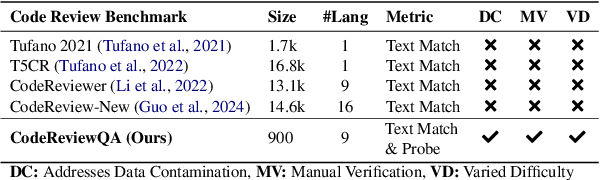
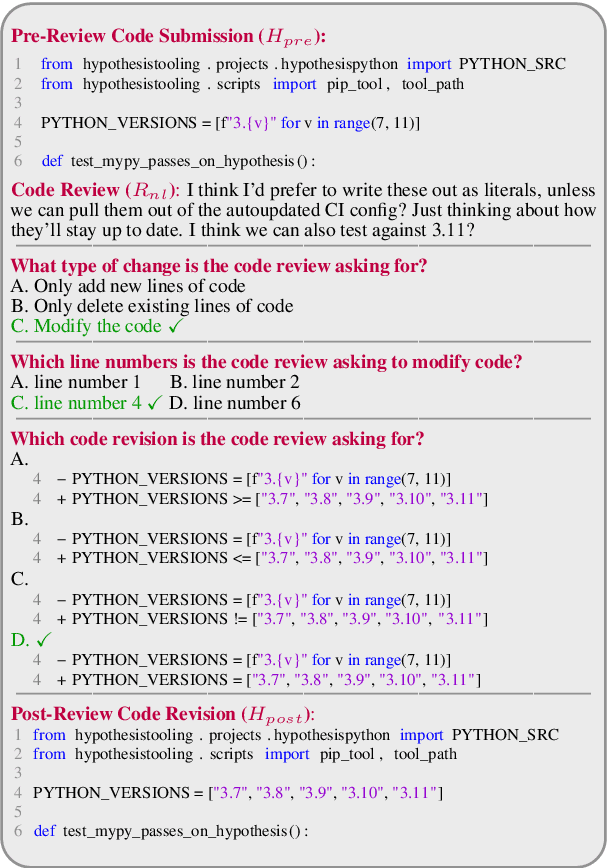
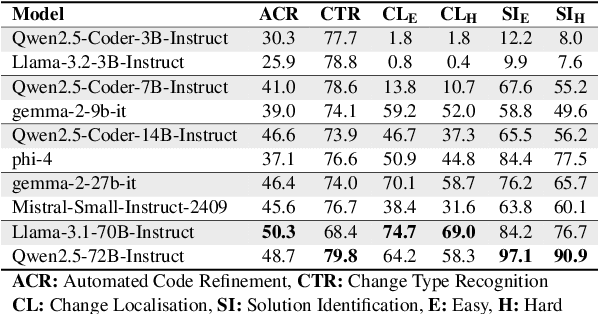
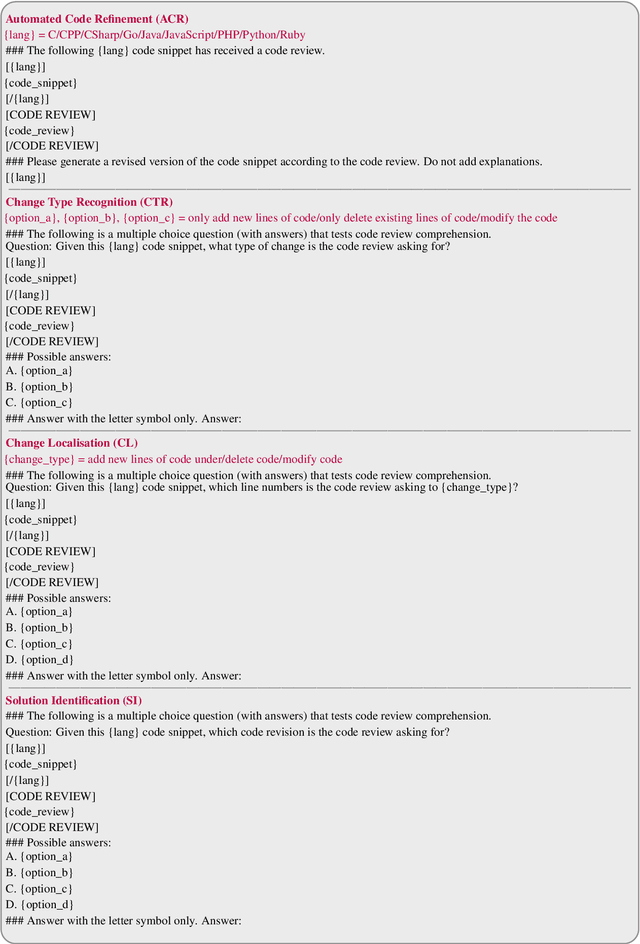
State-of-the-art large language models (LLMs) have demonstrated impressive code generation capabilities but struggle with real-world software engineering tasks, such as revising source code to address code reviews, hindering their practical use. Code review comments are often implicit, ambiguous, and colloquial, requiring models to grasp both code and human intent. This challenge calls for evaluating large language models' ability to bridge both technical and conversational contexts. While existing work has employed the automated code refinement (ACR) task to resolve these comments, current evaluation methods fall short, relying on text matching metrics that provide limited insight into model failures and remain susceptible to training data contamination. To address these limitations, we introduce a novel evaluation benchmark, $\textbf{CodeReviewQA}$ that enables us to conduct fine-grained assessment of model capabilities and mitigate data contamination risks. In CodeReviewQA, we decompose the generation task of code refinement into $\textbf{three essential reasoning steps}$: $\textit{change type recognition}$ (CTR), $\textit{change localisation}$ (CL), and $\textit{solution identification}$ (SI). Each step is reformulated as multiple-choice questions with varied difficulty levels, enabling precise assessment of model capabilities, while mitigating data contamination risks. Our comprehensive evaluation spans 72 recently released large language models on $\textbf{900 manually curated, high-quality examples}$ across nine programming languages. Our results show that CodeReviewQA is able to expose specific model weaknesses in code review comprehension, disentangled from their generative automated code refinement results.
Should Code Models Learn Pedagogically? A Preliminary Evaluation of Curriculum Learning for Real-World Software Engineering Tasks
Feb 06, 2025Learning-based techniques, especially advanced pre-trained models for code have demonstrated capabilities in code understanding and generation, solving diverse software engineering (SE) tasks. Despite the promising results, current training approaches may not fully optimize model performance, as they typically involve learning from randomly shuffled training data. Recent work shows that Curriculum Learning (CL) can improve performance on code-related tasks through incremental learning based on the difficulty of synthetic code. Yet, the effectiveness of CL with conventional difficulty measures in SE tasks remains largely unexplored. In this study, we explore two conventional code metrics: code length and cyclomatic complexity to determine the difficulty levels. We investigate how the pre-trained code model (CodeT5) learns under CL, through the tasks of code clone detection and code summarization. Our empirical study on the CodeXGLUE benchmark showed contrasting results to prior studies, where the model exhibited signs of catastrophic forgetting and shortcut learning. Surprisingly, model performance saturates after only the first quartile of training, potentially indicating a limit in the model's representation capacity and/or the task's inherent difficulty. Future work should further explore various CL strategies with different code models across a wider range of SE tasks for a more holistic understanding.
Human-In-the-Loop Software Development Agents
Nov 19, 2024Recently, Large Language Models (LLMs)-based multi-agent paradigms for software engineering are introduced to automatically resolve software development tasks (e.g., from a given issue to source code). However, existing work is evaluated based on historical benchmark datasets, does not consider human feedback at each stage of the automated software development process, and has not been deployed in practice. In this paper, we introduce a Human-in-the-loop LLM-based Agents framework (HULA) for software development that allows software engineers to refine and guide LLMs when generating coding plans and source code for a given task. We design, implement, and deploy the HULA framework into Atlassian JIRA for internal uses. Through a multi-stage evaluation of the HULA framework, Atlassian software engineers perceive that HULA can minimize the overall development time and effort, especially in initiating a coding plan and writing code for straightforward tasks. On the other hand, challenges around code quality are raised to be solved in some cases. We draw lessons learned and discuss opportunities for future work, which will pave the way for the advancement of LLM-based agents in software development.
Automatic Programming: Large Language Models and Beyond
May 03, 2024
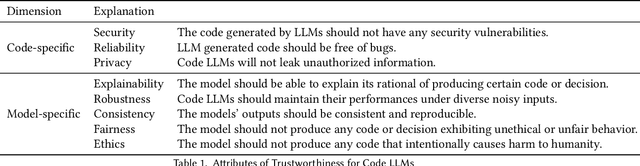
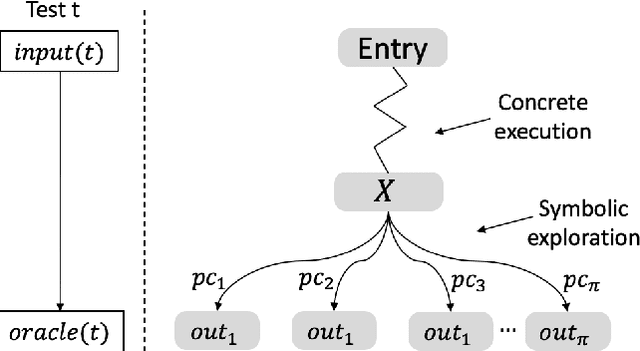

Automatic programming has seen increasing popularity due to the emergence of tools like GitHub Copilot which rely on Large Language Models (LLMs). At the same time, automatically generated code faces challenges during deployment due to concerns around quality and trust. In this article, we study automated coding in a general sense and study the concerns around code quality, security and related issues of programmer responsibility. These are key issues for organizations while deciding on the usage of automatically generated code. We discuss how advances in software engineering such as program repair and analysis can enable automatic programming. We conclude with a forward looking view, focusing on the programming environment of the near future, where programmers may need to switch to different roles to fully utilize the power of automatic programming. Automated repair of automatically generated programs from LLMs, can help produce higher assurance code from LLMs, along with evidence of assurance