 Add to Chrome
 Add to Firefox
 Add to Edge
CORTEX: A Structured Reasoning Benchmark for Trustworthy 3D Chest CT MLLMs
Jun 25, 2026
Reasoning in multimodal large language models (MLLMs) has shown strong promise in medical imaging. However, this reasoning is usually free-form text judged only by its final answer, making it hard to interpret and verify, especially in 3D radiology, where a diagnosis should be traceable to evidence in the scan. Existing chest CT question-answering datasets compound this by reducing expert radiology reports to answer-only pairs, dropping the reasoning that links findings to conclusions and omitting the patient history clinicians rely on. As a result, reasoning-capable 3D chest CT MLLMs remain out of reach, as neither the structured supervision needed to train them nor the protocol needed to verify their reasoning yet exists. We introduce CORTEX (Clinically Organized Reasoning and sTructured EXplanation), a structured reasoning benchmark for 3D chest CT. For each question, CORTEX restores the missing reasoning as a four-stage diagnostic trace mirroring a radiologist's workflow: task understanding, visual observation, diagnostic reasoning, and answer synthesis. We generate these traces using frontier large language models with broad medical and general-domain knowledge, then filter and verify them with a stage-level evaluation protocol combining automated rubric scoring with expert radiologist review. Crucially, both the reasoning structure and evaluation rubrics are designed in close collaboration with clinicians. Built on CT-RATE, a large, publicly available chest CT dataset without reasoning annotations, CORTEX comprises 76,177 validated reasoning traces across open-ended VQA, closed-ended VQA, and report generation, providing both the structured supervision and the stage-level evaluation protocol needed to build and evaluate trustworthy reasoning models for 3D chest CT. Our dataset and evaluation code will be made publicly available upon acceptance.

Counterfactual Explanations for Deep Two-Sample Testing
May 29, 2026Two-sample testing is a fundamental tool for detecting distributional differences across scientific domains, but classical tests (including kernel-based tests) can be ineffective on high-dimensional structured data such as images. Recent deep two-sample tests improve sensitivity in these settings by learning informative representations, yet they provide limited insight into which data features drive rejection of the null hypothesis $H_0$. To address this issue, we propose a counterfactual explanation framework for deep two-sample testing that generates sample-level edits moving observations from a source group toward a target group while explicitly reducing the discrepancy measured by the test. Our method combines a diffusion autoencoder with a pretrained deep two-sample test model and optimizes a maximum mean discrepancy (MMD) objective in the test model's representation space to produce plausible counterfactuals. We quantify distribution-level effects through changes in the test statistic and the resulting two-sample p-values. We evaluate the method on synthetic 2D shape datasets and two MRI cohorts. Across both settings, the counterfactual transformations consistently increase p-values relative to the original samples, indicating that the edited source set becomes statistically closer to the target distribution under the test. We measure minimality using LPIPS to ensure the counterfactuals remain close to the original samples. The resulting edits provide interpretable evidence of the features associated with the detected group differences. On MRI, the localized changes are consistent with known anatomical differences between cohorts.
Towards Visually Explaining Statistical Tests with Applications in Biomedical Imaging
Jan 20, 2026Deep neural two-sample tests have recently shown strong power for detecting distributional differences between groups, yet their black-box nature limits interpretability and practical adoption in biomedical analysis. Moreover, most existing post-hoc explainability methods rely on class labels, making them unsuitable for label-free statistical testing settings. We propose an explainable deep statistical testing framework that augments deep two-sample tests with sample-level and feature-level explanations, revealing which individual samples and which input features drive statistically significant group differences. Our method highlights which image regions and which individual samples contribute most to the detected group difference, providing spatial and instance-wise insight into the test's decision. Applied to biomedical imaging data, the proposed framework identifies influential samples and highlights anatomically meaningful regions associated with disease-related variation. This work bridges statistical inference and explainable AI, enabling interpretable, label-free population analysis in medical imaging.
AnatomiX, an Anatomy-Aware Grounded Multimodal Large Language Model for Chest X-Ray Interpretation
Jan 06, 2026Multimodal medical large language models have shown impressive progress in chest X-ray interpretation but continue to face challenges in spatial reasoning and anatomical understanding. Although existing grounding techniques improve overall performance, they often fail to establish a true anatomical correspondence, resulting in incorrect anatomical understanding in the medical domain. To address this gap, we introduce AnatomiX, a multitask multimodal large language model explicitly designed for anatomically grounded chest X-ray interpretation. Inspired by the radiological workflow, AnatomiX adopts a two stage approach: first, it identifies anatomical structures and extracts their features, and then leverages a large language model to perform diverse downstream tasks such as phrase grounding, report generation, visual question answering, and image understanding. Extensive experiments across multiple benchmarks demonstrate that AnatomiX achieves superior anatomical reasoning and delivers over 25% improvement in performance on anatomy grounding, phrase grounding, grounded diagnosis and grounded captioning tasks compared to existing approaches. Code and pretrained model are available at https://github.com/aneesurhashmi/anatomix
JAPAN: Joint Adaptive Prediction Areas with Normalising-Flows
May 29, 2025
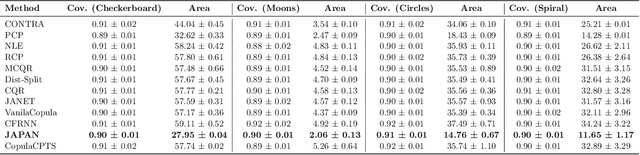
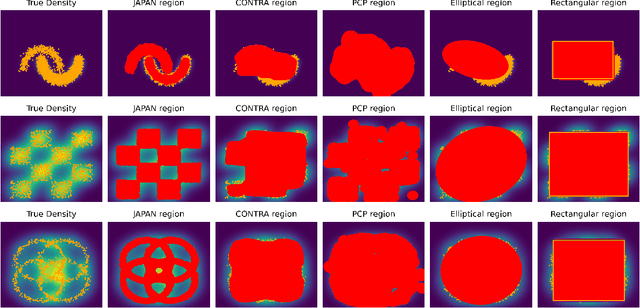

Conformal prediction provides a model-agnostic framework for uncertainty quantification with finite-sample validity guarantees, making it an attractive tool for constructing reliable prediction sets. However, existing approaches commonly rely on residual-based conformity scores, which impose geometric constraints and struggle when the underlying distribution is multimodal. In particular, they tend to produce overly conservative prediction areas centred around the mean, often failing to capture the true shape of complex predictive distributions. In this work, we introduce JAPAN (Joint Adaptive Prediction Areas with Normalising-Flows), a conformal prediction framework that uses density-based conformity scores. By leveraging flow-based models, JAPAN estimates the (predictive) density and constructs prediction areas by thresholding on the estimated density scores, enabling compact, potentially disjoint, and context-adaptive regions that retain finite-sample coverage guarantees. We theoretically motivate the efficiency of JAPAN and empirically validate it across multivariate regression and forecasting tasks, demonstrating good calibration and tighter prediction areas compared to existing baselines. We also provide several \emph{extensions} adding flexibility to our proposed framework.
Token Cropr: Faster ViTs for Quite a Few Tasks
Dec 01, 2024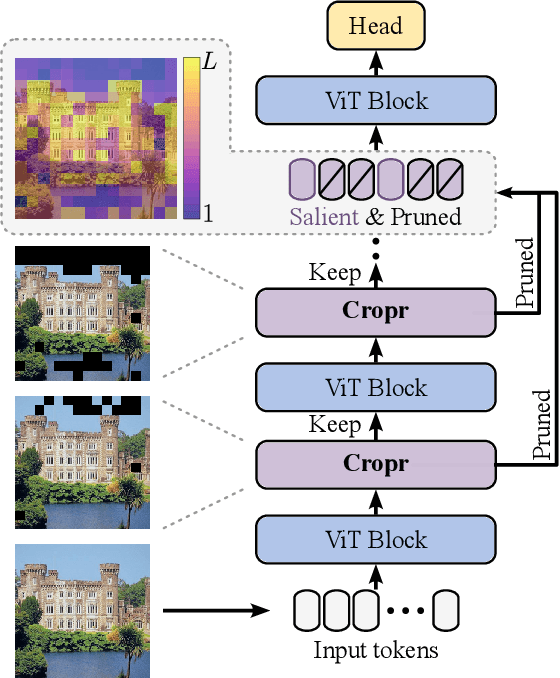
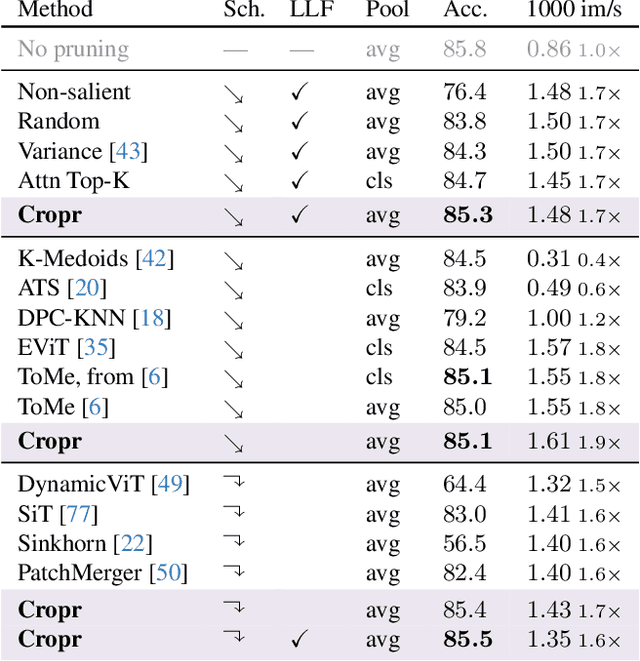
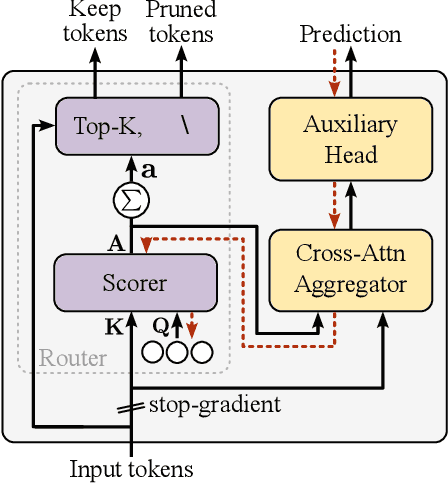
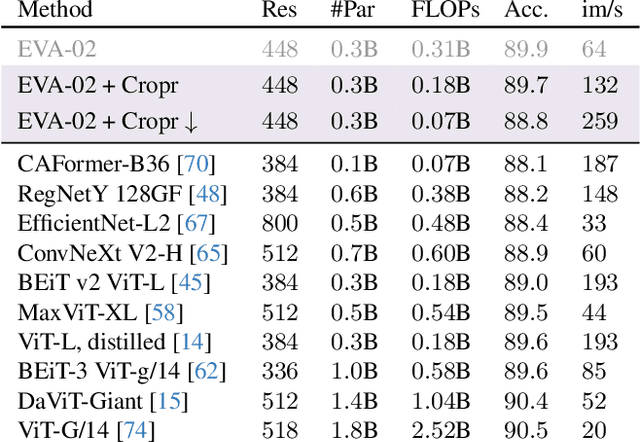
The adoption of Vision Transformers (ViTs) in resource-constrained applications necessitates improvements in inference throughput. To this end several token pruning and merging approaches have been proposed that improve efficiency by successively reducing the number of tokens. However, it remains an open problem to design a token reduction method that is fast, maintains high performance, and is applicable to various vision tasks. In this work, we present a token pruner that uses auxiliary prediction heads that learn to select tokens end-to-end based on task relevance. These auxiliary heads can be removed after training, leading to throughput close to that of a random pruner. We evaluate our method on image classification, semantic segmentation, object detection, and instance segmentation, and show speedups of 1.5 to 4x with small drops in performance. As a best case, on the ADE20k semantic segmentation benchmark, we observe a 2x speedup relative to the no-pruning baseline, with a negligible performance penalty of 0.1 median mIoU across 5 seeds.
Conformalised Conditional Normalising Flows for Joint Prediction Regions in time series
Nov 26, 2024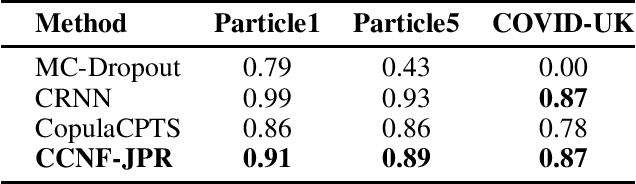
Conformal Prediction offers a powerful framework for quantifying uncertainty in machine learning models, enabling the construction of prediction sets with finite-sample validity guarantees. While easily adaptable to non-probabilistic models, applying conformal prediction to probabilistic generative models, such as Normalising Flows is not straightforward. This work proposes a novel method to conformalise conditional normalising flows, specifically addressing the problem of obtaining prediction regions for multi-step time series forecasting. Our approach leverages the flexibility of normalising flows to generate potentially disjoint prediction regions, leading to improved predictive efficiency in the presence of potential multimodal predictive distributions.
Deep Nonparametric Conditional Independence Tests for Images
Nov 09, 2024Conditional independence tests (CITs) test for conditional dependence between random variables. As existing CITs are limited in their applicability to complex, high-dimensional variables such as images, we introduce deep nonparametric CITs (DNCITs). The DNCITs combine embedding maps, which extract feature representations of high-dimensional variables, with nonparametric CITs applicable to these feature representations. For the embedding maps, we derive general properties on their parameter estimators to obtain valid DNCITs and show that these properties include embedding maps learned through (conditional) unsupervised or transfer learning. For the nonparametric CITs, appropriate tests are selected and adapted to be applicable to feature representations. Through simulations, we investigate the performance of the DNCITs for different embedding maps and nonparametric CITs under varying confounder dimensions and confounder relationships. We apply the DNCITs to brain MRI scans and behavioral traits, given confounders, of healthy individuals from the UK Biobank (UKB), confirming null results from a number of ambiguous personality neuroscience studies with a larger data set and with our more powerful tests. In addition, in a confounder control study, we apply the DNCITs to brain MRI scans and a confounder set to test for sufficient confounder control, leading to a potential reduction in the confounder dimension under improved confounder control compared to existing state-of-the-art confounder control studies for the UKB. Finally, we provide an R package implementing the DNCITs.
JANET: Joint Adaptive predictioN-region Estimation for Time-series
Jul 08, 2024Conformal prediction provides machine learning models with prediction sets that offer theoretical guarantees, but the underlying assumption of exchangeability limits its applicability to time series data. Furthermore, existing approaches struggle to handle multi-step ahead prediction tasks, where uncertainty estimates across multiple future time points are crucial. We propose JANET (Joint Adaptive predictioN-region Estimation for Time-series), a novel framework for constructing conformal prediction regions that are valid for both univariate and multivariate time series. JANET generalises the inductive conformal framework and efficiently produces joint prediction regions with controlled K-familywise error rates, enabling flexible adaptation to specific application needs. Our empirical evaluation demonstrates JANET's superior performance in multi-step prediction tasks across diverse time series datasets, highlighting its potential for reliable and interpretable uncertainty quantification in sequential data.
On the Challenges and Opportunities in Generative AI
Feb 28, 2024The field of deep generative modeling has grown rapidly and consistently over the years. With the availability of massive amounts of training data coupled with advances in scalable unsupervised learning paradigms, recent large-scale generative models show tremendous promise in synthesizing high-resolution images and text, as well as structured data such as videos and molecules. However, we argue that current large-scale generative AI models do not sufficiently address several fundamental issues that hinder their widespread adoption across domains. In this work, we aim to identify key unresolved challenges in modern generative AI paradigms that should be tackled to further enhance their capabilities, versatility, and reliability. By identifying these challenges, we aim to provide researchers with valuable insights for exploring fruitful research directions, thereby fostering the development of more robust and accessible generative AI solutions.