 Add to Chrome
 Add to Firefox
 Add to Edge
GemNav: Discrete-Token Visual Robot Navigation using a Multimodal Large Language Model
Jul 08, 2026
Visual navigation policies built on large pretrained models have so far followed a common recipe: a dedicated visual encoder, a bespoke action head, and training on thousands of hours of cross-embodiment datasets. We ask whether this recipe is necessary. In this paper, we introduce GemNav, a visual robot navigation policy that adapts a frozen Multimodal Large Language Model (MLLM) for short-to-medium horizon waypoint navigation using Low-Rank Adaptation (LoRA) on the language tower alone, with no auxiliary visual encoder and no continuous regression head. Waypoints and categorical navigation signals share a single discrete token vocabulary generated by the language-model head, and a soft-decoded auxiliary loss recovers the metric structure that pure cross-entropy training discards. On a single 8.7-hour open corpus, roughly three orders of magnitude smaller than competing training sets, the policy transfers zero-shot to four physically distinct unseen environments and stops within 0.25-0.42m of the goal across 20 real-world trials covering an open carpark, an obstacle carpark, a long outdoor chemical yard, and an indoor warehouse. Conditioning on short image histories improves offline metrics but yields no robot benefit, pointing to a ceiling on what temporal context adds once pretrained vision features are in place. These results indicate that discrete-token adaptation of frozen MLLMs can provide a data-efficient, deployable alternative for foundation model robot navigation.

Spatially Stratified Distillation for Heterogeneous Radar Place Recognition
Jun 17, 2026Scalable, all-weather place recognition increasingly relies on heterogeneous radar place recognition to bridge diverse hardware platforms. A notable application is matching queries from cost-effective 4D automotive radars against high-fidelity reference maps built by dense spinning radars. This process is fundamentally limited by the extreme sparsity (and narrow field-of-view) of the 4D sensor, which captures only a fraction of the structural density present in the spinning radar database. Prior efforts address this issue by unifying different radar signals. That is, projecting both signals into a common representational space. Yet, they suffer performance degradation in multi-session environments. In this paper, we propose spatially-stratified distillation (SSD); a strategy that replaces standard uniform distillation with an asymmetric spatial alignment derived directly from physical radar returns. In regions where both radars exhibit overlapping returns, SSD enforces strong feature alignment. Crucially, in sparse regions where the 4D student lacks returns but the teacher contains valid structure within the shared field of view, SSD applies heavily discounted distillation weights. Extensive evaluations of the recent HeRCULES dataset demonstrate that SSD significantly outperforms prior place recognition methods, achieving state-of-the-art results on its challenging dynamic sequences.
Visual Place Recognition in Forests with Depth-Aware Distillation
Jun 11, 2026Visual place recognition in natural forest environments remains challenging due to repetitive vegetation, weak structural cues, and significant appearance variation across traversals. To address this limitation, this paper proposes a lightweight depth-aware distillation framework that injects geometric cues into a DINOv2-based place recognition model, while maintaining its pre-trained descriptor space. Evaluated on the recent WildCross benchmark, the proposed approach yields gains over an appearance-only counterpart, providing robustness to appearance variations. These results demonstrate the importance of depth as a strong complementary modality for place recognition in natural environments and identify depth-aware distillation as a promising direction for more robust forest perception.
PseudoNeg-MAE: Self-Supervised Point Cloud Learning using Conditional Pseudo-Negative Embeddings
Sep 24, 2024We propose PseudoNeg-MAE, a novel self-supervised learning framework that enhances global feature representation of point cloud mask autoencoder by making them both discriminative and sensitive to transformations. Traditional contrastive learning methods focus on achieving invariance, which can lead to the loss of valuable transformation-related information. In contrast, PseudoNeg-MAE explicitly models the relationship between original and transformed data points using a parametric network COPE, which learns the localized displacements caused by transformations within the latent space. However, jointly training COPE with the MAE leads to undesirable trivial solutions where COPE outputs collapse to an identity. To address this, we introduce a novel loss function incorporating pseudo-negatives, which effectively penalizes these trivial invariant solutions and promotes transformation sensitivity in the embeddings. We validate PseudoNeg-MAE on shape classification and relative pose estimation tasks, where PseudoNeg-MAE achieves state-of-the-art performance on the ModelNet40 and ScanObjectNN datasets under challenging evaluation protocols and demonstrates superior accuracy in estimating relative poses. These results show the effectiveness of PseudoNeg-MAE in learning discriminative and transformation-sensitive representations.
Learning Compact Channel Correlation Representation for LiDAR Place Recognition
Sep 24, 2024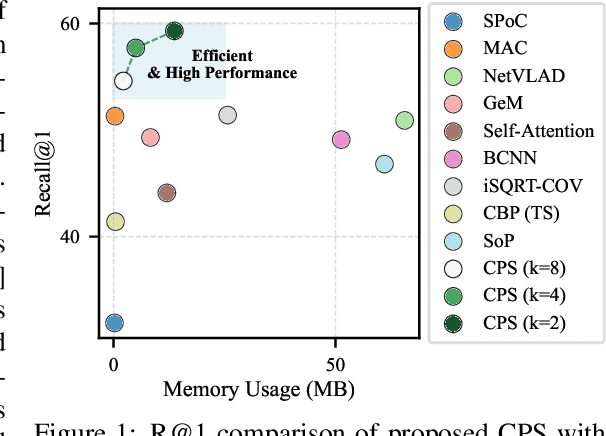

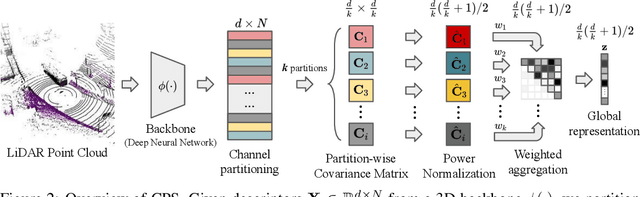
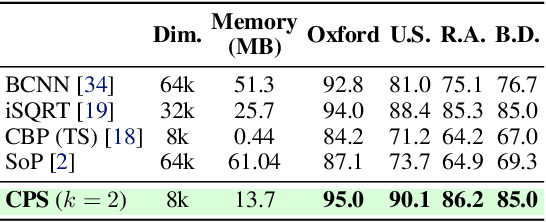
This paper presents a novel approach to learn compact channel correlation representation for LiDAR place recognition, called C3R, aimed at reducing the computational burden and dimensionality associated with traditional covariance pooling methods for place recognition tasks. Our method partitions the feature matrix into smaller groups, computes group-wise covariance matrices, and aggregates them via a learnable aggregation strategy. Matrix power normalization is applied to ensure stability. Theoretical analyses are also given to demonstrate the effectiveness of the proposed method, including its ability to preserve permutation invariance and maintain high mutual information between the original features and the aggregated representation. We conduct extensive experiments on four large-scale, public LiDAR place recognition datasets including Oxford RobotCar, In-house, MulRan, and WildPlaces datasets to validate our approach's superiority in accuracy, and robustness. Furthermore, we provide the quantitative results of our approach for a deeper understanding. The code will be released upon acceptance.
Learning Partial Correlation based Deep Visual Representation for Image Classification
Apr 26, 2023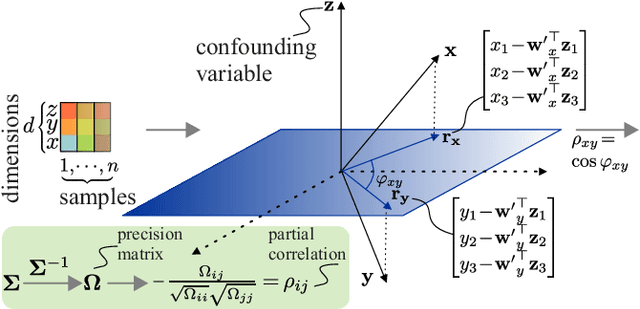
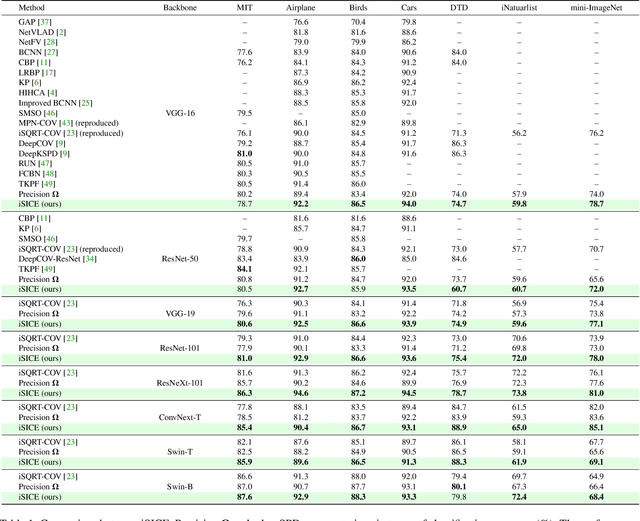

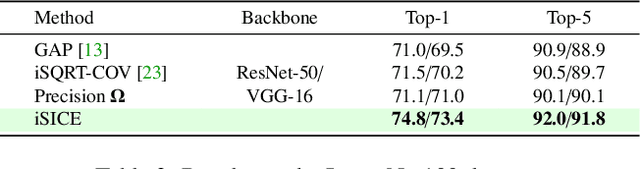
Visual representation based on covariance matrix has demonstrates its efficacy for image classification by characterising the pairwise correlation of different channels in convolutional feature maps. However, pairwise correlation will become misleading once there is another channel correlating with both channels of interest, resulting in the ``confounding'' effect. For this case, ``partial correlation'' which removes the confounding effect shall be estimated instead. Nevertheless, reliably estimating partial correlation requires to solve a symmetric positive definite matrix optimisation, known as sparse inverse covariance estimation (SICE). How to incorporate this process into CNN remains an open issue. In this work, we formulate SICE as a novel structured layer of CNN. To ensure end-to-end trainability, we develop an iterative method to solve the above matrix optimisation during forward and backward propagation steps. Our work obtains a partial correlation based deep visual representation and mitigates the small sample problem often encountered by covariance matrix estimation in CNN. Computationally, our model can be effectively trained with GPU and works well with a large number of channels of advanced CNNs. Experiments show the efficacy and superior classification performance of our deep visual representation compared to covariance matrix based counterparts.
Deep Learning based HEp-2 Image Classification: A Comprehensive Review
Nov 20, 2019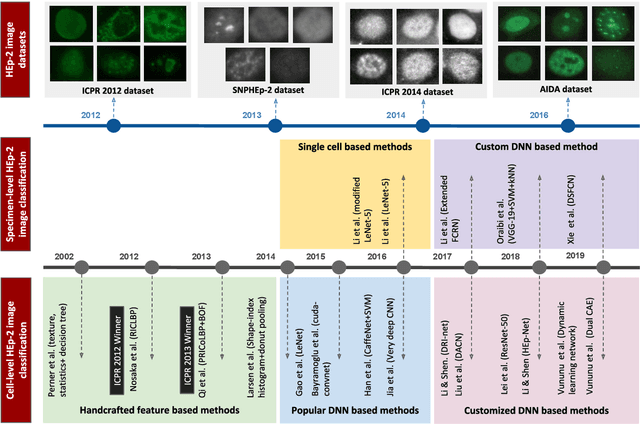
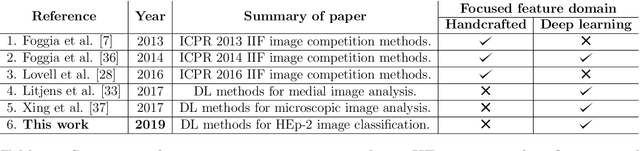
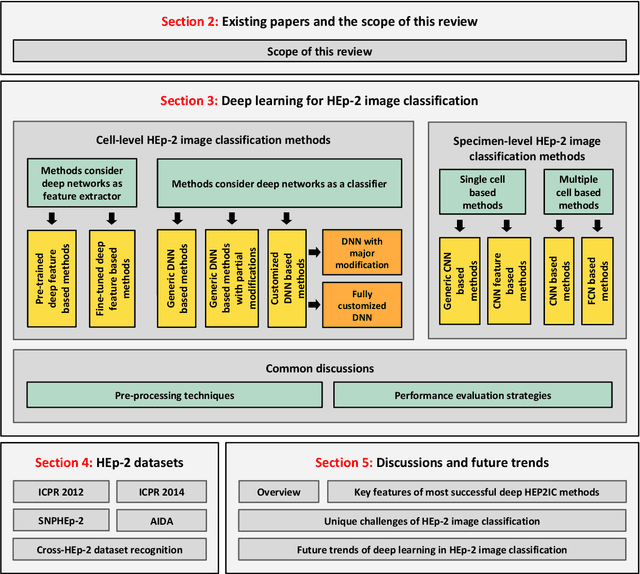
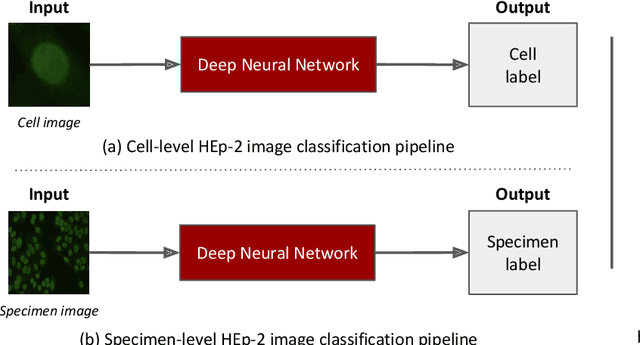
Classification of HEp-2 cell patterns plays a significant role in the indirect immunofluorescence test for identifying autoimmune diseases in the human body. Many automatic HEp-2 cell classification methods have been proposed in recent years, amongst which deep learning based methods have shown impressive performance. This paper provides a comprehensive review of the existing deep learning based HEp-2 cell image classification methods. These methods perform HEp-2 image classification in two levels, namely, cell-level and specimen-level. Both levels are covered in this review. In each level, the methods are organized with a deep network usage based taxonomy. The core idea, notable achievements, and key advantages and weakness of each method are critically analyzed. Furthermore, a concise review of the existing HEp-2 datasets that are commonly used in the literature is given. The paper ends with an overview of the current state-of-the-arts and a discussion on novel opportunities and future research directions in this field. It is hoped that this paper would give readers a comprehensive reference of this novel, challenging, and thriving field.