 Add to Chrome
 Add to Firefox
 Add to Edge
ImagenWorld: Stress-Testing Image Generation Models with Explainable Human Evaluation on Open-ended Real-World Tasks
Mar 29, 2026
Advances in diffusion, autoregressive, and hybrid models have enabled high-quality image synthesis for tasks such as text-to-image, editing, and reference-guided composition. Yet, existing benchmarks remain limited, either focus on isolated tasks, cover only narrow domains, or provide opaque scores without explaining failure modes. We introduce \textbf{ImagenWorld}, a benchmark of 3.6K condition sets spanning six core tasks (generation and editing, with single or multiple references) and six topical domains (artworks, photorealistic images, information graphics, textual graphics, computer graphics, and screenshots). The benchmark is supported by 20K fine-grained human annotations and an explainable evaluation schema that tags localized object-level and segment-level errors, complementing automated VLM-based metrics. Our large-scale evaluation of 14 models yields several insights: (1) models typically struggle more in editing tasks than in generation tasks, especially in local edits. (2) models excel in artistic and photorealistic settings but struggle with symbolic and text-heavy domains such as screenshots and information graphics. (3) closed-source systems lead overall, while targeted data curation (e.g., Qwen-Image) narrows the gap in text-heavy cases. (4) modern VLM-based metrics achieve Kendall accuracies up to 0.79, approximating human ranking, but fall short of fine-grained, explainable error attribution. ImagenWorld provides both a rigorous benchmark and a diagnostic tool to advance robust image generation.

SWE-QA-Pro: A Representative Benchmark and Scalable Training Recipe for Repository-Level Code Understanding
Mar 17, 2026Agentic repository-level code understanding is essential for automating complex software engineering tasks, yet the field lacks reliable benchmarks. Existing evaluations often overlook the long tail topics and rely on popular repositories where Large Language Models (LLMs) can cheat via memorized knowledge. To address this, we introduce SWE-QA-Pro, a benchmark constructed from diverse, long-tail repositories with executable environments. We enforce topical balance via issue-driven clustering to cover under-represented task types and apply a rigorous difficulty calibration process: questions solvable by direct-answer baselines are filtered out. This results in a dataset where agentic workflows significantly outperform direct answering (e.g., a ~13-point gap for Claude Sonnet 4.5), confirming the necessity of agentic codebase exploration. Furthermore, to tackle the scarcity of training data for such complex behaviors, we propose a scalable synthetic data pipeline that powers a two-stage training recipe: Supervised Fine-Tuning (SFT) followed by Reinforcement Learning from AI Feedback (RLAIF). This approach allows small open models to learn efficient tool usage and reasoning. Empirically, a Qwen3-8B model trained with our recipe surpasses GPT-4o by 2.3 points on SWE-QA-Pro and substantially narrows the gap to state-of-the-art proprietary models, demonstrating both the validity of our evaluation and the effectiveness of our agentic training workflow.
EvolveCoder: Evolving Test Cases via Adversarial Verification for Code Reinforcement Learning
Mar 13, 2026Reinforcement learning with verifiable rewards (RLVR) is a promising approach for improving code generation in large language models, but its effectiveness is limited by weak and static verification signals in existing coding RL datasets. In this paper, we propose a solution-conditioned and adversarial verification framework that iteratively refines test cases based on the execution behaviors of candidate solutions, with the goal of increasing difficulty, improving discriminative power, and reducing redundancy. Based on this framework, we introduce EvolveCoder-22k, a large-scale coding reinforcement learning dataset constructed through multiple rounds of adversarial test case evolution. Empirical analysis shows that iterative refinement substantially strengthens verification, with pass@1 decreasing from 43.80 to 31.22. Reinforcement learning on EvolveCoder-22k yields stable optimization and consistent performance gains, improving Qwen3-4B by an average of 4.2 points across four downstream benchmarks and outperforming strong 4B-scale baselines. Our results highlight the importance of adversarial, solution-conditioned verification for effective and scalable reinforcement learning in code generation.
StructEval: Benchmarking LLMs' Capabilities to Generate Structural Outputs
May 26, 2025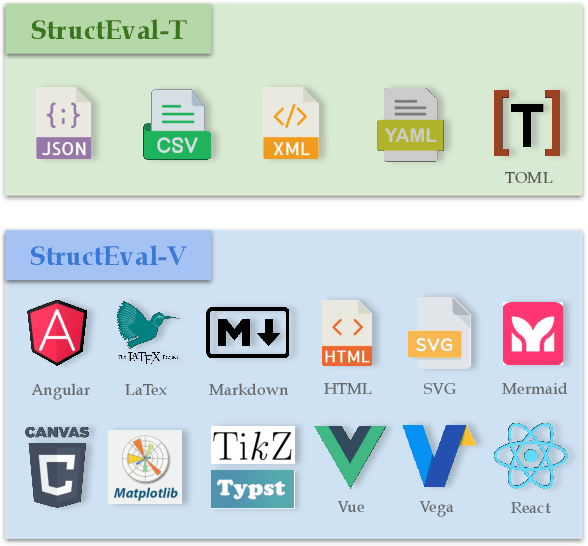
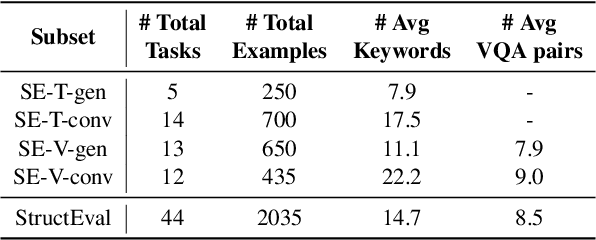
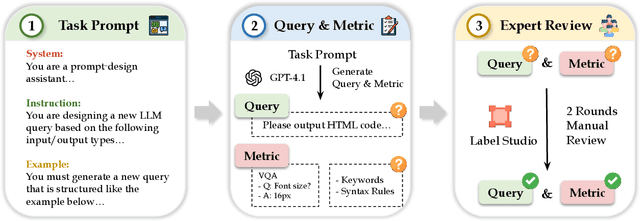
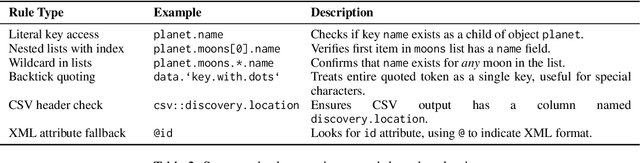
As Large Language Models (LLMs) become integral to software development workflows, their ability to generate structured outputs has become critically important. We introduce StructEval, a comprehensive benchmark for evaluating LLMs' capabilities in producing both non-renderable (JSON, YAML, CSV) and renderable (HTML, React, SVG) structured formats. Unlike prior benchmarks, StructEval systematically evaluates structural fidelity across diverse formats through two paradigms: 1) generation tasks, producing structured output from natural language prompts, and 2) conversion tasks, translating between structured formats. Our benchmark encompasses 18 formats and 44 types of task, with novel metrics for format adherence and structural correctness. Results reveal significant performance gaps, even state-of-the-art models like o1-mini achieve only 75.58 average score, with open-source alternatives lagging approximately 10 points behind. We find generation tasks more challenging than conversion tasks, and producing correct visual content more difficult than generating text-only structures.
RTGen: Real-Time Generative Detection Transformer
Feb 28, 2025While open-vocabulary object detectors require predefined categories during inference, generative object detectors overcome this limitation by endowing the model with text generation capabilities. However, existing generative object detection methods directly append an autoregressive language model to an object detector to generate texts for each detected object. This straightforward design leads to structural redundancy and increased processing time. In this paper, we propose a Real-Time GENerative Detection Transformer (RTGen), a real-time generative object detector with a succinct encoder-decoder architecture. Specifically, we introduce a novel Region-Language Decoder (RL-Decoder), which innovatively integrates a non-autoregressive language model into the detection decoder, enabling concurrent processing of object and text information. With these efficient designs, RTGen achieves a remarkable inference speed of 60.41 FPS. Moreover, RTGen obtains 18.6 mAP on the LVIS dataset, outperforming the previous SOTA method by 3.5 mAP.