 Add to Chrome
 Add to Firefox
 Add to Edge
ImagenWorld: Stress-Testing Image Generation Models with Explainable Human Evaluation on Open-ended Real-World Tasks
Mar 29, 2026
Advances in diffusion, autoregressive, and hybrid models have enabled high-quality image synthesis for tasks such as text-to-image, editing, and reference-guided composition. Yet, existing benchmarks remain limited, either focus on isolated tasks, cover only narrow domains, or provide opaque scores without explaining failure modes. We introduce \textbf{ImagenWorld}, a benchmark of 3.6K condition sets spanning six core tasks (generation and editing, with single or multiple references) and six topical domains (artworks, photorealistic images, information graphics, textual graphics, computer graphics, and screenshots). The benchmark is supported by 20K fine-grained human annotations and an explainable evaluation schema that tags localized object-level and segment-level errors, complementing automated VLM-based metrics. Our large-scale evaluation of 14 models yields several insights: (1) models typically struggle more in editing tasks than in generation tasks, especially in local edits. (2) models excel in artistic and photorealistic settings but struggle with symbolic and text-heavy domains such as screenshots and information graphics. (3) closed-source systems lead overall, while targeted data curation (e.g., Qwen-Image) narrows the gap in text-heavy cases. (4) modern VLM-based metrics achieve Kendall accuracies up to 0.79, approximating human ranking, but fall short of fine-grained, explainable error attribution. ImagenWorld provides both a rigorous benchmark and a diagnostic tool to advance robust image generation.

TheoremExplainAgent: Towards Multimodal Explanations for LLM Theorem Understanding
Feb 26, 2025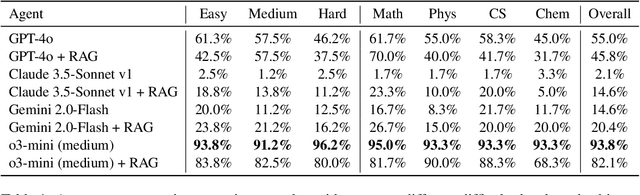
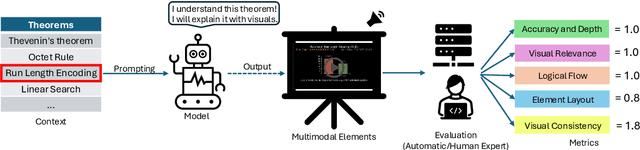
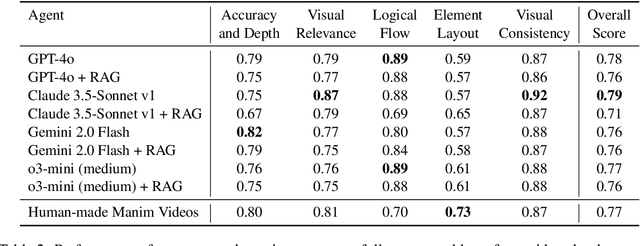

Understanding domain-specific theorems often requires more than just text-based reasoning; effective communication through structured visual explanations is crucial for deeper comprehension. While large language models (LLMs) demonstrate strong performance in text-based theorem reasoning, their ability to generate coherent and pedagogically meaningful visual explanations remains an open challenge. In this work, we introduce TheoremExplainAgent, an agentic approach for generating long-form theorem explanation videos (over 5 minutes) using Manim animations. To systematically evaluate multimodal theorem explanations, we propose TheoremExplainBench, a benchmark covering 240 theorems across multiple STEM disciplines, along with 5 automated evaluation metrics. Our results reveal that agentic planning is essential for generating detailed long-form videos, and the o3-mini agent achieves a success rate of 93.8% and an overall score of 0.77. However, our quantitative and qualitative studies show that most of the videos produced exhibit minor issues with visual element layout. Furthermore, multimodal explanations expose deeper reasoning flaws that text-based explanations fail to reveal, highlighting the importance of multimodal explanations.