 Add to Chrome
 Add to Firefox
 Add to Edge
Efficient Bilevel Optimization with KFAC-Based Hypergradients
Mar 31, 2026
Bilevel optimization (BO) is widely applicable to many machine learning problems. Scaling BO, however, requires repeatedly computing hypergradients, which involves solving inverse Hessian-vector products (IHVPs). In practice, these operations are often approximated using crude surrogates such as one-step gradient unrolling or identity/short Neumann expansions, which discard curvature information. We build on implicit function theorem-based algorithms and propose to incorporate Kronecker-factored approximate curvature (KFAC), yielding curvature-aware hypergradients with a better performance efficiency trade-off than Conjugate Gradient (CG) or Neumann methods and consistently outperforming unrolling. We evaluate this approach across diverse tasks, including meta-learning and AI safety problems. On models up to BERT, we show that curvature information is valuable at scale, and KFAC can provide it with only modest memory and runtime overhead. Our implementation is available at https://github.com/liaodisen/NeuralBo.

StructEval: Benchmarking LLMs' Capabilities to Generate Structural Outputs
May 26, 2025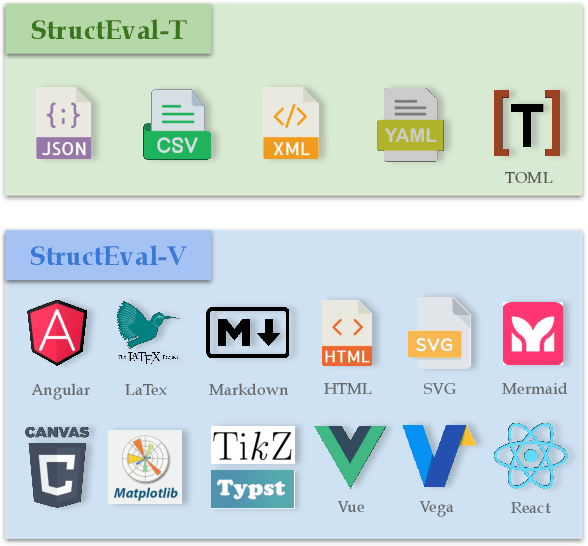
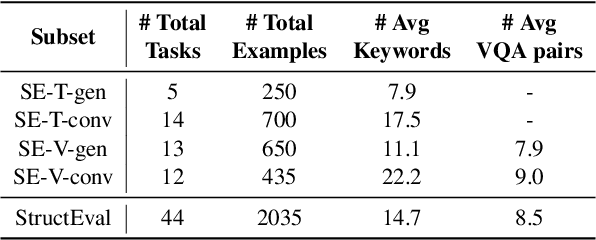
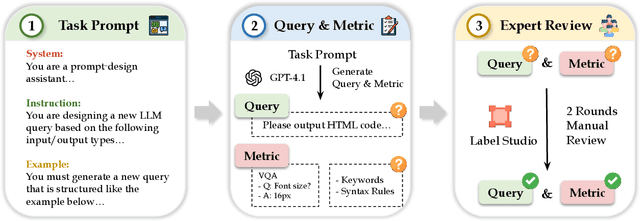
As Large Language Models (LLMs) become integral to software development workflows, their ability to generate structured outputs has become critically important. We introduce StructEval, a comprehensive benchmark for evaluating LLMs' capabilities in producing both non-renderable (JSON, YAML, CSV) and renderable (HTML, React, SVG) structured formats. Unlike prior benchmarks, StructEval systematically evaluates structural fidelity across diverse formats through two paradigms: 1) generation tasks, producing structured output from natural language prompts, and 2) conversion tasks, translating between structured formats. Our benchmark encompasses 18 formats and 44 types of task, with novel metrics for format adherence and structural correctness. Results reveal significant performance gaps, even state-of-the-art models like o1-mini achieve only 75.58 average score, with open-source alternatives lagging approximately 10 points behind. We find generation tasks more challenging than conversion tasks, and producing correct visual content more difficult than generating text-only structures.