 Add to Chrome
 Add to Firefox
 Add to Edge
SinD 2.0: A Multi-City UAV Dataset with Semantic Risk Annotations for SOTIF-Oriented Safety Validation at Signalized Intersections
Jul 18, 2026
Safety validation at signalized intersections remains a critical bottleneck for the deployment of autonomous driving systems (ADS), as these scenarios involve dense heterogeneous traffic, contested right of way, and long-tail safety-critical interactions, posing significant challenges to the Safety of the Intended Functionality (SOTIF). Existing naturalistic driving datasets often suffer from geographical homogeneity, sparsity of safety-critical events, and lack of semantic risk annotations, which limit the evaluation of algorithmic generalizability and targeted SOTIF verification. To address these gaps, this paper introduces SinD 2.0, a large-scale drone-based intersection dataset dedicated to cross-domain ADS safety analysis. The main contributions of SinD 2.0 are: (1) Cross-domain diversity: It covers six signalized intersections across four Chinese cities, capturing distinct intersection topologies and regional driving behavior characteristics; (2) High-density risk interactions: A total of 32,682 safety-critical events are extracted via surrogate safety measures, significantly enriching the density of boundary test scenarios; (3) Hierarchical semantic annotations: Besides integration with high-definition (HD) maps and Signal Phase and Timing (SPaT) data, it provides multi-dimensional semantic labels including traffic violations, high-risk interactions, visual shielding, and narrow feasible areas; (4) Full-stack testing toolchain: It supports automated scenario extraction, prediction-only evaluation, open-loop replay, reactive closed-loop testing, and photorealistic rendering. Benchmark experiments demonstrate that SinD 2.0 exhibits significant domain shifts across cities, and the semantic risk subsets can effectively expose the performance limitations of ADS algorithms. The dataset, annotations, and testing toolchain are available at https://github.com/SOTIF-AVLab/SinD/tree/main.

Legal Decision-making for Highway Automated Driving
Jul 10, 2023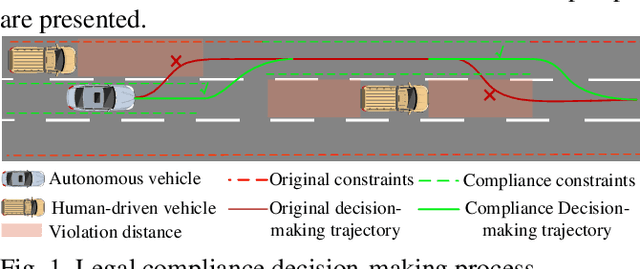
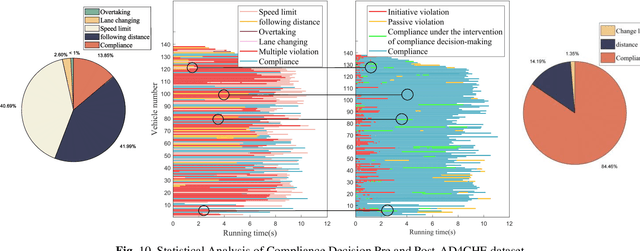
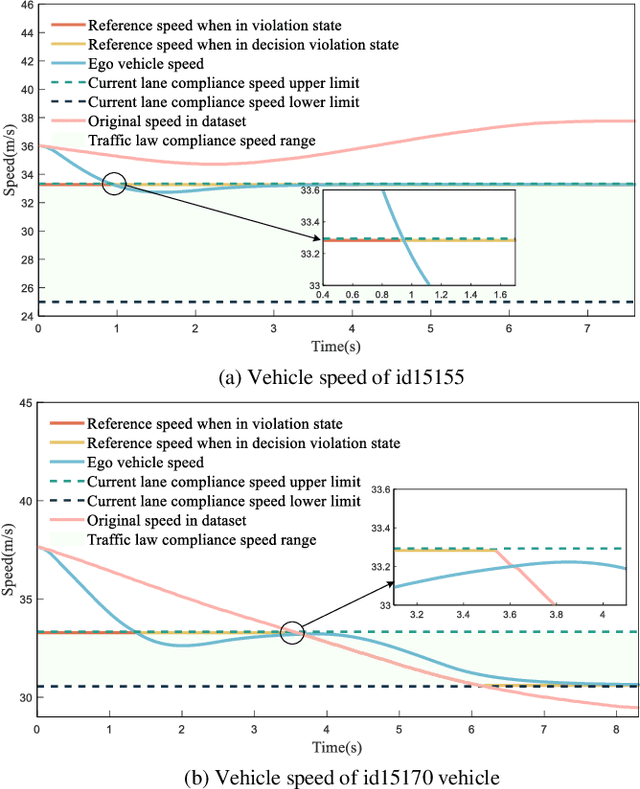
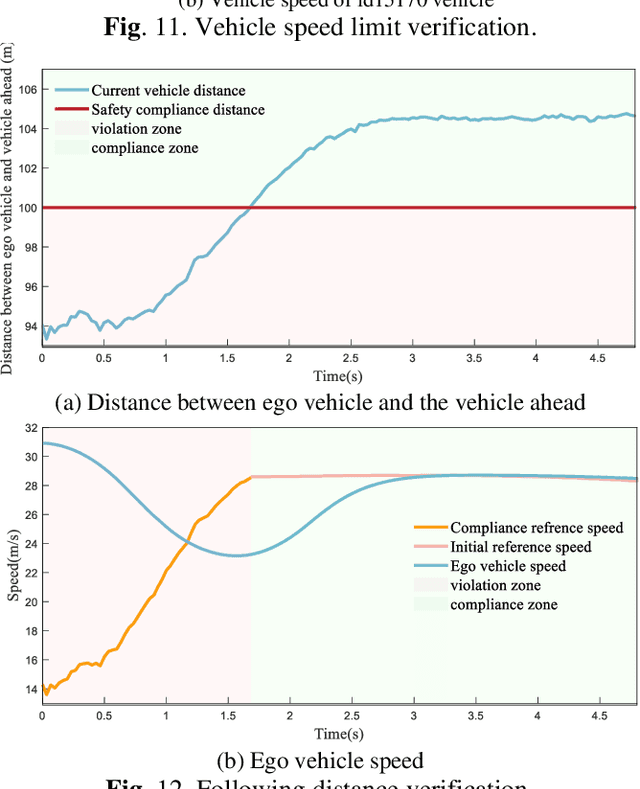
Compliance with traffic laws is a fundamental requirement for human drivers on the road, and autonomous vehicles must adhere to traffic laws as well. However, current autonomous vehicles prioritize safety and collision avoidance primarily in their decision-making and planning, which will lead to misunderstandings and distrust from human drivers and may even result in accidents in mixed traffic flow. Therefore, ensuring the compliance of the autonomous driving decision-making system is essential for ensuring the safety of autonomous driving and promoting the widespread adoption of autonomous driving technology. To this end, the paper proposes a trigger-based layered compliance decision-making framework. This framework utilizes the decision intent at the highest level as a signal to activate an online violation monitor that identifies the type of violation committed by the vehicle. Then, a four-layer architecture for compliance decision-making is employed to generate compliantly trajectories. Using this system, autonomous vehicles can detect and correct potential violations in real-time, thereby enhancing safety and building public confidence in autonomous driving technology. Finally, the proposed method is evaluated on the DJI AD4CHE highway dataset under four typical highway scenarios: speed limit, following distance, overtaking, and lane-changing. The results indicate that the proposed method increases the vehicle's overall compliance rate from 13.85% to 84.46%, while reducing the proportion of active violations to 0%, demonstrating its effectiveness.
Road Traffic Law Adaptive Decision-making for Self-Driving Vehicles
Apr 26, 2022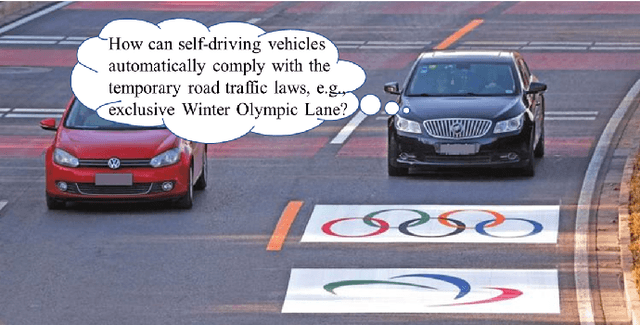
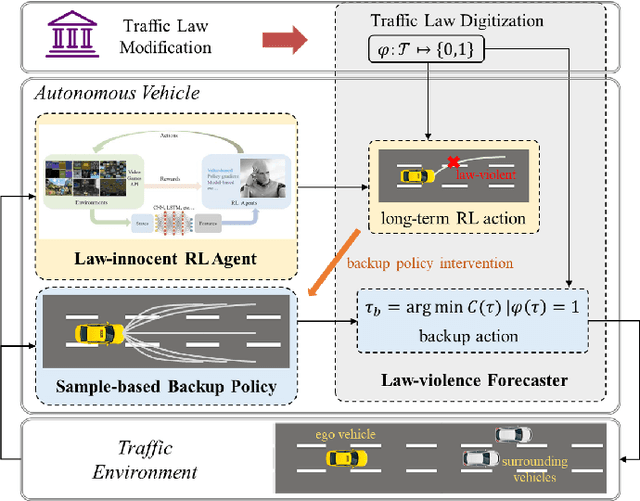
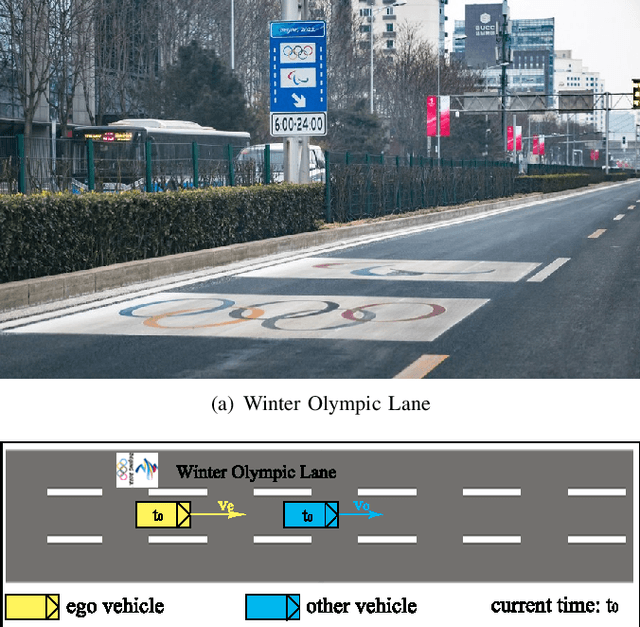
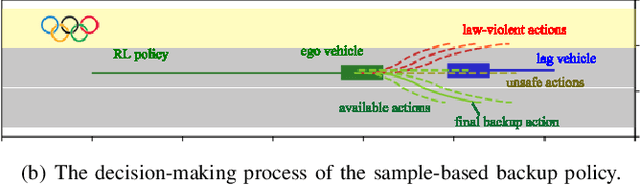
Self-driving vehicles have their own intelligence to drive on open roads. However, vehicle managers, e.g., government or industrial companies, still need a way to tell these self-driving vehicles what behaviors are encouraged or forbidden. Unlike human drivers, current self-driving vehicles cannot understand the traffic laws, thus rely on the programmers manually writing the corresponding principles into the driving systems. It would be less efficient and hard to adapt some temporary traffic laws, especially when the vehicles use data-driven decision-making algorithms. Besides, current self-driving vehicle systems rarely take traffic law modification into consideration. This work aims to design a road traffic law adaptive decision-making method. The decision-making algorithm is designed based on reinforcement learning, in which the traffic rules are usually implicitly coded in deep neural networks. The main idea is to supply the adaptability to traffic laws of self-driving vehicles by a law-adaptive backup policy. In this work, the natural language-based traffic laws are first translated into a logical expression by the Linear Temporal Logic method. Then, the system will try to monitor in advance whether the self-driving vehicle may break the traffic laws by designing a long-term RL action space. Finally, a sample-based planning method will re-plan the trajectory when the vehicle may break the traffic rules. The method is validated in a Beijing Winter Olympic Lane scenario and an overtaking case, built in CARLA simulator. The results show that by adopting this method, the self-driving vehicles can comply with new issued or updated traffic laws effectively. This method helps self-driving vehicles governed by digital traffic laws, which is necessary for the wide adoption of autonomous driving.