 Add to Chrome
 Add to Firefox
 Add to Edge
OmniReasoner: Thinking with Long Audio-Video via Native Tool Use
Jul 21, 2026
Long audio-video reasoning is difficult for omnimodal LLMs because the decisive evidence is often sparse, cross-modal, and too expensive to preserve with uniformly high-fidelity inputs. We introduce OmniReasoner, a tool-use post-training framework for Thinking with Long Audio-Video: omni-modal LLMs learn, via supervised fine-tuning and reinforcement learning, to decide whether and where to call a zoom-in tool before answering. OmniReasoner first builds a low-cost global preview of the full stream and then, when needed, calls the zoom-in tool with a requested temporal interval for higher-fidelity visual and audio inspection before answering. Because the model observes different sampling granularities before and after this call -- a sparse global preview and a denser local clip -- we introduce TimeAnchor, which keeps the tool's temporal argument valid and round-trip-consistent across these granularities, rather than tied to frame indices from a particular sampling rate. To make this tool-use behavior trainable without expensive manual interval annotation, we build a Temporal Augmented Data Engine that synthesizes tool-use post-training trajectories by video editing and composition. Experiments across omnimodal and video benchmarks show that OmniReasoner improves both answer accuracy and temporal grounding while concentrating high-fidelity computation on informative regions. Code is available at https://github.com/RockyChen0205/OmniReasoner.

JD Oxygen AI Item Center (Oxygen AIIC) V1: An Industrial-Scale LLM/VLM-Centric Solution for Item Understanding, Management, and Applications
Jun 29, 2026JD$.$com, one of the world's largest e-commerce platforms, serves over 700 million active users and millions of merchants, with a catalog of tens of billions of SKUs. At this scale, high-quality, structured item knowledge underpins a better consumer experience, lower management costs, and higher operational efficiency-yet producing and serving it poses three industrial-scale challenges: fast-emerging concepts, high-quality knowledge production for massive SKUs, and diverse downstream requirements. To address these challenges, we present the JD Oxygen AI Item Center (Oxygen AIIC), an industrial-scale platform built on LLMs/VLMs for item-knowledge production and service. Oxygen AIIC is built around four core pillars: (i) ontology engineering driven by efficient human-AI collaboration, which supports the dynamic evolution and agile expansion of an ontology with millions of entries; (ii) a "Semantic Search then Discrimination"(S2D) knowledge identification architecture that, combined with throughput improvement strategies, enables scalable, extensible, and high-throughput AI Item Library production for tens of billions of SKUs; (iii) self-evolving item-understanding LLMs/VLMs that improve in a stable and controllable manner, enabling knowledge production with 94.2% precision and 82.8% recall; and (iv) a unified item tunnel that serves as the data and service hub. Oxygen AIIC now covers tens of thousands of JD categories and processes hundreds of millions of item updates per day on Huawei Ascend NPUs. It has accumulated hundreds of billions of item-knowledge assets. Deployed across core business scenarios-including search, recommendation, operations, category planning-Oxygen AIIC has delivered measurable gains at scale. Search-traffic coverage reaches 80.4%, item-information quality issues drop by 37%, the automated fill rate of core attributes during item listing exceeds 80%.
Rashomon Sets for Prototypical-Part Networks: Editing Interpretable Models in Real-Time
Mar 03, 2025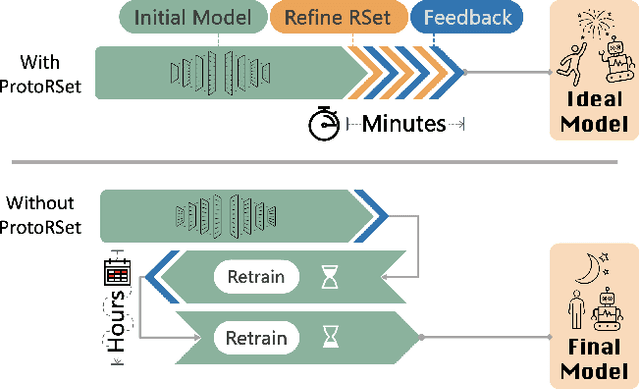
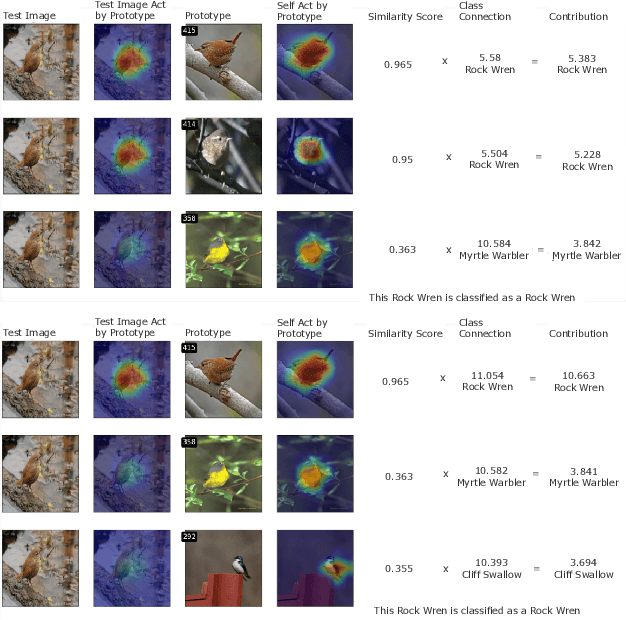
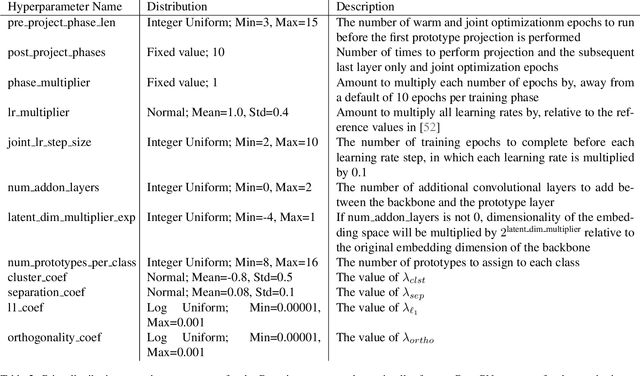
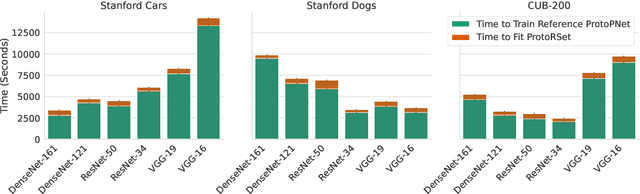
Interpretability is critical for machine learning models in high-stakes settings because it allows users to verify the model's reasoning. In computer vision, prototypical part models (ProtoPNets) have become the dominant model type to meet this need. Users can easily identify flaws in ProtoPNets, but fixing problems in a ProtoPNet requires slow, difficult retraining that is not guaranteed to resolve the issue. This problem is called the "interaction bottleneck." We solve the interaction bottleneck for ProtoPNets by simultaneously finding many equally good ProtoPNets (i.e., a draw from a "Rashomon set"). We show that our framework - called Proto-RSet - quickly produces many accurate, diverse ProtoPNets, allowing users to correct problems in real time while maintaining performance guarantees with respect to the training set. We demonstrate the utility of this method in two settings: 1) removing synthetic bias introduced to a bird identification model and 2) debugging a skin cancer identification model. This tool empowers non-machine-learning experts, such as clinicians or domain experts, to quickly refine and correct machine learning models without repeated retraining by machine learning experts.
FPN-IAIA-BL: A Multi-Scale Interpretable Deep Learning Model for Classification of Mass Margins in Digital Mammography
Jun 10, 2024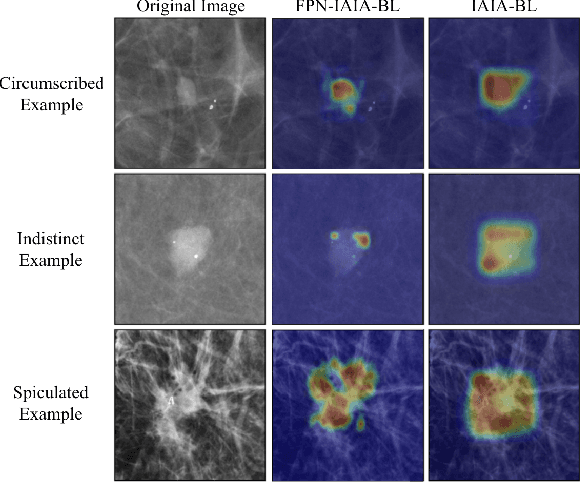

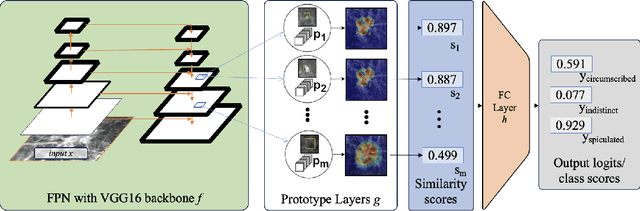

Digital mammography is essential to breast cancer detection, and deep learning offers promising tools for faster and more accurate mammogram analysis. In radiology and other high-stakes environments, uninterpretable ("black box") deep learning models are unsuitable and there is a call in these fields to make interpretable models. Recent work in interpretable computer vision provides transparency to these formerly black boxes by utilizing prototypes for case-based explanations, achieving high accuracy in applications including mammography. However, these models struggle with precise feature localization, reasoning on large portions of an image when only a small part is relevant. This paper addresses this gap by proposing a novel multi-scale interpretable deep learning model for mammographic mass margin classification. Our contribution not only offers an interpretable model with reasoning aligned with radiologist practices, but also provides a general architecture for computer vision with user-configurable prototypes from coarse- to fine-grained prototypes.
This Looks Like Those: Illuminating Prototypical Concepts Using Multiple Visualizations
Oct 28, 2023We present ProtoConcepts, a method for interpretable image classification combining deep learning and case-based reasoning using prototypical parts. Existing work in prototype-based image classification uses a ``this looks like that'' reasoning process, which dissects a test image by finding prototypical parts and combining evidence from these prototypes to make a final classification. However, all of the existing prototypical part-based image classifiers provide only one-to-one comparisons, where a single training image patch serves as a prototype to compare with a part of our test image. With these single-image comparisons, it can often be difficult to identify the underlying concept being compared (e.g., ``is it comparing the color or the shape?''). Our proposed method modifies the architecture of prototype-based networks to instead learn prototypical concepts which are visualized using multiple image patches. Having multiple visualizations of the same prototype allows us to more easily identify the concept captured by that prototype (e.g., ``the test image and the related training patches are all the same shade of blue''), and allows our model to create richer, more interpretable visual explanations. Our experiments show that our ``this looks like those'' reasoning process can be applied as a modification to a wide range of existing prototypical image classification networks while achieving comparable accuracy on benchmark datasets.
Deformable ProtoPNet: An Interpretable Image Classifier Using Deformable Prototypes
Nov 29, 2021

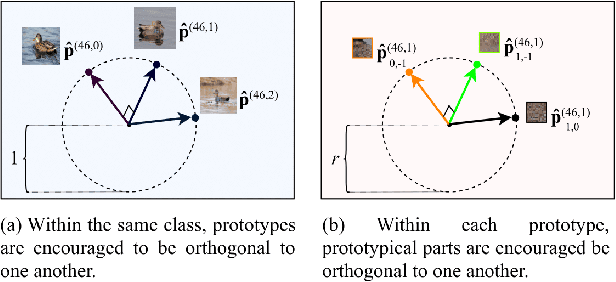
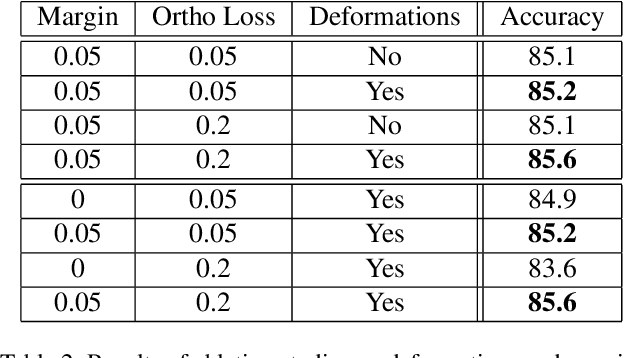
Machine learning has been widely adopted in many domains, including high-stakes applications such as healthcare, finance, and criminal justice. To address concerns of fairness, accountability and transparency, predictions made by machine learning models in these critical domains must be interpretable. One line of work approaches this challenge by integrating the power of deep neural networks and the interpretability of case-based reasoning to produce accurate yet interpretable image classification models. These models generally classify input images by comparing them with prototypes learned during training, yielding explanations in the form of "this looks like that." However, methods from this line of work use spatially rigid prototypes, which cannot explicitly account for pose variations. In this paper, we address this shortcoming by proposing a case-based interpretable neural network that provides spatially flexible prototypes, called a deformable prototypical part network (Deformable ProtoPNet). In a Deformable ProtoPNet, each prototype is made up of several prototypical parts that adaptively change their relative spatial positions depending on the input image. This enables each prototype to detect object features with a higher tolerance to spatial transformations, as the parts within a prototype are allowed to move. Consequently, a Deformable ProtoPNet can explicitly capture pose variations, improving both model accuracy and the richness of explanations provided. Compared to other case-based interpretable models using prototypes, our approach achieves competitive accuracy, gives an explanation with greater context, and is easier to train, thus enabling wider use of interpretable models for computer vision.
Interpretable Mammographic Image Classification using Cased-Based Reasoning and Deep Learning
Jul 12, 2021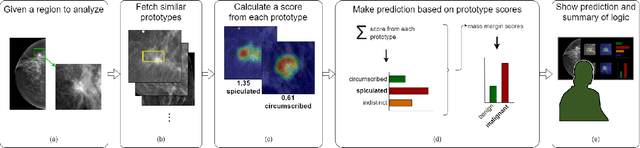
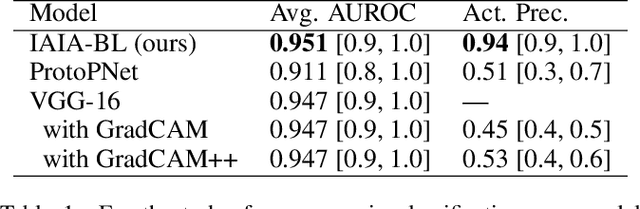
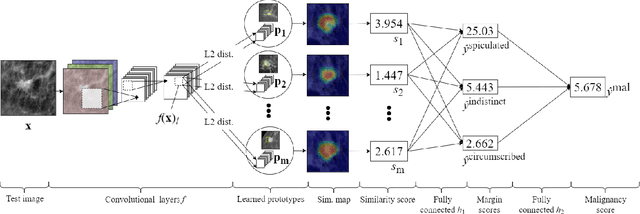
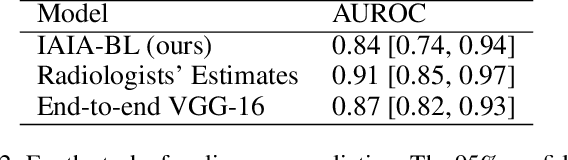
When we deploy machine learning models in high-stakes medical settings, we must ensure these models make accurate predictions that are consistent with known medical science. Inherently interpretable networks address this need by explaining the rationale behind each decision while maintaining equal or higher accuracy compared to black-box models. In this work, we present a novel interpretable neural network algorithm that uses case-based reasoning for mammography. Designed to aid a radiologist in their decisions, our network presents both a prediction of malignancy and an explanation of that prediction using known medical features. In order to yield helpful explanations, the network is designed to mimic the reasoning processes of a radiologist: our network first detects the clinically relevant semantic features of each image by comparing each new image with a learned set of prototypical image parts from the training images, then uses those clinical features to predict malignancy. Compared to other methods, our model detects clinical features (mass margins) with equal or higher accuracy, provides a more detailed explanation of its prediction, and is better able to differentiate the classification-relevant parts of the image.
ECKPN: Explicit Class Knowledge Propagation Network for Transductive Few-shot Learning
Jun 16, 2021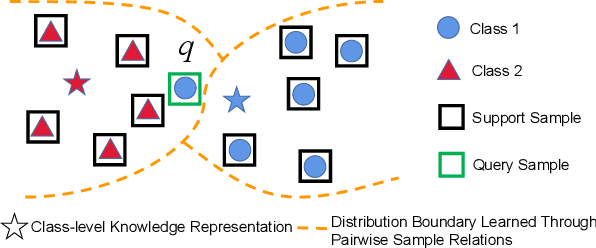
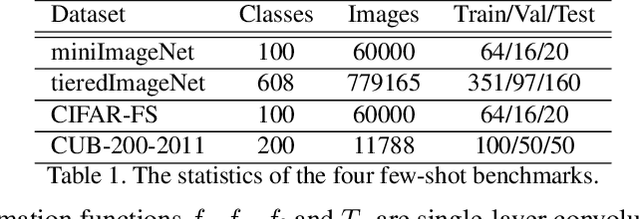
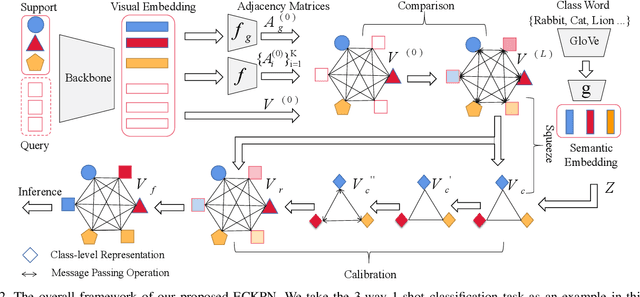
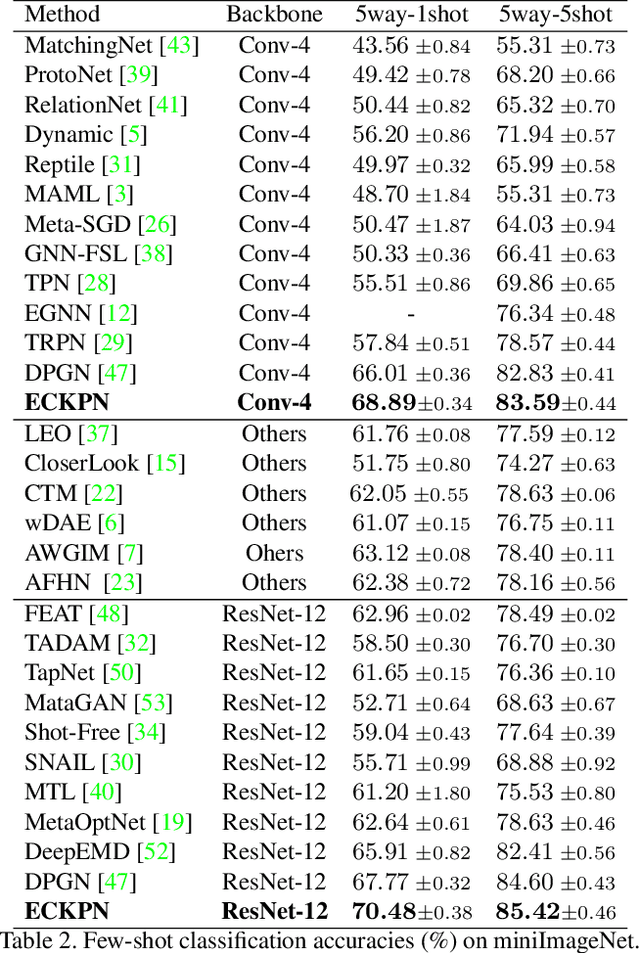
Recently, the transductive graph-based methods have achieved great success in the few-shot classification task. However, most existing methods ignore exploring the class-level knowledge that can be easily learned by humans from just a handful of samples. In this paper, we propose an Explicit Class Knowledge Propagation Network (ECKPN), which is composed of the comparison, squeeze and calibration modules, to address this problem. Specifically, we first employ the comparison module to explore the pairwise sample relations to learn rich sample representations in the instance-level graph. Then, we squeeze the instance-level graph to generate the class-level graph, which can help obtain the class-level visual knowledge and facilitate modeling the relations of different classes. Next, the calibration module is adopted to characterize the relations of the classes explicitly to obtain the more discriminative class-level knowledge representations. Finally, we combine the class-level knowledge with the instance-level sample representations to guide the inference of the query samples. We conduct extensive experiments on four few-shot classification benchmarks, and the experimental results show that the proposed ECKPN significantly outperforms the state-of-the-art methods.
A Holistic Approach to Interpretability in Financial Lending: Models, Visualizations, and Summary-Explanations
Jun 04, 2021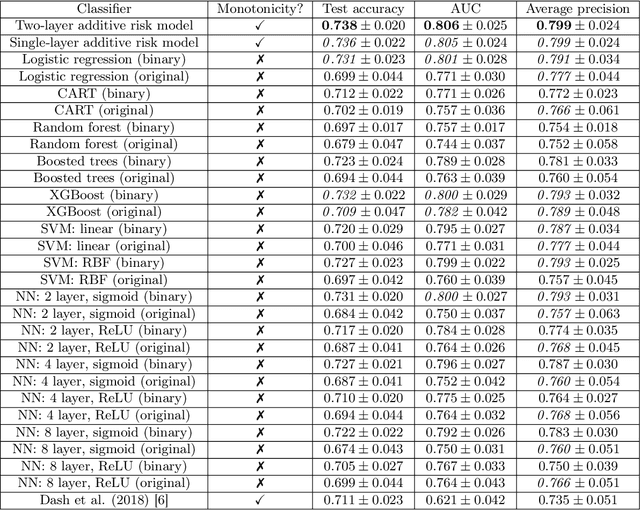
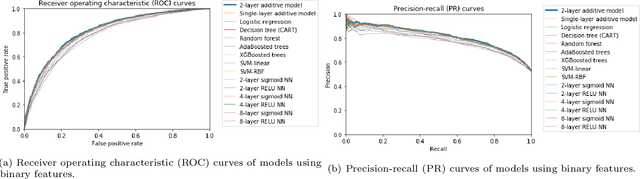
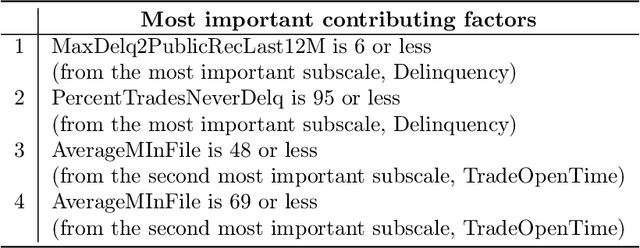
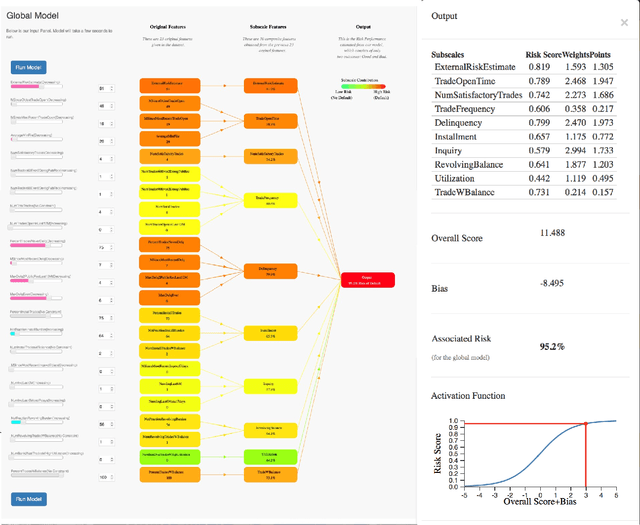
Lending decisions are usually made with proprietary models that provide minimally acceptable explanations to users. In a future world without such secrecy, what decision support tools would one want to use for justified lending decisions? This question is timely, since the economy has dramatically shifted due to a pandemic, and a massive number of new loans will be necessary in the short term. We propose a framework for such decisions, including a globally interpretable machine learning model, an interactive visualization of it, and several types of summaries and explanations for any given decision. The machine learning model is a two-layer additive risk model, which resembles a two-layer neural network, but is decomposable into subscales. In this model, each node in the first (hidden) layer represents a meaningful subscale model, and all of the nonlinearities are transparent. Our online visualization tool allows exploration of this model, showing precisely how it came to its conclusion. We provide three types of explanations that are simpler than, but consistent with, the global model: case-based reasoning explanations that use neighboring past cases, a set of features that were the most important for the model's prediction, and summary-explanations that provide a customized sparse explanation for any particular lending decision made by the model. Our framework earned the FICO recognition award for the Explainable Machine Learning Challenge, which was the first public challenge in the domain of explainable machine learning.
IAIA-BL: A Case-based Interpretable Deep Learning Model for Classification of Mass Lesions in Digital Mammography
Mar 23, 2021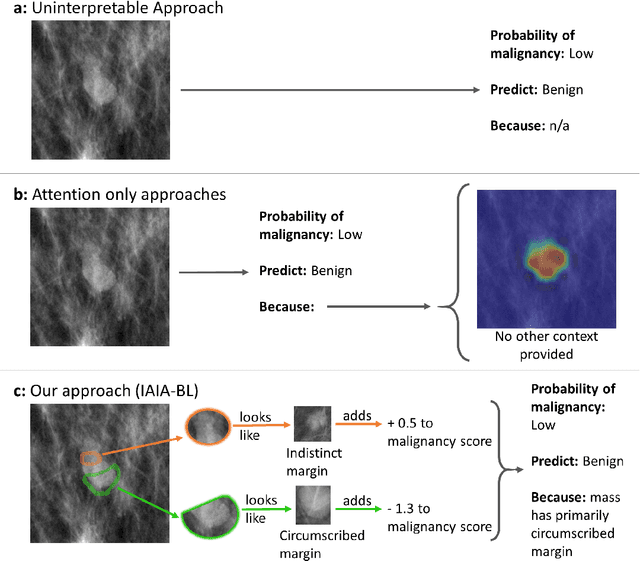
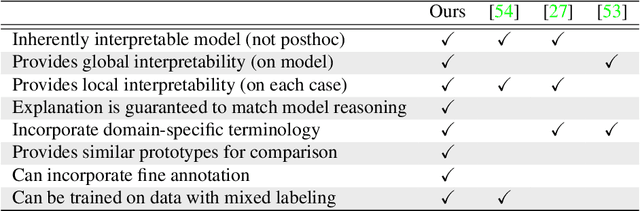
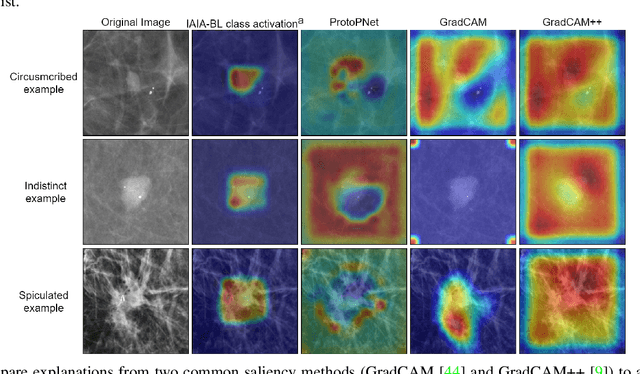
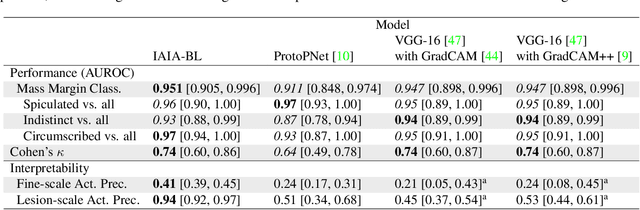
Interpretability in machine learning models is important in high-stakes decisions, such as whether to order a biopsy based on a mammographic exam. Mammography poses important challenges that are not present in other computer vision tasks: datasets are small, confounding information is present, and it can be difficult even for a radiologist to decide between watchful waiting and biopsy based on a mammogram alone. In this work, we present a framework for interpretable machine learning-based mammography. In addition to predicting whether a lesion is malignant or benign, our work aims to follow the reasoning processes of radiologists in detecting clinically relevant semantic features of each image, such as the characteristics of the mass margins. The framework includes a novel interpretable neural network algorithm that uses case-based reasoning for mammography. Our algorithm can incorporate a combination of data with whole image labelling and data with pixel-wise annotations, leading to better accuracy and interpretability even with a small number of images. Our interpretable models are able to highlight the classification-relevant parts of the image, whereas other methods highlight healthy tissue and confounding information. Our models are decision aids, rather than decision makers, aimed at better overall human-machine collaboration. We do not observe a loss in mass margin classification accuracy over a black box neural network trained on the same data.