 Add to Chrome
 Add to Firefox
 Add to Edge
RepBench: Compiling Benchmarks into Capability Representations for Large Language Models
Jul 30, 2026
Representation engineering reads and steers capability directions in large language models, yet methods are typically evaluated on paper-specific synthetic data. The resulting measurements are difficult to compare or reproduce and may reflect surface patterns rather than capabilities. We present RepBench, a benchmark-grounded data layer for capability-aligned representation probing. Crawling 13,427 benchmark papers yields a taxonomy of 182 capability clusters in 13 families; harvesting 353 public benchmark datasets yields 46,149 audited probe texts covering 94 capabilities, each supported by at least two independent benchmarks. This multi-benchmark design reduces dependence on any single source: raw per-text vectors exhibit no natural cluster granularity, whereas benchmark-pooled capability vectors show an interior clustering optimum at a small number of clusters on all 12 evaluated models, with low agreement to the human taxonomy. Under cross-benchmark transfer evaluation across twelve models completed by all four readouts, difference-in-means attains the highest model-level mean on ten models, while logistic regression wins the most capability-model cells. This disagreement shows that the readout method and aggregation criterion are meaningful evaluation dimensions. The pipeline, corpus, and evaluation code are released as a reusable closed-loop workflow.

OmniReasoner: Thinking with Long Audio-Video via Native Tool Use
Jul 21, 2026Long audio-video reasoning is difficult for omnimodal LLMs because the decisive evidence is often sparse, cross-modal, and too expensive to preserve with uniformly high-fidelity inputs. We introduce OmniReasoner, a tool-use post-training framework for Thinking with Long Audio-Video: omni-modal LLMs learn, via supervised fine-tuning and reinforcement learning, to decide whether and where to call a zoom-in tool before answering. OmniReasoner first builds a low-cost global preview of the full stream and then, when needed, calls the zoom-in tool with a requested temporal interval for higher-fidelity visual and audio inspection before answering. Because the model observes different sampling granularities before and after this call -- a sparse global preview and a denser local clip -- we introduce TimeAnchor, which keeps the tool's temporal argument valid and round-trip-consistent across these granularities, rather than tied to frame indices from a particular sampling rate. To make this tool-use behavior trainable without expensive manual interval annotation, we build a Temporal Augmented Data Engine that synthesizes tool-use post-training trajectories by video editing and composition. Experiments across omnimodal and video benchmarks show that OmniReasoner improves both answer accuracy and temporal grounding while concentrating high-fidelity computation on informative regions. Code is available at https://github.com/RockyChen0205/OmniReasoner.
Each Prompt Matters: Scaling Reinforcement Learning Without Wasting Rollouts on Hundred-Billion-Scale MoE
Dec 08, 2025We present CompassMax-V3-Thinking, a hundred-billion-scale MoE reasoning model trained with a new RL framework built on one principle: each prompt must matter. Scaling RL to this size exposes critical inefficiencies-zero-variance prompts that waste rollouts, unstable importance sampling over long horizons, advantage inversion from standard reward models, and systemic bottlenecks in rollout processing. To overcome these challenges, we introduce several unified innovations: (1) Multi-Stage Zero-Variance Elimination, which filters out non-informative prompts and stabilizes group-based policy optimization (e.g. GRPO) by removing wasted rollouts; (2) ESPO, an entropy-adaptive optimization method that balances token-level and sequence-level importance sampling to maintain stable learning dynamics; (3) a Router Replay strategy that aligns training-time MoE router decisions with inference-time behavior to mitigate train-infer discrepancies, coupled with a reward model adjustment to prevent advantage inversion; (4) a high-throughput RL system with FP8-precision rollouts, overlapped reward computation, and length-aware scheduling to eliminate performance bottlenecks. Together, these contributions form a cohesive pipeline that makes RL on hundred-billion-scale MoE models stable and efficient. The resulting model delivers strong performance across both internal and public evaluations.
Towards Reliable Evaluation of Large Language Models for Multilingual and Multimodal E-Commerce Applications
Oct 23, 2025Large Language Models (LLMs) excel on general-purpose NLP benchmarks, yet their capabilities in specialized domains remain underexplored. In e-commerce, existing evaluations-such as EcomInstruct, ChineseEcomQA, eCeLLM, and Shopping MMLU-suffer from limited task diversity (e.g., lacking product guidance and after-sales issues), limited task modalities (e.g., absence of multimodal data), synthetic or curated data, and a narrow focus on English and Chinese, leaving practitioners without reliable tools to assess models on complex, real-world shopping scenarios. We introduce EcomEval, a comprehensive multilingual and multimodal benchmark for evaluating LLMs in e-commerce. EcomEval covers six categories and 37 tasks (including 8 multimodal tasks), sourced primarily from authentic customer queries and transaction logs, reflecting the noisy and heterogeneous nature of real business interactions. To ensure both quality and scalability of reference answers, we adopt a semi-automatic pipeline in which large models draft candidate responses subsequently reviewed and modified by over 50 expert annotators with strong e-commerce and multilingual expertise. We define difficulty levels for each question and task category by averaging evaluation scores across models with different sizes and capabilities, enabling challenge-oriented and fine-grained assessment. EcomEval also spans seven languages-including five low-resource Southeast Asian languages-offering a multilingual perspective absent from prior work.
Compass-Thinker-7B Technical Report
Aug 12, 2025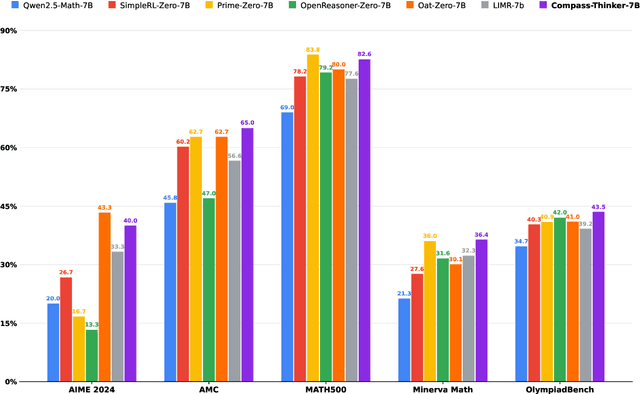
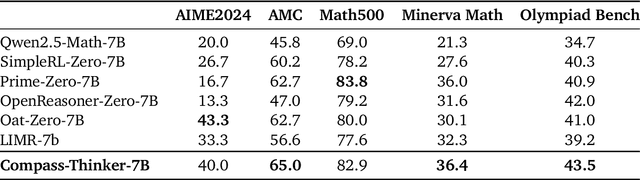
Recent R1-Zero-like research further demonstrates that reasoning extension has given large language models (LLMs) unprecedented reasoning capabilities, and Reinforcement Learning is the core technology to elicit its complex reasoning. However, conducting RL experiments directly on hyperscale models involves high computational costs and resource demands, posing significant risks. We propose the Compass-Thinker-7B model, which aims to explore the potential of Reinforcement Learning with less computational resources and costs, and provides insights for further research into RL recipes for larger models. Compass-Thinker-7B is trained from an open source model through a specially designed Reinforcement Learning Pipeline. we curate a dataset of 30k verifiable mathematics problems for the Reinforcement Learning Pipeline. By configuring data and training settings with different difficulty distributions for different stages, the potential of the model is gradually released and the training efficiency is improved. Extensive evaluations show that Compass-Thinker-7B possesses exceptional reasoning potential, and achieves superior performance on mathematics compared to the same-sized RL model.Especially in the challenging AIME2024 evaluation, Compass-Thinker-7B achieves 40% accuracy.