 Add to Chrome
 Add to Firefox
 Add to Edge
Degrees of Freedom and Beamforming for Large Intelligent Surfaces
Jun 18, 2026
Spatial degrees of freedom (DoF), sampling, and beamforming are fundamental to multi-user large intelligent surfaces (LISs), where electromagnetic fields must be shaped, resolved, and focused at multiple near-field locations. This work estimates the number of DoF using closed-form expressions derived from the mutual shadow area for representative LIS configurations. The resulting DoF predictions are validated through numerical singular-value spectra, whose spectral knee points closely match the theoretical estimates. For line-source configurations, an analytic sampling scheme is developed by partitioning the source or observation line into unit-DoF intervals, enabling the selection of spatial samples. Beamforming results using maximum-ratio transmission and zero-forcing demonstrate that approximately the number of DoF independent beams can be formed. Attempting to exceed this limit results in increased interference and degraded performance. For surface-based LIS configurations, sampling points are instead determined numerically using the discrete empirical interpolation method. The corresponding beamforming results further confirm that the target region can support approximately as many independent beams as predicted by the DoF analysis. Finally, a polarization-aware study reveals that the electric-field components contribute unequally to the DoF and that the total-field DoF is twice that of a single polarization component.

Spatial Degrees of Freedom and Channel Strength for Antenna Systems
Mar 30, 2026The number of spatial degrees of freedom (NDoF) and channel strength in antenna systems are examined within a geometric framework. Starting from a correlation-operator representation of the channel between transmitter and receiver regions, we analyze the associated eigenspectrum and relate the NDoF to its spectral transition (corner). We compare the spectrum-based effective NDoF and effective rank metrics, clarifying their behavior for both idealized and realistic eigenvalue distributions. In parallel, we develop geometry-based asymptotic estimates in terms of mutual shadow (view) measures and coupling strength. Specifically, we show that while the projected length or area predicts the number of usable modes in two- and three-dimensional settings, the coupling strength determines the average eigenvalue level. Canonical configurations of parallel lines and regions are used to derive closed-form asymptotic expressions for the effective NDoF, revealing significant deviations from the spectral corner in closely spaced configurations. The results illustrate that these are physically grounded. The proposed theory and techniques are computationally efficient and form a toolbox for estimating the modal richness in near-field channels, with implications for array design, inverse problems, and high-capacity communication systems.
Properties of Near Field Focusing for Three-Dimensional Large Intelligent Surface
Feb 13, 2026This work investigates near-field focusing using a three-dimensional (3D) large intelligent surface (LIS) across frequencies and polarizations. Specifically, the LIS elements are distributed in 3D space within a long corridor, rather than being confined to a single planar aperture, and the focal point is located at a prescribed position in the radiating near field. By formulating optimization problems under both local and global power constraints, we obtain the corresponding optima. For continuous apertures, the optimal current magnitude distribution matches time-reversal (TR) solution under the global constraint and conjugate-phase (CP) solution when the local constraint dominates. When both constraints are active, the solution assigns larger excitation magnitudes to elements closer to the illumination field. This behavior remains invariant with respect to frequency and polarization for a fixed-size LIS. These findings are consistent to the more practical case of using discretized apertures in the form of Hertzian dipole arrays, studied using both analytical results and full-wave simulation. In addition, with the CP method, specific polarizations lead to identical transverse and longitudinal resolution, in contrast, under the TR method, these quantities can differ across polarizations.
Physical Limits and Optimal Synthesis of Beyond Diagonal Anomalous Scatterers
May 01, 2025Realizing metasurfaces for anomalous scattering is fundamental to designing reflector arrays, reconfigurable intelligent surfaces, and metasurface antennas. However, the basic cost of steering scattering into non-specular directions is not fully understood. This paper derives tight physical bounds on anomalous scattering using antenna array systems equipped with non-local matching networks. The matching networks are explicitly synthesized based on the solutions of the optimization problems that define these bounds. Furthermore, we analyze fundamental limits for metasurface antennas implemented with metallic and dielectric materials exhibiting minimal loss within a finite design region. The results reveal a typical 6dB reduction in bistatic radar cross section (RCS) in anomalous directions compared to the forward direction. Numerical examples complement the theory and illustrate the inherent cost of achieving anomalous scattering relative to forward or specular scattering for canonical configurations.
Shadow Area and Degrees-of-Freedom for Free-Space Communication
Jul 30, 2024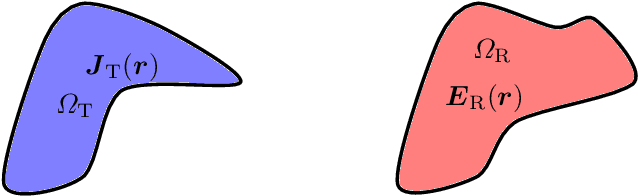
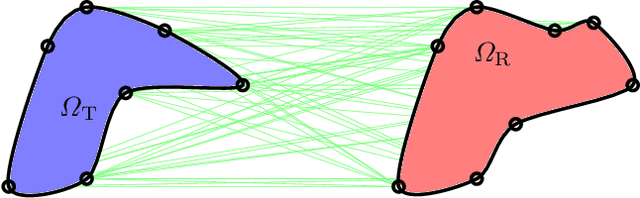
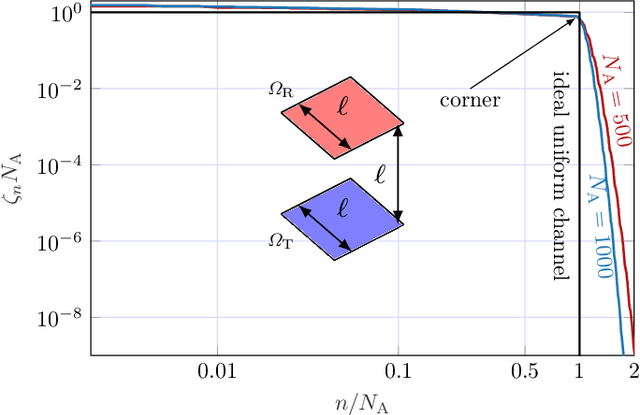
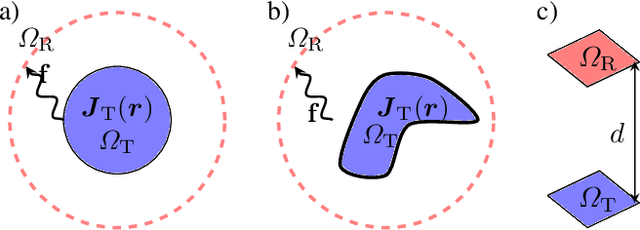
The number of degrees-of-freedom (NDoF) in a communication system is limited by the number of antenna ports, element shapes, positions, and the propagation environment. As the number of antenna elements increases within a given region, the NDoF eventually saturates due to correlation of the radiated fields. The maximal NDoF can be determined numerically for communication between two regions using singular value decomposition of a channel model representing wave propagation between densely sampled sources at the transmitter and fields at the receiver. This paper provides a straightforward analytical estimate of the NDoF for arbitrarily shaped transmitter and receiver regions. The analysis show that the NDoF for electrically large regions is approximated by the mutual shadow area of the regions, measured in wavelengths. Several setups illustrate the results, which are then compared with numerical evaluations of the singular values of the propagation channel. These new analytical expressions also simplify to previously established results based on Weyl's law and the paraxial approximation.
Degrees of Freedom for Radiating Systems
Apr 13, 2024Electromagnetic degrees of freedom are instrumental in antenna design, wireless communications, imaging, and scattering. Larger number of degrees of freedom enhances control in antenna design, influencing radiation patterns and directivity, while in communication systems, it links to spatial channels for increased data rates and reliability, and resolution in imaging. The correlation between computed degrees of freedom and physical quantities is not fully understood, prompting a comparison between classical estimates, Weyl's law, modal expansions, and optimization techniques. In this paper, it is shown that NDoF for arbitrary shaped radiating structures approaches the shadow area measured in squared wavelengths.