 Add to Chrome
 Add to Firefox
 Add to Edge
PDE foundation model-accelerated inverse estimation of system parameters in inertial confinement fusion
Mar 04, 2026
PDE foundation models are typically pretrained on large, diverse corpora of PDE datasets and can be adapted to new settings with limited task-specific data. However, most downstream evaluations focus on forward problems, such as autoregressive rollout prediction. In this work, we study an inverse problem in inertial confinement fusion (ICF): estimating system parameters (inputs) from multi-modal, snapshot-style observations (outputs). Using the open JAG benchmark, which provides hyperspectral X-ray images and scalar observables per simulation, we finetune the PDE foundation model and train a lightweight task-specific head to jointly reconstruct hyperspectral images and regress system parameters. The fine-tuned model achieves accurate hyperspectral reconstruction (test MSE 1.2e-3) and strong parameter-estimation performance (up to R^2=0.995). Data-scaling experiments (5%-100% of the training set) show consistent improvements in both reconstruction and regression losses as the amount of training data increases, with the largest marginal gains in the low-data regime. Finally, finetuning from pretrained MORPH weights outperforms training the same architecture from scratch, demonstrating that foundation-model initialization improves sample efficiency for data-limited inverse problems in ICF.

Out-of-distribution transfer of PDE foundation models to material dynamics under extreme loading
Mar 04, 2026Most PDE foundation models are pretrained and fine-tuned on fluid-centric benchmarks. Their utility under extreme-loading material dynamics remains unclear. We benchmark out-of-distribution transfer on two discontinuity-dominated regimes in which shocks, evolving interfaces, and fracture produce highly non-smooth fields: shock-driven multi-material interface dynamics (perturbed layered interface or PLI) and dynamic fracture/failure evolution (FRAC). We formulate the downstream task as terminal-state prediction, i.e., learning a long-horizon map that predicts the final state directly from the first snapshot without intermediate supervision. Using a unified training and evaluation protocol, we evaluate two open-source pretrained PDE foundation models, POSEIDON and MORPH, and compare fine-tuning from pretrained weights against training from scratch across training-set sizes to quantify sample efficiency under distribution shift.
Web-based Elicitation of Human Perception on mixup Data
Nov 02, 2022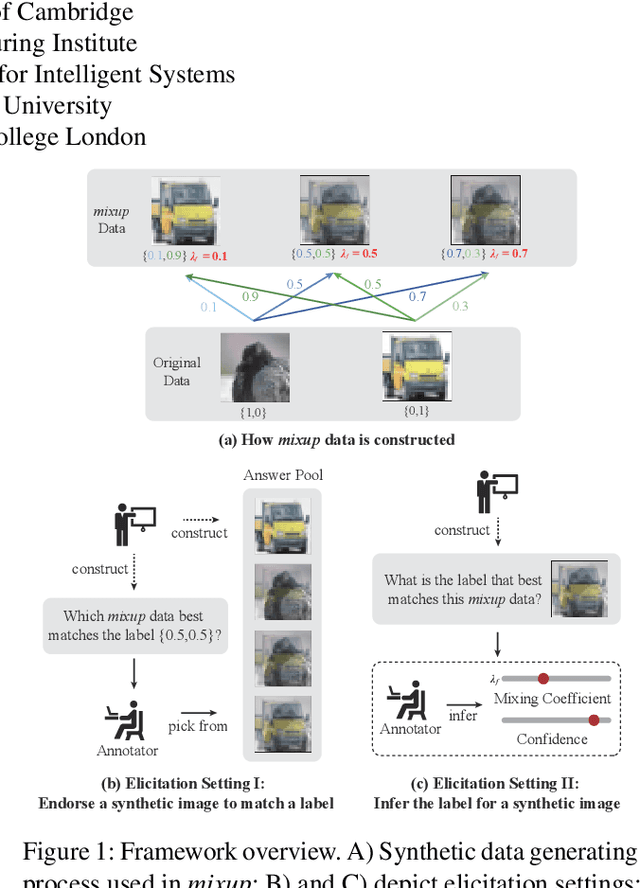
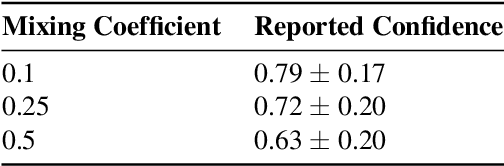
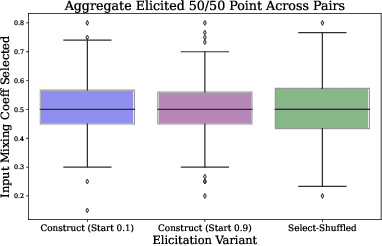
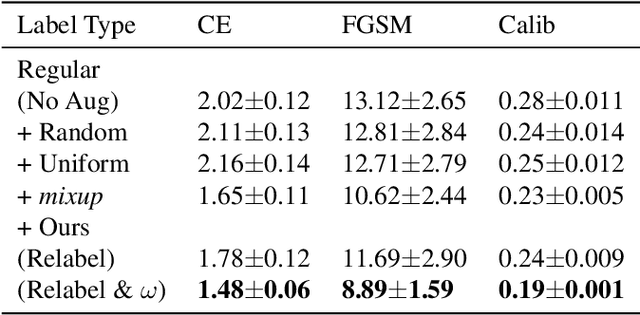
Synthetic data is proliferating on the web and powering many advances in machine learning. However, it is not always clear if synthetic labels are perceptually sensible to humans. The web provides us with a platform to take a step towards addressing this question through online elicitation. We design a series of elicitation interfaces, which we release as \texttt{HILL MixE Suite}, and recruit 159 participants, to provide perceptual judgments over the kinds of synthetic data constructed during \textit{mixup} training: a powerful regularizer shown to improve model robustness, generalization, and calibration. We find that human perception does not consistently align with the labels traditionally used for synthetic points and begin to demonstrate the applicability of these findings to potentially increase the reliability of downstream models. We release all elicited judgments in a new data hub we call \texttt{H-Mix}.