 Add to Chrome
 Add to Firefox
 Add to Edge
Round-Trip Consistency: Bidirectional Diffusion Models Can Predict Their Own Rollout Errors
Aug 01, 2026
Autoregressive models accumulate error over long rollouts, yet at deployment there is no ground truth to measure it against. We train a single conditional latent diffusion model that steps a dynamical system forward or backward in time via a direction flag, and show that this bidirectionality supplies a measurement-free test-time error signal: rolling forward $i$ steps and then backward $i$ steps must return the model to its start, so the round-trip discrepancy $\mathcal{C}_i$ is a self-supervised proxy for the unobservable rollout error: no ensembles, no held-out data, no governing equations, for one extra rollout. We validate on compressible magnetohydrodynamics (MHD), an astrophysical turbulent radiative mixing layer, and natural face videos (CelebV-HQ). On held-out MHD trajectories, $\mathcal{C}_i$ ranks rollout error (Spearman $0.91$-$0.98$ at fixed depth; $0.69 \pm 0.16$ within trajectories), and a simple calibrator fit on training rollouts predicts its magnitude to within $1.14\times$ ($68\%$) and $1.29\times$ ($95\%$) with near-nominal coverage - one nat beyond a depth-only predictor, transferring to all six decoded physical fields. The same signal flags the out-of-distribution Orszag-Tang vortex (AUROC $0.98$; $1.0$ by depth $10$) exactly where sampling-dispersion baselines invert, and it cuts incurred error by $15\%$ at $80\%$ coverage - three times the depth-only baseline. Bidirectional training comes at negative cost, beating direction specialists in both directions, and the backward direction doubles as a fast inverse solver. On LE-PDE-UQ's turbulent Navier-Stokes benchmark, a single bidirectional model reaches accuracy within $1.3\times$ of their ten-model ensemble at a tenth of the training cost, with the best training-free pixel-level calibration. Round-trip consistency turns reversibility into a practical trust signal for generative models.

Bidirectional Autoregressive Latent Diffusion for Forward and Inverse Magnetohydrodynamics
Jun 28, 2026This work presents a new bidirectional autoregressive latent diffusion approach for predicting the evolution of multiple fields (mass density, pressure, velocity, and magnetic field components) for magnetohydrodynamics. We show that this bidirectional flow can be used as a self-supervised consistency metric for uncertainty and error estimation, which enables the model to estimate test-time uncertainty and error without access to ground truth, by comparing how closely flowing forwards and backwards in time returns to the same predicted fields. We also demonstrate this methods's potential to serve as a non-invasive plasma diagnostic, and show how adaptive feedback can be used to make the model more robust based on sparse diagnostics or limited views/measurements.
Mahalanobis-Guided Latent OOD Detection for Hybrid ES-DRL Control in Time-Varying Systems
Jun 09, 2026In this paper, we study Mahalanobis-guided latent out-of-distribution (OOD) detection for test-time RL controller switching in nonlinear time-varying systems. RL controllers can quickly control high-dimensional systems within the training distribution, but their performance can degrade when time-varying dynamics produce unseen observations. We consider a combined ES--DRL controller, where RL provides fast in-distribution actions and bounded extremum seeking (ES) provides robust model-independent control under OOD operation. The key challenge is deciding when to switch. We train a variational autoencoder (VAE) on in-distribution beam-profile observations and use Mahalanobis distance in the VAE latent space to detect OOD beam profiles at test time. This OOD decision sets a binary switch that selects either the RL controller or the ES controller. We evaluate the approach in safety-critical particle accelerator control. In this setting, spatial magnet motion creates OOD beam profiles that were not seen during RL training. Visualization of the VAE latent space shows that the proposed method identifies this OOD scenario and provides an interpretable signal for switching between RL and ES in the combined controller.
PhaseFlow4D: Physically Constrained 4D Beam Reconstruction via Feedback-Guided Latent Diffusion
Apr 07, 2026We address the problem of recovering a time-varying 4D distribution from a sparse sequence of 2D projections - analogous to novel-view synthesis from sparse cameras, but applied to the 4D transverse phase space density $ρ(x,p_x,y,p_y)$ of charged particle beams. Direct single shot measurement of this high-dimensional distribution is physically impossible in real particle accelerator systems; only limited 1D or 2D projections are accessible. We propose PhaseFlow4D, a feedback-guided latent diffusion model that reconstructs and tracks the full 4D phase space from incomplete 2D observations alone, with built-in hard physics constraints. Our core technical contribution is a 4D VAE whose decoder generates the full 4D phase space tensor, from which 2D projections are analytically computed and compared against 2D beam measurements. This projection-consistency constraint guarantees physical correctness by construction - not as a soft penalty, but as an architectural prior. An adaptive feedback loop then continuously tunes the conditioning vector of the latent diffusion model to track time-varying distributions online without retraining. We validate on multi-particle simulations of heavy-ion beams at the Facility for Rare Isotope Beams (FRIB), where full physics simulations require $\sim$6 hours on a 100-core HPC system. PhaseFlow4D achieves accurate 4D reconstructions 11000$\times$ faster while faithfully tracking distribution shifts under time-varying source conditions - demonstrating that principled generative reconstruction under incomplete observations transfers robustly beyond visual domains.
PDE foundation model-accelerated inverse estimation of system parameters in inertial confinement fusion
Mar 04, 2026PDE foundation models are typically pretrained on large, diverse corpora of PDE datasets and can be adapted to new settings with limited task-specific data. However, most downstream evaluations focus on forward problems, such as autoregressive rollout prediction. In this work, we study an inverse problem in inertial confinement fusion (ICF): estimating system parameters (inputs) from multi-modal, snapshot-style observations (outputs). Using the open JAG benchmark, which provides hyperspectral X-ray images and scalar observables per simulation, we finetune the PDE foundation model and train a lightweight task-specific head to jointly reconstruct hyperspectral images and regress system parameters. The fine-tuned model achieves accurate hyperspectral reconstruction (test MSE 1.2e-3) and strong parameter-estimation performance (up to R^2=0.995). Data-scaling experiments (5%-100% of the training set) show consistent improvements in both reconstruction and regression losses as the amount of training data increases, with the largest marginal gains in the low-data regime. Finally, finetuning from pretrained MORPH weights outperforms training the same architecture from scratch, demonstrating that foundation-model initialization improves sample efficiency for data-limited inverse problems in ICF.
Out-of-distribution transfer of PDE foundation models to material dynamics under extreme loading
Mar 04, 2026Most PDE foundation models are pretrained and fine-tuned on fluid-centric benchmarks. Their utility under extreme-loading material dynamics remains unclear. We benchmark out-of-distribution transfer on two discontinuity-dominated regimes in which shocks, evolving interfaces, and fracture produce highly non-smooth fields: shock-driven multi-material interface dynamics (perturbed layered interface or PLI) and dynamic fracture/failure evolution (FRAC). We formulate the downstream task as terminal-state prediction, i.e., learning a long-horizon map that predicts the final state directly from the first snapshot without intermediate supervision. Using a unified training and evaluation protocol, we evaluate two open-source pretrained PDE foundation models, POSEIDON and MORPH, and compare fine-tuning from pretrained weights against training from scratch across training-set sizes to quantify sample efficiency under distribution shift.
Advancing accelerator virtual beam diagnostics through latent evolution modeling: an integrated solution to forward, inverse, tuning, and UQ problems
Feb 26, 2026Virtual beam diagnostics relies on computationally intensive beam dynamics simulations where high-dimensional charged particle beams evolve through the accelerator. We propose Latent Evolution Model (LEM), a hybrid machine learning framework with an autoencoder that projects high-dimensional phase spaces into lower-dimensional representations, coupled with transformers to learn temporal dynamics in the latent space. This approach provides a common foundational framework addressing multiple interconnected challenges in beam diagnostics. For \textit{forward modeling}, a Conditional Variational Autoencoder (CVAE) encodes 15 unique projections of the 6D phase space into a latent representation, while a transformer predicts downstream latent states from upstream inputs. For \textit{inverse problems}, we address two distinct challenges: (a) predicting upstream phase spaces from downstream observations by utilizing the same CVAE architecture with transformers trained on reversed temporal sequences along with aleatoric uncertainty quantification, and (b) estimating RF settings from the latent space of the trained LEM using a dedicated dense neural network that maps latent representations to RF parameters. For \textit{tuning problems}, we leverage the trained LEM and RF estimator within a Bayesian optimization framework to determine optimal RF settings that minimize beam loss. This paper summarizes our recent efforts and demonstrates how this unified approach effectively addresses these traditionally separate challenges.
Adaptive conditional latent diffusion maps beam loss to 2D phase space projections
Feb 25, 2025Beam loss (BLM) and beam current monitors (BCM) are ubiquitous at particle accelerator around the world. These simple devices provide non-invasive high level beam measurements, but give no insight into the detailed 6D (x,y,z,px,py,pz) beam phase space distributions or dynamics. We show that generative conditional latent diffusion models can learn intricate patterns to map waveforms of tens of BLMs or BCMs along an accelerator to detailed 2D projections of a charged particle beam's 6D phase space density. This transformational method can be used at any particle accelerator to transform simple non-invasive devices into detailed beam phase space diagnostics. We demonstrate this concept via multi-particle simulations of the high intensity beam in the kilometer-long LANSCE linear proton accelerator.
Physics-Informed Super-Resolution Diffusion for 6D Phase Space Diagnostics
Jan 08, 2025Adaptive physics-informed super-resolution diffusion is developed for non-invasive virtual diagnostics of the 6D phase space density of charged particle beams. An adaptive variational autoencoder (VAE) embeds initial beam condition images and scalar measurements to a low-dimensional latent space from which a 326 pixel 6D tensor representation of the beam's 6D phase space density is generated. Projecting from a 6D tensor generates physically consistent 2D projections. Physics-guided super-resolution diffusion transforms low-resolution images of the 6D density to high resolution 256x256 pixel images. Un-supervised adaptive latent space tuning enables tracking of time-varying beams without knowledge of time-varying initial conditions. The method is demonstrated with experimental data and multi-particle simulations at the HiRES UED. The general approach is applicable to a wide range of complex dynamic systems evolving in high-dimensional phase space. The method is shown to be robust to distribution shift without re-training.
CBOL-Tuner: Classifier-pruned Bayesian optimization to explore temporally structured latent spaces for particle accelerator tuning
Dec 02, 2024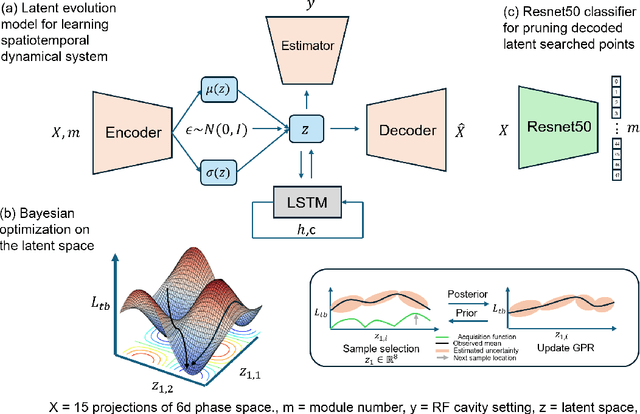
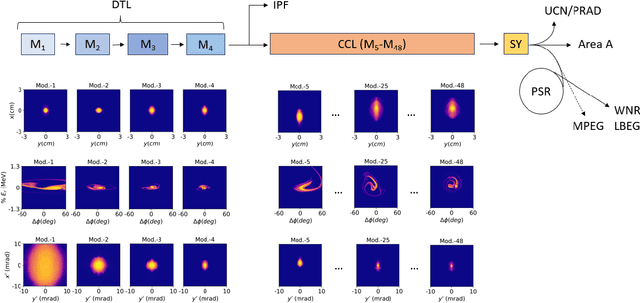
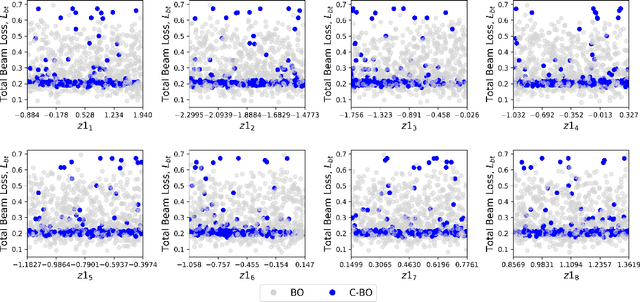
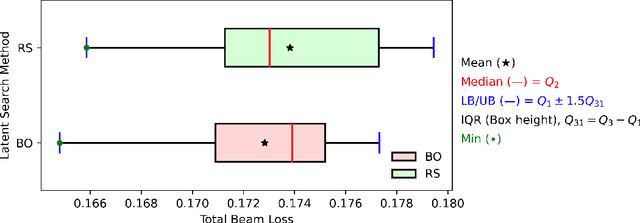
Complex dynamical systems, such as particle accelerators, often require complicated and time-consuming tuning procedures for optimal performance. It may also be required that these procedures estimate the optimal system parameters, which govern the dynamics of a spatiotemporal beam -- this can be a high-dimensional optimization problem. To address this, we propose a Classifier-pruned Bayesian Optimization-based Latent space Tuner (CBOL-Tuner), a framework for efficient exploration within a temporally-structured latent space. The CBOL-Tuner integrates a convolutional variational autoencoder (CVAE) for latent space representation, a long short-term memory (LSTM) network for temporal dynamics, a dense neural network (DNN) for parameter estimation, and a classifier-pruned Bayesian optimizer (C-BO) to adaptively search and filter the latent space for optimal solutions. CBOL-Tuner demonstrates superior performance in identifying multiple optimal settings and outperforms alternative global optimization methods.