 Add to Chrome
 Add to Firefox
 Add to Edge
MicroVerse: An Instrument for Measuring Self-Authored Identity Drift in Long-Horizon Multi-Agent Language-Model Simulations
Aug 16, 2026
Long-horizon, multi-agent language model (LM) simulations are widely proposed for studying social behavior, yet instruments to measure whether persona-conditioned agents maintain identity fidelity under sustained pressure are lacking. We present MicroVerse, a behavioral-science instrument that measures identity drift in generative agents. Agents carry an immutable "soul file" (core values, moral boundaries, personality, goals) and inhabit a resource-scarce 50 x 50 environment where water is a non-respawning survival constraint. Scarcity is operationalized via a per-tick existence-cost gradient. The eight-verb action space maps directly to moral boundaries (trade, talk, attack, scavenge). Using a three-layer memory architecture, agents periodically revise a mutable current identity against their immutable original soul via importance-triggered reflection. To mitigate survivor bias, MicroVerse decouples measurement from behavior using uniform longitudinal engine snapshots every N ticks alongside a forced-end snapshot of all living and dead agents. Identity drift is scored offline using a paraphrase-aware, value-anchored, multi-register diff rather than raw cosine similarity. We evaluate the instrument via a controlled seed run (n = 25) and a reflection-threshold sweep (thresholds {40, 80, 150}) to determine if drift dynamics are gate artifacts or threshold-robust properties. We report two primary findings: (1) Anti-self-deception emerges unprompted as the single largest semantic category of identity modification (27 of 111 added boundaries, 24%). (2) The system is threshold-robust; lower gates accelerate and increase revision frequency but preserve drift direction. All empirical results are strictly preliminary existence proofs and effect shapes (one model, one seed per arm, n = 25) rather than statistical significance claims.

KV-RM: Regularizing KV-Cache Movement for Static-Graph LLM Serving
May 10, 2026Static-graph LLM decoders provide predictable launches, fixed tensor shapes, and low submission overhead, but online decoding exposes highly irregular KV-cache behavior: request lengths differ, EOS events arrive asynchronously, and logical histories fragment over time. Dynamic runtimes recover flexibility through paged KV management and step-level scheduling, while static-graph executors often over-reserve memory and suffer burst-time latency outliers. This paper studies whether much of this variability can be absorbed below a fixed decode interface. We present KV-RM, a runtime design that regularizes KV-cache movement beneath a static-graph LLM decoder. KV-RM decouples logical KV histories from physical storage, tracks active KV state through a block pager, and materializes each decode step through a single committed descriptor. A merge-staged transport path coalesces non-contiguous KV mappings into a small number of large transfer groups before a fixed-shape attention kernel consumes them. Optional bounded far-history summaries can be enabled under the same interface, but the core design does not depend on them. On a 2-GPU NVIDIA A100 node, KV-RM improves mixed-length decoding throughput and tail latency relative to a static-graph baseline, reduces reserved KV memory across workload families, and removes severe burst-time latency spikes under production-trace replay. These results suggest that KV-cache movement, rather than kernel shape, can be an effective boundary for recovering runtime flexibility in static-graph LLM serving.
Knowing When to Stop: Dynamic Context Cutoff for Large Language Models
Feb 03, 2025
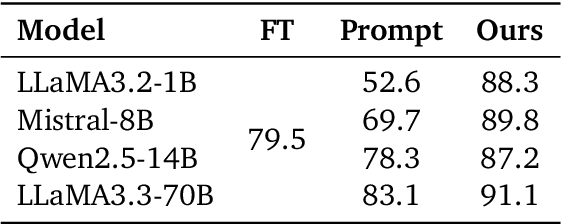

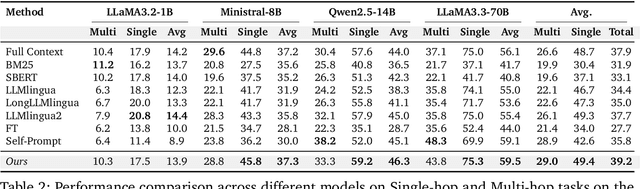
Large language models (LLMs) process entire input contexts indiscriminately, which is inefficient in cases where the information required to answer a query is localized within the context. We present dynamic context cutoff, a human-inspired method enabling LLMs to self-terminate processing upon acquiring sufficient task-relevant information. Through analysis of model internals, we discover that specific attention heads inherently encode "sufficiency signals" - detectable through lightweight classifiers - that predict when critical information has been processed. This reveals a new efficiency paradigm: models' internal understanding naturally dictates processing needs rather than external compression heuristics. Comprehensive experiments across six QA datasets (up to 40K tokens) with three model families (LLaMA/Qwen/Mistral, 1B0-70B) demonstrate 1.33x average token reduction while improving accuracy by 1.3%. Furthermore, our method demonstrates better performance with the same rate of token reduction compared to other context efficiency methods. Additionally, we observe an emergent scaling phenomenon: while smaller models require require probing for sufficiency detection, larger models exhibit intrinsic self-assessment capabilities through prompting.
Empowering Users in Digital Privacy Management through Interactive LLM-Based Agents
Oct 15, 2024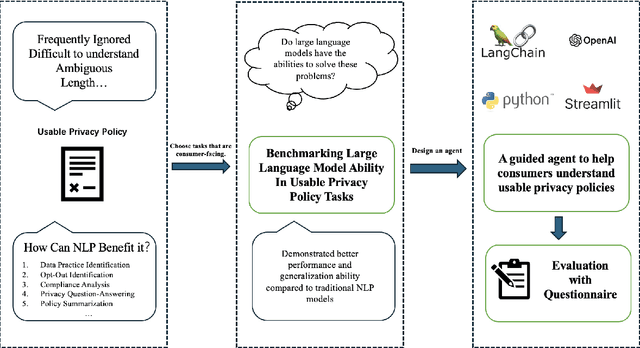
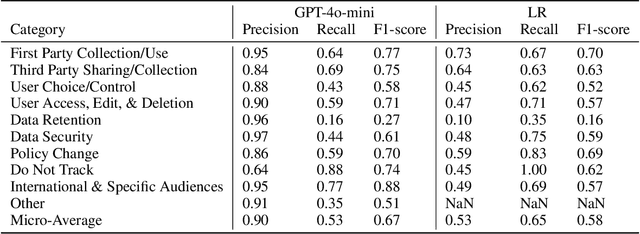
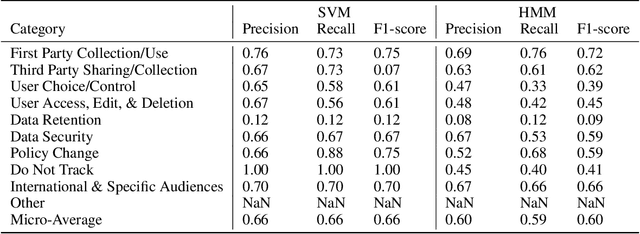
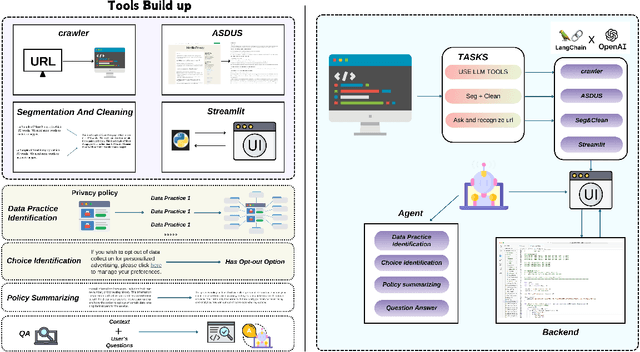
This paper presents a novel application of large language models (LLMs) to enhance user comprehension of privacy policies through an interactive dialogue agent. We demonstrate that LLMs significantly outperform traditional models in tasks like Data Practice Identification, Choice Identification, Policy Summarization, and Privacy Question Answering, setting new benchmarks in privacy policy analysis. Building on these findings, we introduce an innovative LLM-based agent that functions as an expert system for processing website privacy policies, guiding users through complex legal language without requiring them to pose specific questions. A user study with 100 participants showed that users assisted by the agent had higher comprehension levels (mean score of 2.6 out of 3 vs. 1.8 in the control group), reduced cognitive load (task difficulty ratings of 3.2 out of 10 vs. 7.8), increased confidence in managing privacy, and completed tasks in less time (5.5 minutes vs. 15.8 minutes). This work highlights the potential of LLM-based agents to transform user interaction with privacy policies, leading to more informed consent and empowering users in the digital services landscape.
Evaluation of OpenAI o1: Opportunities and Challenges of AGI
Sep 27, 2024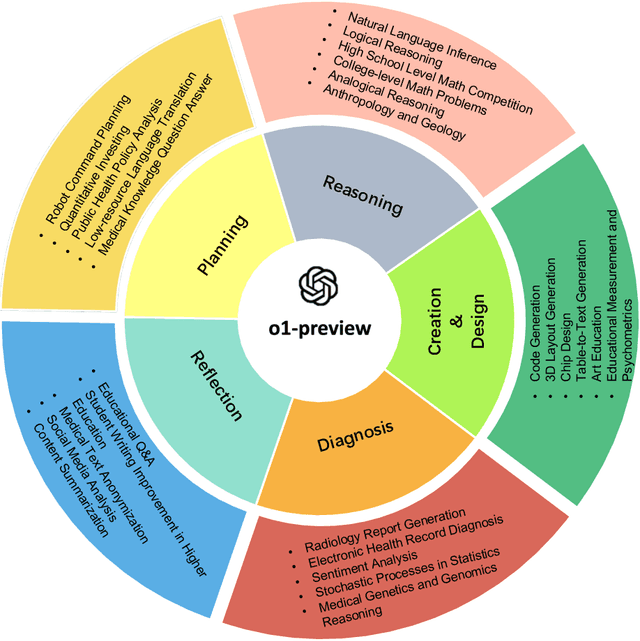
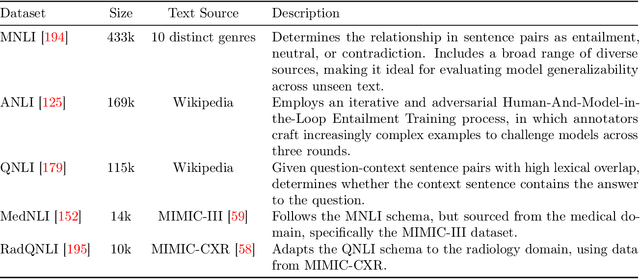


This comprehensive study evaluates the performance of OpenAI's o1-preview large language model across a diverse array of complex reasoning tasks, spanning multiple domains, including computer science, mathematics, natural sciences, medicine, linguistics, and social sciences. Through rigorous testing, o1-preview demonstrated remarkable capabilities, often achieving human-level or superior performance in areas ranging from coding challenges to scientific reasoning and from language processing to creative problem-solving. Key findings include: -83.3% success rate in solving complex competitive programming problems, surpassing many human experts. -Superior ability in generating coherent and accurate radiology reports, outperforming other evaluated models. -100% accuracy in high school-level mathematical reasoning tasks, providing detailed step-by-step solutions. -Advanced natural language inference capabilities across general and specialized domains like medicine. -Impressive performance in chip design tasks, outperforming specialized models in areas such as EDA script generation and bug analysis. -Remarkable proficiency in anthropology and geology, demonstrating deep understanding and reasoning in these specialized fields. -Strong capabilities in quantitative investing. O1 has comprehensive financial knowledge and statistical modeling skills. -Effective performance in social media analysis, including sentiment analysis and emotion recognition. The model excelled particularly in tasks requiring intricate reasoning and knowledge integration across various fields. While some limitations were observed, including occasional errors on simpler problems and challenges with certain highly specialized concepts, the overall results indicate significant progress towards artificial general intelligence.