 Add to Chrome
 Add to Firefox
 Add to Edge
LLM4Fluid: Large Language Models as Generalizable Neural Solvers for Fluid Dynamics
Jan 29, 2026
Deep learning has emerged as a promising paradigm for spatio-temporal modeling of fluid dynamics. However, existing approaches often suffer from limited generalization to unseen flow conditions and typically require retraining when applied to new scenarios. In this paper, we present LLM4Fluid, a spatio-temporal prediction framework that leverages Large Language Models (LLMs) as generalizable neural solvers for fluid dynamics. The framework first compresses high-dimensional flow fields into a compact latent space via reduced-order modeling enhanced with a physics-informed disentanglement mechanism, effectively mitigating spatial feature entanglement while preserving essential flow structures. A pretrained LLM then serves as a temporal processor, autoregressively predicting the dynamics of physical sequences with time series prompts. To bridge the modality gap between prompts and physical sequences, which can otherwise degrade prediction accuracy, we propose a dedicated modality alignment strategy that resolves representational mismatch and stabilizes long-term prediction. Extensive experiments across diverse flow scenarios demonstrate that LLM4Fluid functions as a robust and generalizable neural solver without retraining, achieving state-of-the-art accuracy while exhibiting powerful zero-shot and in-context learning capabilities. Code and datasets are publicly available at https://github.com/qisongxiao/LLM4Fluid.

LLM-based Multi-Agent Copilot for Quantum Sensor
Aug 07, 2025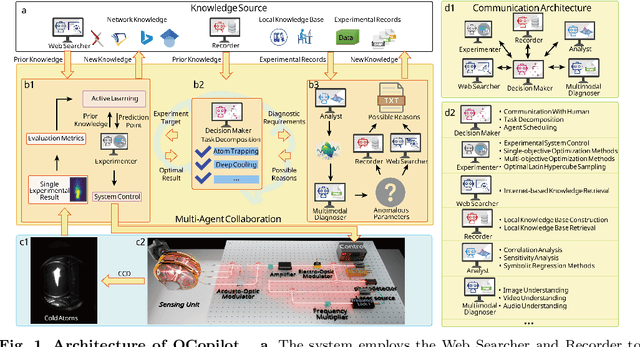
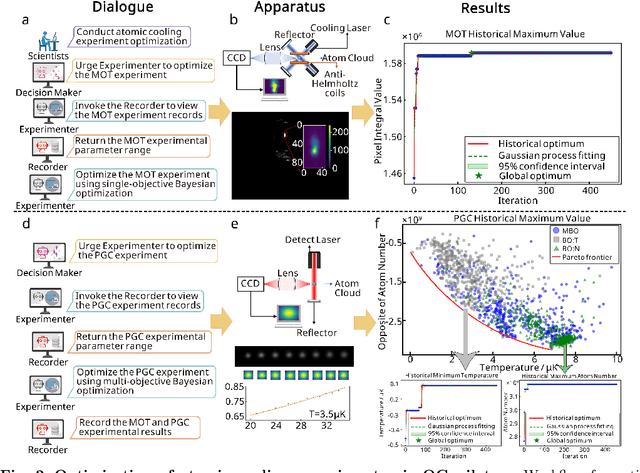
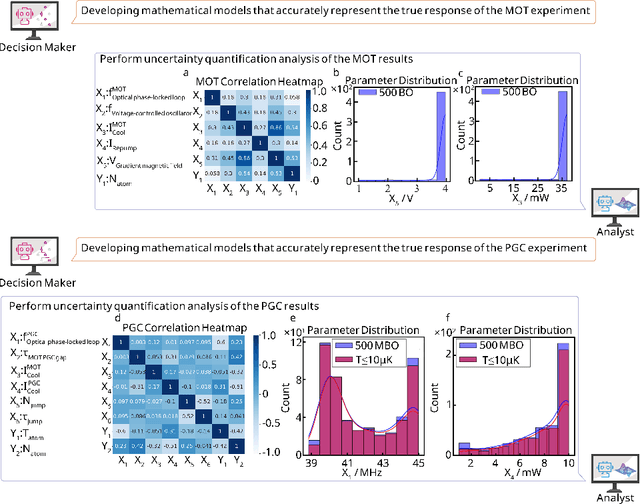
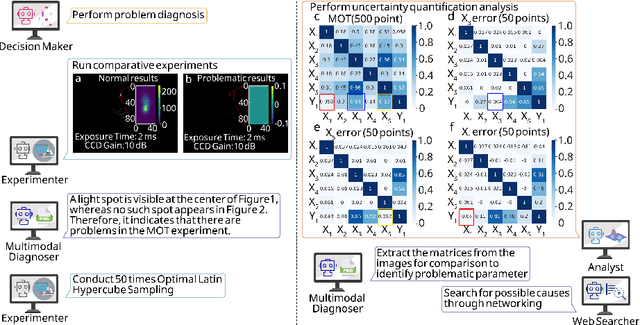
Large language models (LLM) exhibit broad utility but face limitations in quantum sensor development, stemming from interdisciplinary knowledge barriers and involving complex optimization processes. Here we present QCopilot, an LLM-based multi-agent framework integrating external knowledge access, active learning, and uncertainty quantification for quantum sensor design and diagnosis. Comprising commercial LLMs with few-shot prompt engineering and vector knowledge base, QCopilot employs specialized agents to adaptively select optimization methods, automate modeling analysis, and independently perform problem diagnosis. Applying QCopilot to atom cooling experiments, we generated 10${}^{\rm{8}}$ sub-$\rm{\mu}$K atoms without any human intervention within a few hours, representing $\sim$100$\times$ speedup over manual experimentation. Notably, by continuously accumulating prior knowledge and enabling dynamic modeling, QCopilot can autonomously identify anomalous parameters in multi-parameter experimental settings. Our work reduces barriers to large-scale quantum sensor deployment and readily extends to other quantum information systems.