 Add to Chrome
 Add to Firefox
 Add to Edge
SORT: A Systematically Optimized Ranking Transformer for Industrial-scale Recommenders
Mar 04, 2026
While Transformers have achieved remarkable success in LLMs through superior scalability, their application in industrial-scale ranking models remains nascent, hindered by the challenges of high feature sparsity and low label density. In this paper, we propose SORT (Systematically Optimized Ranking Transformer), a scalable model designed to bridge the gap between Transformers and industrial-scale ranking models. We address the high feature sparsity and low label density challenges through a series of optimizations, including request-centric sample organization, local attention, query pruning and generative pre-training. Furthermore, we introduce a suite of refinements to the tokenization, multi-head attention (MHA), and feed-forward network (FFN) modules, which collectively stabilize the training process and enlarge the model capacity. To maximize hardware efficiency, we optimize our training system to elevate the model FLOPs utilization (MFU) to 22%. Extensive experiments demonstrate that SORT outperforms strong baselines and exhibits excellent scalability across data size, model size and sequence length, while remaining flexible at integrating diverse features. Finally, online A/B testing in large-scale e-commerce scenarios confirms that SORT achieves significant gains in key business metrics, including orders (+6.35%), buyers (+5.97%) and GMV (+5.47%), while simultaneously halving latency (-44.67%) and doubling throughput (+121.33%).

Hierarchical and Contrastive Representation Learning for Knowledge-aware Recommendation
Apr 15, 2023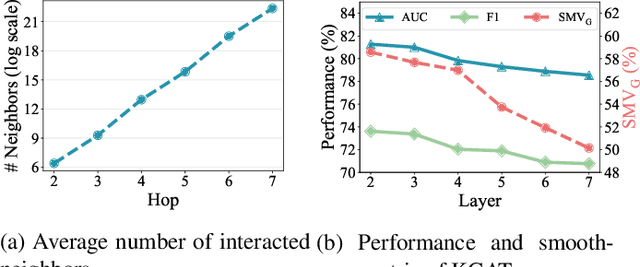
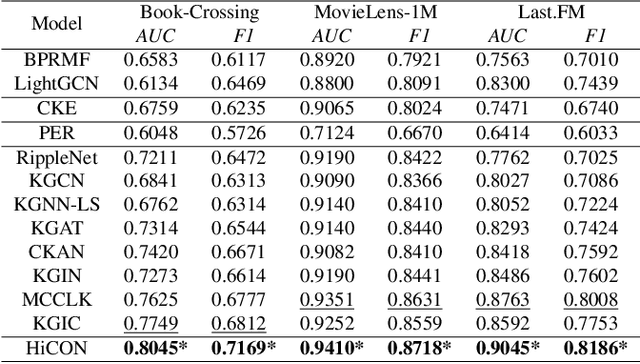
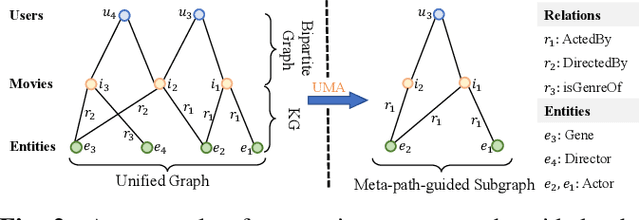
Incorporating knowledge graph into recommendation is an effective way to alleviate data sparsity. Most existing knowledge-aware methods usually perform recursive embedding propagation by enumerating graph neighbors. However, the number of nodes' neighbors grows exponentially as the hop number increases, forcing the nodes to be aware of vast neighbors under this recursive propagation for distilling the high-order semantic relatedness. This may induce more harmful noise than useful information into recommendation, leading the learned node representations to be indistinguishable from each other, that is, the well-known over-smoothing issue. To relieve this issue, we propose a Hierarchical and CONtrastive representation learning framework for knowledge-aware recommendation named HiCON. Specifically, for avoiding the exponential expansion of neighbors, we propose a hierarchical message aggregation mechanism to interact separately with low-order neighbors and meta-path-constrained high-order neighbors. Moreover, we also perform cross-order contrastive learning to enforce the representations to be more discriminative. Extensive experiments on three datasets show the remarkable superiority of HiCON over state-of-the-art approaches.
When Neural Model Meets NL2Code: A Survey
Dec 19, 2022Given a natural language that describes the user's demands, the NL2Code task aims to generate code that addresses the demands. This is a critical but challenging task that mirrors the capabilities of AI-powered programming. The NL2Code task is inherently versatile, diverse and complex. For example, a demand can be described in different languages, in different formats, and at different levels of granularity. This inspired us to do this survey for NL2Code. In this survey, we focus on how does neural network (NN) solves NL2Code. We first propose a comprehensive framework, which is able to cover all studies in this field. Then, we in-depth parse the existing studies into this framework. We create an online website to record the parsing results, which tracks existing and recent NL2Code progress. In addition, we summarize the current challenges of NL2Code as well as its future directions. We hope that this survey can foster the evolution of this field.