 Add to Chrome
 Add to Firefox
 Add to Edge
Attend to Your Own Thoughts: Breaking the Barrier for Post-Training Quantization of Reasoning LLMs through the Lens of 1.58-Bit Quantization
Aug 02, 2026
We propose ScaleQ-1.58, a scalable ternary post-training quantization (PTQ) framework for reasoning LLMs. Its core insight stems from an empirical finding: although modern LLMs are typically trained to exhibit chain-of-thought reasoning capabilities, in the PTQ regime, even the latest CAT-Q method based on learning-based differentiable ternarization still leads to performance collapse on challenging mathematics and coding tasks when using conventional calibration schemes that ignore the model's reasoning process. Driven by this finding, we introduce a simple calibration approach, Attend to Your Own Thoughts (AYOT), where reasoning traces and final answers generated by the pre-trained high-precision target LLM on a proper set of calibration samples are used as the context input during the ternarization process, along with the corresponding questions. ScaleQ-1.58 is formed by simply integrating AYOT with CAT-Q, which demonstrates several scaling properties: (1) with only 4M calibration tokens, Qwen3-1.7B ternarized by ScaleQ-1.58 reaches over 90.52% of the performance of the prior best BitNet b1.58 2B4T averaged over 4 mathematics and coding tasks, and our ternary Qwen3-4B shows an absolute gain of 8.97%, while requiring 1,000,000x fewer calibration tokens for quantization; (2) ScaleQ-1.58 generalizes well to both dense and MoE architectures, with performance improving as model scale increases (up to 235B parameters); (3) ScaleQ-1.58 demonstrates strong generalization across tasks of varying difficulty levels, including mathematics, coding and scientific logic reasoning, as well as commonsense reasoning and basic language generation; (4) its performance continues to improve as the number of calibration tokens increases. Notably, AYOT also exhibits strong generalization ability across other quantization bit-widths. Code will be available at https://github.com/IntelChina-AI/BitTern.

CAT-Q: Cost-efficient and Accurate Ternary Quantization for LLMs
Jun 25, 2026In this paper, we present CAT-Q, Cost-efficient and Accurate Ternary Quantization, for compressing and accelerating LLMs. Unlike existing state-of-the-art ternary quantization methods that rely on data-intensive and costly quantization-aware training to mitigate severe performance degradation, CAT-Q is a simple yet effective post-training quantization scheme that is readily applicable to LLMs with diverse architectures and model sizes. It has two key components, learnable modulation (LM) and softened ternarization (ST), which are coupled from an optimization perspective. LM leverages a composition of learnable factors to modulate the distribution of pre-trained high-precision weights and the ternary threshold, making them less sensitive to ternarization. ST further introduces a differentiable transition function to guide the ternarization process toward stable convergence. We show that, for pre-trained LLMs with 1.7B to 8B parameters, CAT-Q can efficiently quantize them into ternary models using only 512 calibration samples, while achieving superior performance than the seminal BitNet 1.58-bit v1 and v2 families (with 1.3B to 7B parameters) trained with 100B tokens, yielding about a 100,000X reduction in training tokens. Moreover, we show for the first time that CAT-Q can quantize much larger pre-trained LLMs having 14B to 235B parameters into leading ternary models within just 8 to 60 hours on 8 A100-80GB GPUs. Code is available at https://github.com/IntelChina-AI/BitTern.
SliderQuant: Accurate Post-Training Quantization for LLMs
Mar 26, 2026In this paper, we address post-training quantization (PTQ) for large language models (LLMs) from an overlooked perspective: given a pre-trained high-precision LLM, the predominant sequential quantization framework treats different layers equally, but this may be not optimal in challenging bit-width settings. We empirically study the quantization impact of different layers on model accuracy, and observe that: (1) shallow/deep layers are usually more sensitive to quantization than intermediate layers; (2) among shallow/deep layers, the most sensitive one is the first/last layer, which exhibits significantly larger quantization error than others. These empirical observations imply that the quantization design for different layers of LLMs is required on multiple levels instead of a single level shared to all layers. Motivated by this, we propose a new PTQ framework termed Sliding-layer Quantization (SliderQuant) that relies on a simple adaptive sliding quantization concept facilitated by few learnable parameters. The base component of SliderQuant is called inter-layer sliding quantization, which incorporates three types of novel sliding window designs tailored for addressing the varying quantization sensitivity of shallow, intermediate and deep layers. The other component is called intra-layer sliding quantization that leverages an incremental strategy to quantize each window. As a result, SliderQuant has a strong ability to reduce quantization errors across layers. Extensive experiments on basic language generation, zero-shot commonsense reasoning and challenging math and code tasks with various LLMs, including Llama/Llama2/Llama3/Qwen2.5 model families, DeepSeek-R1 distilled models and large MoE models, show that our method outperforms existing PTQ methods (including the latest PTQ methods using rotation transformations) for both weight-only quantization and weight-activation quantization.
Ske2Grid: Skeleton-to-Grid Representation Learning for Action Recognition
Aug 15, 2023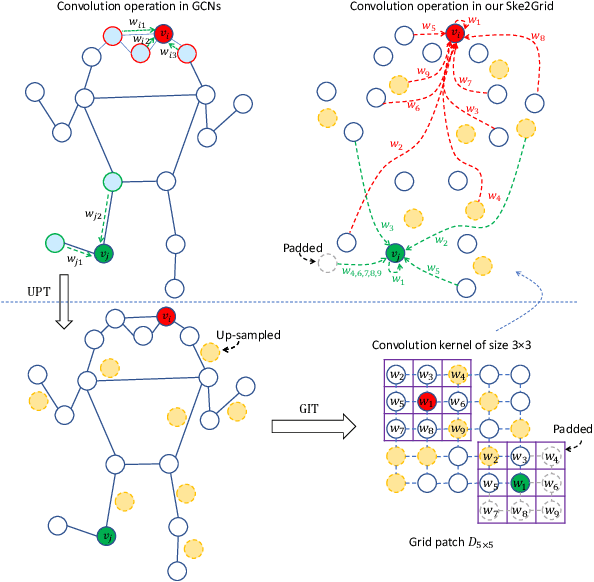
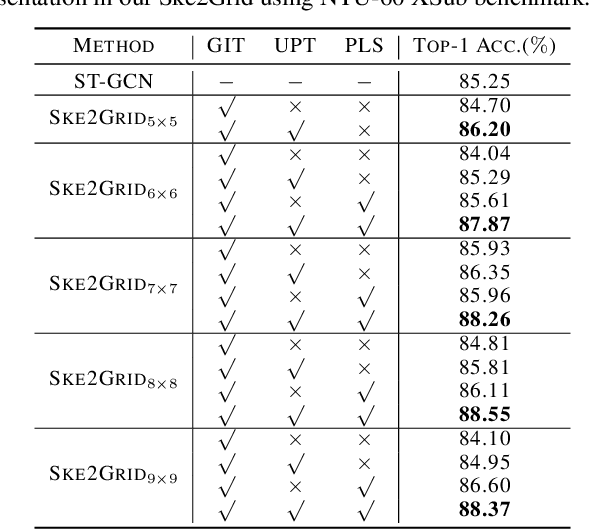
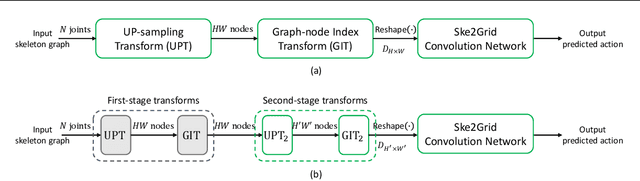

This paper presents Ske2Grid, a new representation learning framework for improved skeleton-based action recognition. In Ske2Grid, we define a regular convolution operation upon a novel grid representation of human skeleton, which is a compact image-like grid patch constructed and learned through three novel designs. Specifically, we propose a graph-node index transform (GIT) to construct a regular grid patch through assigning the nodes in the skeleton graph one by one to the desired grid cells. To ensure that GIT is a bijection and enrich the expressiveness of the grid representation, an up-sampling transform (UPT) is learned to interpolate the skeleton graph nodes for filling the grid patch to the full. To resolve the problem when the one-step UPT is aggressive and further exploit the representation capability of the grid patch with increasing spatial size, a progressive learning strategy (PLS) is proposed which decouples the UPT into multiple steps and aligns them to multiple paired GITs through a compact cascaded design learned progressively. We construct networks upon prevailing graph convolution networks and conduct experiments on six mainstream skeleton-based action recognition datasets. Experiments show that our Ske2Grid significantly outperforms existing GCN-based solutions under different benchmark settings, without bells and whistles. Code and models are available at https://github.com/OSVAI/Ske2Grid
Hierarchical and Contrastive Representation Learning for Knowledge-aware Recommendation
Apr 15, 2023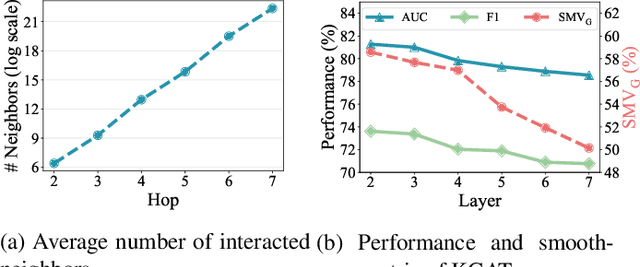
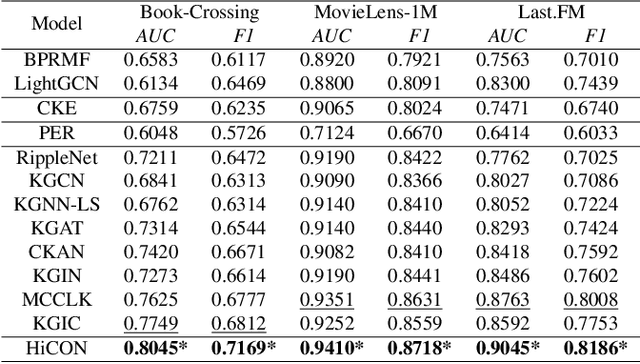
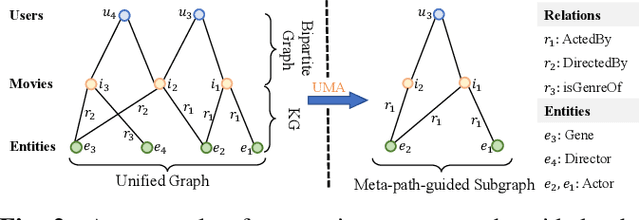
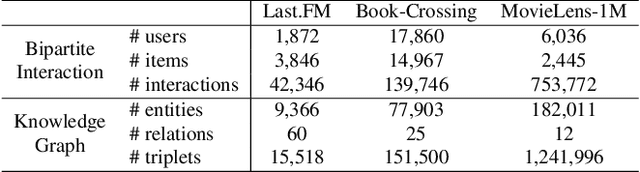
Incorporating knowledge graph into recommendation is an effective way to alleviate data sparsity. Most existing knowledge-aware methods usually perform recursive embedding propagation by enumerating graph neighbors. However, the number of nodes' neighbors grows exponentially as the hop number increases, forcing the nodes to be aware of vast neighbors under this recursive propagation for distilling the high-order semantic relatedness. This may induce more harmful noise than useful information into recommendation, leading the learned node representations to be indistinguishable from each other, that is, the well-known over-smoothing issue. To relieve this issue, we propose a Hierarchical and CONtrastive representation learning framework for knowledge-aware recommendation named HiCON. Specifically, for avoiding the exponential expansion of neighbors, we propose a hierarchical message aggregation mechanism to interact separately with low-order neighbors and meta-path-constrained high-order neighbors. Moreover, we also perform cross-order contrastive learning to enforce the representations to be more discriminative. Extensive experiments on three datasets show the remarkable superiority of HiCON over state-of-the-art approaches.
3D Human Pose Lifting with Grid Convolution
Feb 17, 2023Existing lifting networks for regressing 3D human poses from 2D single-view poses are typically constructed with linear layers based on graph-structured representation learning. In sharp contrast to them, this paper presents Grid Convolution (GridConv), mimicking the wisdom of regular convolution operations in image space. GridConv is based on a novel Semantic Grid Transformation (SGT) which leverages a binary assignment matrix to map the irregular graph-structured human pose onto a regular weave-like grid pose representation joint by joint, enabling layer-wise feature learning with GridConv operations. We provide two ways to implement SGT, including handcrafted and learnable designs. Surprisingly, both designs turn out to achieve promising results and the learnable one is better, demonstrating the great potential of this new lifting representation learning formulation. To improve the ability of GridConv to encode contextual cues, we introduce an attention module over the convolutional kernel, making grid convolution operations input-dependent, spatial-aware and grid-specific. We show that our fully convolutional grid lifting network outperforms state-of-the-art methods with noticeable margins under (1) conventional evaluation on Human3.6M and (2) cross-evaluation on MPI-INF-3DHP. Code is available at https://github.com/OSVAI/GridConv