 Add to Chrome
 Add to Firefox
 Add to Edge
See Fair, Speak Truth: Equitable Attention Improves Grounding and Reduces Hallucination in Vision-Language Alignment
Apr 10, 2026
Multimodal large language models (MLLMs) frequently hallucinate objects that are absent from the visual input, often because attention during decoding is disproportionately drawn to visually dominant or frequently occurring content. We observe that this inequity in attention allocation is a root cause of object hallucination: when rare, small, or contextually peripheral objects receive insufficient attention, the model fails to ground its generation in the full visual scene. We argue that every object in an image, regardless of its size, frequency or visual salience, deserves equal representational opportunity during decoding. To this end, we propose DOP-OBC, a training-free and architecture-agnostic decoding strategy built on the principle of equitable attention. Two complementary object-aware signals work in tandem: a Dominant Object Penalty (DOP) that softly suppresses attention over-concentration on visually dominant regions, and an Outlier Boost Coefficient (OBC) that amplifies attention toward rare yet confidently detected objects. These signals are injected as per-row logit modulations within the causal attention mask, requiring no weight updates and preserving autoregressive decoding properties. Extensive experiments across image and video MLLMs demonstrate consistent reductions in object hallucination on CHAIR and POPE benchmarks, alongside improvements in GPT-4o assessed captioning quality across correctness, consistency, detail, context and temporal dimensions. DOP-OBC establishes that fairness in attention allocation is not merely a design principle but a practical and effective path toward more faithful multimodal generation.

TuLaBM: Tumor-Biased Latent Bridge Matching for Contrast-Enhanced MRI Synthesis
Mar 19, 2026Contrast-enhanced magnetic resonance imaging (CE-MRI) plays a crucial role in brain tumor assessment; however, its acquisition requires gadolinium-based contrast agents (GBCAs), which increase costs and raise safety concerns. Consequently, synthesizing CE-MRI from non-contrast MRI (NC-MRI) has emerged as a promising alternative. Early Generative Adversarial Network (GAN)-based approaches suffered from instability and mode collapse, while diffusion models, despite impressive synthesis quality, remain computationally expensive and often fail to faithfully reproduce critical tumor contrast patterns. To address these limitations, we propose Tumor-Biased Latent Bridge Matching (TuLaBM), which formulates NC-to-CE MRI translation as Brownian bridge transport between source and target distributions in a learned latent space, enabling efficient training and inference. To enhance tumor-region fidelity, we introduce a Tumor-Biased Attention Mechanism (TuBAM) that amplifies tumor-relevant latent features during bridge evolution, along with a boundary-aware loss that constrains tumor interfaces to improve margin sharpness. While bridge matching has been explored for medical image translation in pixel space, our latent formulation substantially reduces computational cost and inference time. Experiments on BraTS2023-GLI (BraSyn) and Cleveland Clinic (in-house) liver MRI dataset show that TuLaBM consistently outperforms state-of-the-art baselines on both whole-image and tumor-region metrics, generalizes effectively to unseen liver MRI data in zero-shot and fine-tuned settings, and achieves inference times under 0.097 seconds per image.
VGS-Decoding: Visual Grounding Score Guided Decoding for Hallucination Mitigation in Medical VLMs
Mar 19, 2026Medical Vision-Language Models (VLMs) often hallucinate by generating responses based on language priors rather than visual evidence, posing risks in clinical applications. We propose Visual Grounding Score Guided Decoding (VGS-Decoding), a training-free method to mitigate hallucinations during inference. Our key insight is that hallucinated tokens maintain or increase their probability when visual information is degraded, while visually grounded tokens decrease in probability. We introduce the Visual Grounding Score (VGS), which measures each token's visual dependency by comparing distributions from original and distorted images. During decoding, we reweight probabilities by amplifying visually grounded tokens while suppressing hallucinations. Unlike fixed-weight contrastive methods, VGS-Decoding provides per-token adaptive control. Experiments on MIMIC-Diff-VQA and VQA-RAD across LLaVA-Med, CheXagent, and MedGemma demonstrate consistent improvements, with up to +9.12% overall gain and $+8.98\%$ in open-ended recall, while introducing only $2\times$ inference overhead and no additional training, making it practical for clinical deployment. Upon acceptance, code will be released publicly to facilitate reproducibility.
MedMO: Grounding and Understanding Multimodal Large Language Model for Medical Images
Feb 06, 2026Multimodal large language models (MLLMs) have rapidly advanced, yet their adoption in medicine remains limited by gaps in domain coverage, modality alignment, and grounded reasoning. In this work, we introduce MedMO, a medical foundation model built upon a generalized MLLM architecture and trained exclusively on large-scale, domain-specific data. MedMO follows a multi-stage training recipe: (i) cross-modal pretraining to align heterogeneous visual encoders with a medical language backbone; (ii) instruction tuning on multi-task supervision that spans captioning, VQA, report generation, retrieval, and grounded disease localization with bounding boxes; and (iii) reinforcement learning with verifiable rewards that combine factuality checks with a box-level GIoU reward to strengthen spatial grounding and step-by-step reasoning in complex clinical scenarios. MedMO consistently outperforms strong open-source medical MLLMs across multiple modalities and tasks. On VQA benchmarks, MedMO achieves an average accuracy improvement of +13.7% over the baseline and performs within 1.9% of the SOTA Fleming-VL. For text-based QA, it attains +6.9% over the baseline and +14.5% over Fleming-VL. In medical report generation, MedMO delivers significant gains in both semantic and clinical accuracy. Moreover, it exhibits strong grounding capability, achieving an IoU improvement of +40.4 over the baseline and +37.0% over Fleming-VL, underscoring its robust spatial reasoning and localization performance. Evaluations across radiology, ophthalmology, and pathology-microscopy confirm MedMO's broad cross-modality generalization. We release two versions of MedMO: 4B and 8B. Project is available at https://genmilab.github.io/MedMO-Page
Dual-Stage Value-Guided Inference with Margin-Based Reward Adjustment for Fast and Faithful VLM Captioning
Jun 18, 2025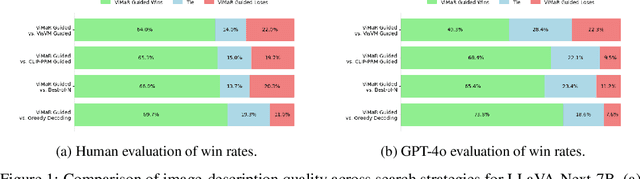
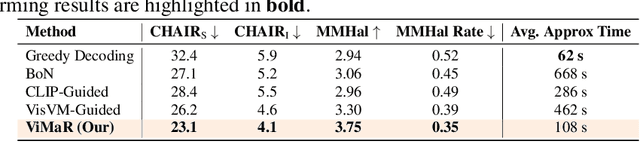
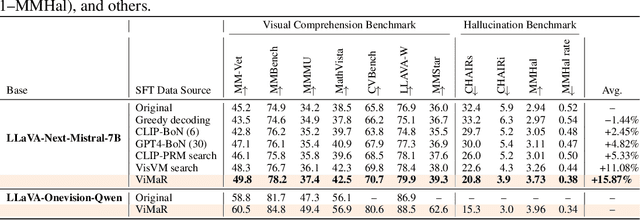

Despite significant advances in inference-time search for vision-language models (VLMs), existing approaches remain both computationally expensive and prone to unpenalized, low-confidence generations which often lead to persistent hallucinations. We introduce \textbf{Value-guided Inference with Margin-based Reward (ViMaR)}, a two-stage inference framework that improves both efficiency and output fidelity by combining a temporal-difference value model with a margin-aware reward adjustment. In the first stage, we perform a single pass to identify the highest-value caption among diverse candidates. In the second stage, we selectively refine only those segments that were overlooked or exhibit weak visual grounding, thereby eliminating frequently rewarded evaluations. A calibrated margin-based penalty discourages low-confidence continuations while preserving descriptive richness. Extensive experiments across multiple VLM architectures demonstrate that ViMaR generates captions that are significantly more reliable, factually accurate, detailed, and explanatory, while achieving over 4$\times$ speedup compared to existing value-guided methods. Specifically, we show that ViMaR trained solely on LLaVA Mistral-7B, \textit{generalizes effectively to guide decoding in a stronger unseen model}. To further validate this, we adapt the ViMaR to steer generation in LLaVA-OneVision-Qwen2-7B, leading to consistent improvements in caption quality and demonstrating robust cross-model guidance. This cross-model generalization highlights ViMaR's flexibility and modularity, positioning it as a scalable and transferable inference-time decoding strategy. Furthermore, when ViMaR-generated captions are used for self-training, the underlying models achieve substantial gains across a broad suite of visual comprehension benchmarks, underscoring the potential of fast, accurate, and self-improving VLM pipelines.