 Add to Chrome
 Add to Firefox
 Add to Edge
Scalable Training of Spatially Grounded 2D Vision-Language Models for Radiology
Jun 18, 2026
We study how to train visually grounded vision-language models (VLMs) for radiology without manual spatial annotations. We introduce RefRad2D, a large-scale bilingual (German/English) dataset of 1.2M CT and MR image-text pairs derived from clinical practice, with task-specific VQA and spatial grounding subsets generated automatically via LLM-based curation and automated segmentation. Trained on this data, our model RadGrounder jointly performs report generation, visual question answering, and spatial grounding via bounding-box detection or segmentation. On external VQA benchmarks (Slake, VQA-RAD), RadGrounder achieves competitive results with specialized medical VLMs. Adding our clinical data to the training mixture improves open-ended VQA over fine-tuning on the downstream datasets alone, showing the transferability of our dataset. Crucially, adding grounding supervision does not degrade language quality, enabling spatially verifiable outputs at no cost to VQA performance.

Learning to Read Where to Look: Disease-Aware Vision-Language Pretraining for 3D CT
Mar 02, 2026Recent 3D CT vision-language models align volumes with reports via contrastive pretraining, but typically rely on limited public data and provide only coarse global supervision. We train a 3D CT vision-language model on 98k report-volume pairs (50k patients) collected at a single hospital, combined with public datasets, using SigLIP-style contrastive pretraining together with prompt-based disease supervision in the shared vision-text embedding space. On CT-RATE, our model achieves state-of-the-art text-to-image retrieval (R@10 31.5 vs. 22.2) and competitive disease classification (AUC 83.8 vs. 83.8), with consistent results on Rad-ChestCT (AUC 77.0 vs. 77.3). We further observe that radiologists routinely reference specific images within their reports (e.g., ``series X, image Y''), linking textual descriptions to precise axial locations. We automatically mine 262k such snippet-slice pairs and introduce the task of intra-scan snippet localization -- predicting the axial depth referred to by a text snippet -- reducing mean absolute error to 36.3 mm at 12 mm feature resolution, compared with 67.0 mm for the best baseline. Adding this localization objective leaves retrieval and classification broadly unchanged within confidence bounds, yielding a single unified model for retrieval, classification, and intra-scan grounding.
Medical Image De-Identification Benchmark Challenge
Jul 31, 2025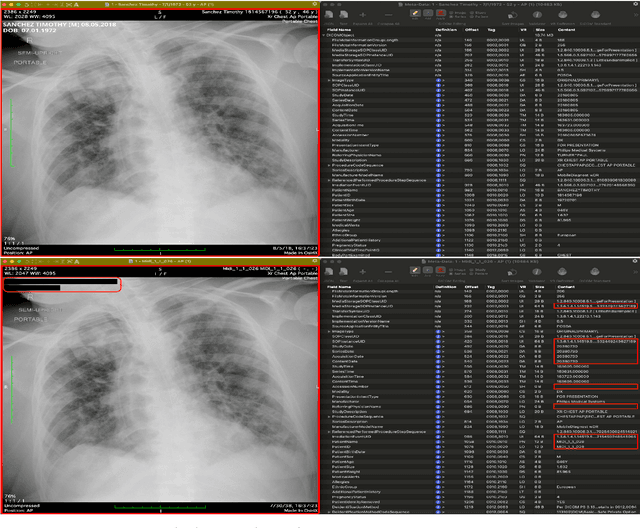
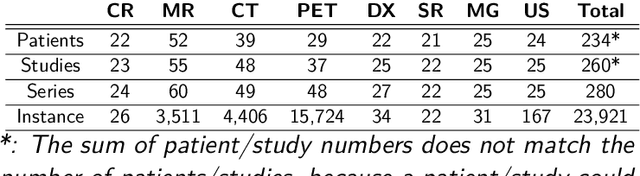
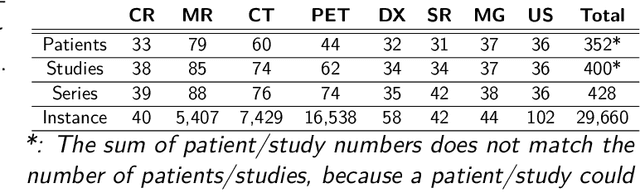
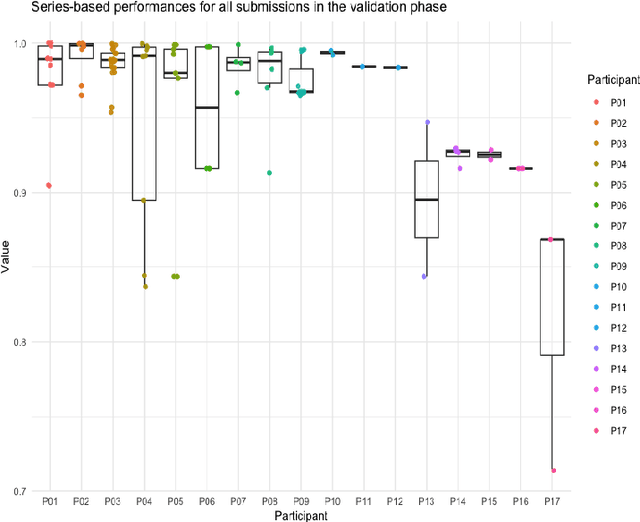
The de-identification (deID) of protected health information (PHI) and personally identifiable information (PII) is a fundamental requirement for sharing medical images, particularly through public repositories, to ensure compliance with patient privacy laws. In addition, preservation of non-PHI metadata to inform and enable downstream development of imaging artificial intelligence (AI) is an important consideration in biomedical research. The goal of MIDI-B was to provide a standardized platform for benchmarking of DICOM image deID tools based on a set of rules conformant to the HIPAA Safe Harbor regulation, the DICOM Attribute Confidentiality Profiles, and best practices in preservation of research-critical metadata, as defined by The Cancer Imaging Archive (TCIA). The challenge employed a large, diverse, multi-center, and multi-modality set of real de-identified radiology images with synthetic PHI/PII inserted. The MIDI-B Challenge consisted of three phases: training, validation, and test. Eighty individuals registered for the challenge. In the training phase, we encouraged participants to tune their algorithms using their in-house or public data. The validation and test phases utilized the DICOM images containing synthetic identifiers (of 216 and 322 subjects, respectively). Ten teams successfully completed the test phase of the challenge. To measure success of a rule-based approach to image deID, scores were computed as the percentage of correct actions from the total number of required actions. The scores ranged from 97.91% to 99.93%. Participants employed a variety of open-source and proprietary tools with customized configurations, large language models, and optical character recognition (OCR). In this paper we provide a comprehensive report on the MIDI-B Challenge's design, implementation, results, and lessons learned.