 Add to Chrome
 Add to Firefox
 Add to Edge
Order within Chaos: Capturing Intrinsic Energy Anomalies for AI-Manipulated Image Forgery Localization
Jun 01, 2026
Recent advancements in generative AI have led to image editing models capable of producing realistic forgeries that evade traditional image forgery localization methods, as these approaches depend on physical noise absent in synthetic data. To address this challenge, we theoretically demonstrate that the diffusion process inherently suppresses local high-frequency variance, creating a statistical energy gap that is distinguishable from the natural entropy of optical imaging. Guided by this insight, we propose FLAME, a unified framework that utilizes a LAD map to capture these intrinsic anomalies, coupled with a parameter-efficient adapter for SAM to achieve precise, pixel-level forgery localization. Furthermore, to bridge the lag between forensic benchmarks and evolving generative models, we introduce EditStream, an automated pipeline for continuous, instruction-based training data synthesis. Extensive experiments demonstrate that FLAME establishes a new state-of-the-art, significantly outperforming previous methods on AI-generated forgery datasets while effectively generalizing to unseen generative architectures. Our code is available at https://github.com/phoenixnir/FLAME.

StemBind: When MLLMs Get Lost Between Rules and Instances in Abstract Visual Reasoning
May 29, 2026Multimodal large language models (MLLMs) often know the rule but pick the wrong answer: on abstract visual reasoning (AVR) tasks, a model can describe what it sees and name the underlying pattern, yet still fail to choose the matching candidate. Existing AVR benchmarks cannot detect this because they collapse perception, rule induction, and answer selection into a single right-or-wrong signal. We introduce StemBind, a shared-stem diagnostic benchmark that probes the same visual stem with three aligned questions: Perception (what is in the image), Rule (what pattern governs it), and Full (which option completes it), so a final-answer error can be attributed to a specific sub-step on the same evidence. StemBind contains 2,298 curated knowledge-light stems across nine auditable visual operations, totaling 19,533 P/R/F tasks, with each full item annotated by Sternberg's four reasoning stages (S1 Encode, S2 Infer, S3 Map, S4 Apply). Evaluating 24 frontier MLLM configurations yields four findings. (i) The R-F chasm: rule accuracy exceeds full-item accuracy on 22 of 24 models, so most failures happen after the rule is identified. (ii) A persistent binding gap: even when P and R are both correct on the same stem, models still answer F incorrectly 51.2% of the time. (iii) The bottleneck is S3: process diagnostics and Stage-wise Stimulus Augmentation localize the dominant failure to rule-to-instance mapping. (iv) Scaling and thinking do not help: neither larger models nor explicit thinking mode reliably closes the gap, and thinking even lowers rule and full-item accuracy. StemBind reframes AVR evaluation from final-answer ranking to locating where abstract visual reasoning breaks down, identifying rule-to-instance binding as a concrete next target for vision-grounded reasoning.
TASAR: Transferable Attack on Skeletal Action Recognition
Sep 04, 2024Skeletal sequences, as well-structured representations of human behaviors, are crucial in Human Activity Recognition (HAR). The transferability of adversarial skeletal sequences enables attacks in real-world HAR scenarios, such as autonomous driving, intelligent surveillance, and human-computer interactions. However, existing Skeleton-based HAR (S-HAR) attacks exhibit weak adversarial transferability and, therefore, cannot be considered true transfer-based S-HAR attacks. More importantly, the reason for this failure remains unclear. In this paper, we study this phenomenon through the lens of loss surface, and find that its sharpness contributes to the poor transferability in S-HAR. Inspired by this observation, we assume and empirically validate that smoothening the rugged loss landscape could potentially improve adversarial transferability in S-HAR. To this end, we propose the first Transfer-based Attack on Skeletal Action Recognition, TASAR. TASAR explores the smoothed model posterior without re-training the pre-trained surrogates, which is achieved by a new post-train Dual Bayesian optimization strategy. Furthermore, unlike previous transfer-based attacks that treat each frame independently and overlook temporal coherence within sequences, TASAR incorporates motion dynamics into the Bayesian attack gradient, effectively disrupting the spatial-temporal coherence of S-HARs. To exhaustively evaluate the effectiveness of existing methods and our method, we build the first large-scale robust S-HAR benchmark, comprising 7 S-HAR models, 10 attack methods, 3 S-HAR datasets and 2 defense models. Extensive results demonstrate the superiority of TASAR. Our benchmark enables easy comparisons for future studies, with the code available in the supplementary material.
Boosting Adversarial Transferability for Skeleton-based Action Recognition via Exploring the Model Posterior Space
Jul 11, 2024
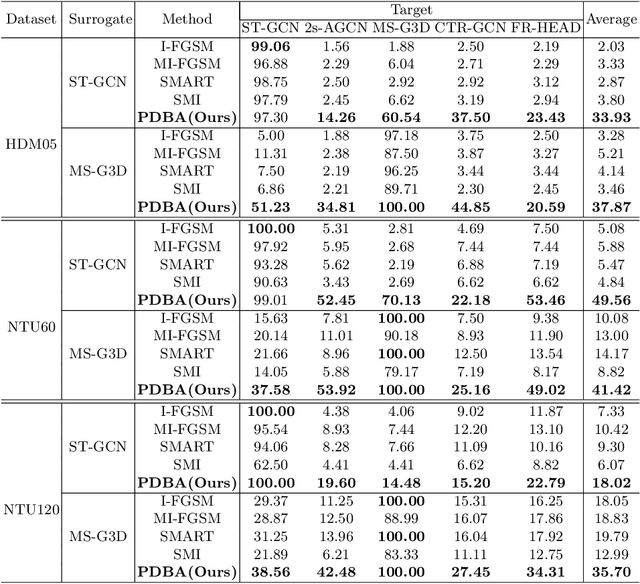
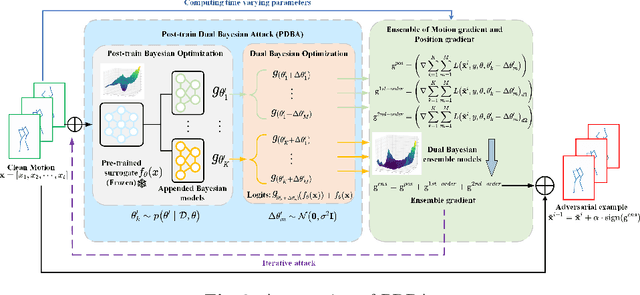
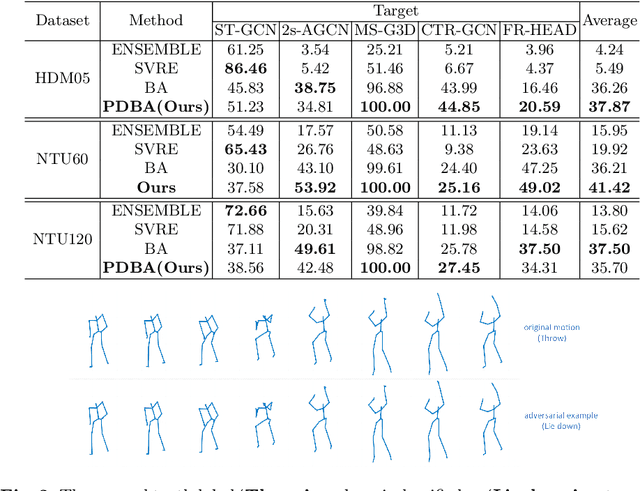
Skeletal motion plays a pivotal role in human activity recognition (HAR). Recently, attack methods have been proposed to identify the universal vulnerability of skeleton-based HAR(S-HAR). However, the research of adversarial transferability on S-HAR is largely missing. More importantly, existing attacks all struggle in transfer across unknown S-HAR models. We observed that the key reason is that the loss landscape of the action recognizers is rugged and sharp. Given the established correlation in prior studies~\cite{qin2022boosting,wu2020towards} between loss landscape and adversarial transferability, we assume and empirically validate that smoothing the loss landscape could potentially improve adversarial transferability on S-HAR. This is achieved by proposing a new post-train Dual Bayesian strategy, which can effectively explore the model posterior space for a collection of surrogates without the need for re-training. Furthermore, to craft adversarial examples along the motion manifold, we incorporate the attack gradient with information of the motion dynamics in a Bayesian manner. Evaluated on benchmark datasets, e.g. HDM05 and NTU 60, the average transfer success rate can reach as high as 35.9\% and 45.5\% respectively. In comparison, current state-of-the-art skeletal attacks achieve only 3.6\% and 9.8\%. The high adversarial transferability remains consistent across various surrogate, victim, and even defense models. Through a comprehensive analysis of the results, we provide insights on what surrogates are more likely to exhibit transferability, to shed light on future research.