 Add to Chrome
 Add to Firefox
 Add to Edge
Disentangling the Expressivity of RoPE
Aug 12, 2026
Two accounts recur in explanations of the success of rotary position embeddings (RoPE). Expressivity studies associate periodic position information with modular predicates, whereas mechanistic and long-context studies emphasize positional anchors and local offsets. We formalize both accounts for fully uniform, finite-precision soft-attention transformers. We find that, if every rotary component is periodic, RoPE transformers recognize exactly the languages definable in past temporal logic with modular predicates. Conventional RoPE is different: The rotations it computes never repeat. This yields a precision-dependent bounded simulation of fixed-offset look-back operators, rather than an all-length modular characterization. Controlled experiments match this separation: Constructed periodic schedules length-generalize on modular languages, while conventional RoPE behaves more like a bounded locality bias and can impair tasks requiring position-invariant access to distant context. Altogether, our findings shed light on RoPE transformers, bringing theoretical expressivity characterizations closer to models used in practice.

Bridging the Gap Between Latent and Explicit Reasoning with Looped Transformers
Jun 30, 2026Language models typically reason via explicit chain-of-thought (CoT), generating intermediate steps token-by-token. Latent CoT offers an alternative: it performs multi-step reasoning in the model's hidden states, replacing decoded tokens with continuous representations for greater efficiency. However, existing latent CoT methods underperform explicit CoT beyond 1B parameters, and the gap widens with scale. Looped, or recurrent-depth, Transformers, which reuse their weights to increase computation depth without adding parameters, are a natural fit for latent reasoning. We therefore ask whether looped Transformers can bridge this gap. We answer affirmatively with a simple recipe: a looped padded Transformer that processes K latent blocks in parallel for R iterations, with a cross-entropy loss on each latent position's gold CoT-step token, similar to explicit CoT supervision. We instantiate it as LOTUS (Looped Transformers with parallel supervision on latents). LOTUS is, to our knowledge, the first latent-CoT method to bridge the gap to explicit CoT at the 3B scale, while cutting thought-phase latency by 2.5x-6.9x from compact math expressions to natural language. Projecting LOTUS's post-loop latents through the base LM head recovers the gold reasoning steps and even surfaces alternative valid intermediate steps, evidence that its latent space is interpretable and CoT-aligned. Ablations confirm that both the looped backbone and the parallel supervision on gold CoT tokens are essential.
Efficiently Representing Algorithms With Chain-of-Thought Transformers
Jun 18, 2026The increasing popularity of \emph{reasoning} models -- language models that output a series of reasoning or thought tokens before producing an answer -- is justified, in part, by theoretical results showing that chain-of-thought (CoT) transformers can simulate Turing machines, and thus perform arbitrary computation. However, the Turing machine, while suitable for complexity-theoretic analysis, is not convenient, intuitive, or efficient for discussing algorithms. Algorithms are typically designed and analyzed at a higher level of abstraction, captured by the \emph{Word RAM} model with random-access memory and unit-cost operations on $\bigO(\log n)$-bit words. As a result, Word RAM algorithms can be substantially more efficient than their Turing machine counterparts, raising the question: \emph{Can CoT transformers efficiently simulate Word RAM algorithms?} For instance, can they sort $n$ items in $\bigO(n \log n)$ steps or run Dijkstra's algorithm in $\bigO(E + V \log V)$ steps? We answer affirmatively, up to poly-logarithmic overhead. We first establish this for finite-precision transformers with poly-logarithmic width and rightmost unique hard attention, then strengthen the result to two more practical settings with finite width and log-precision: \emph{continuous} CoT, where reasoning takes the form of vectors rather than tokens, and a \emph{hybrid} architecture in which transformer layers sit atop a recurrent (linear RNN) layer. In all three cases, we find that CoT \emph{can} efficiently simulate any Word RAM algorithm with only a poly-logarithmic overhead in $n$. This overhead reduces to log-square when the Word RAM has a ``flat'' instruction set, and only logarithmic for multiplication-free flat instructions -- in stark contrast to known CoT simulations of Turing machines, which require quadratic overhead over Word RAM.
Causally Evaluating the Learnability of Formal Language Tasks
Jun 08, 2026Language models, as multi-task learners, acquire a wide range of abilities during training. A fundamental question is how much task-specific data is needed to learn a given task. Answering this for natural language is difficult: tasks are hard to delineate and can confound one another. To rigorously investigate the relationship between data frequency and learnability, we turn to a controlled setting using formal languages induced from probabilistic finite automata. These serve as a methodological testbed to demonstrate that standard correlational evaluation practices are inherently flawed. To enable causal analysis, we introduce the binning semiring, an algebraic object that lets us control how often a targeted property occurs in a sampled corpus. We formulate the experimental pipeline as a causal graphical model and derive decomposed Kullback-Leibler divergence metrics to measure the learnability of specific sub-tasks. Our experiments show that evaluating learnability without causal intervention leads to incorrect conclusions due to confounders in correlational analysis, and serve as a warning about correlational pitfalls in natural-language settings.
Understanding the Parameter Space Geometry of Transformers Encoding Boolean Functions
Jun 07, 2026Transformers consistently fail to learn certain simple functions that are provably expressible with specific parameter settings. This gap between learnability and expressivity is particularly prominent for sensitive functions -- functions whose output is likely to change if a single bit of the input is flipped -- for example, PARITY. While prior work has established that transformers exhibit a bias toward functions with low average sensitivity, the precise mechanism underlying this bias remains poorly understood. To shed light on this phenomenon, we study the geometry of transformers' parameter space. We show that sensitive functions -- even when representable -- occupy a vanishingly small region that random initialization is very likely to miss. Specifically, we shift the focus from average sensitivity to the full sensitivity profile -- the distribution of sensitivity values across all inputs -- and prove that randomly initialized transformers almost surely compute functions which have low-sensitivity strings. Consequently, any function that lacks such strings is provably unlearnable.
Revisiting Padded Transformer Expressivity: Which Architectural Choices Matter and Which Don't
May 28, 2026Recent work describes what transformers can and cannot compute through connections to boolean circuits, but existing results lack exact characterizations and are sensitive to modeling choices. Padded transformers -- to whose input filler symbols such as ``...'' are appended -- emerge as a useful gadget for establishing equivalences to circuit classes by providing polynomial space for adaptive parallel computation. However, only a limited set of padded transformer idealizations has been studied, leaving open how robustly these equivalences hold under changes to attention type, model width, and uniformity. We find that, under practical assumptions, padded transformers are surprisingly robust to all of these, and identify numeric precision and model depth as the main factors affecting expressivity. Concretely, we prove that polynomially padded $\text{L-uniform}$ constant-precision transformers are equivalent to $\text{L-uniform AC}^0$, while growing-precision ones achieve $\text{L-uniform TC}^0$ regardless of width. Furthermore, looping enables sequential processing analogous to circuits: $\log^d N$-looped constant-precision transformers reach $\text{FO-uniform AC}^d$, and growing-precision ones reach $\text{FO-uniform TC}^d$. Interestingly, growing width or precision beyond logarithmic does not increase expressivity, and all our results hold for both softmax and average hard attention transformers.
Olmo Hybrid: From Theory to Practice and Back
Apr 07, 2026Recent work has demonstrated the potential of non-transformer language models, especially linear recurrent neural networks (RNNs) and hybrid models that mix recurrence and attention. Yet there is no consensus on whether the potential benefits of these new architectures justify the risk and effort of scaling them up. To address this, we provide evidence for the advantages of hybrid models over pure transformers on several fronts. First, theoretically, we show that hybrid models do not merely inherit the expressivity of transformers and linear RNNs, but can express tasks beyond both, such as code execution. Putting this theory to practice, we train Olmo Hybrid, a 7B-parameter model largely comparable to Olmo 3 7B but with the sliding window layers replaced by Gated DeltaNet layers. We show that Olmo Hybrid outperforms Olmo 3 across standard pretraining and mid-training evaluations, demonstrating the benefit of hybrid models in a controlled, large-scale setting. We find that the hybrid model scales significantly more efficiently than the transformer, explaining its higher performance. However, its unclear why greater expressivity on specific formal problems should result in better scaling or superior performance on downstream tasks unrelated to those problems. To explain this apparent gap, we return to theory and argue why increased expressivity should translate to better scaling efficiency, completing the loop. Overall, our results suggest that hybrid models mixing attention and recurrent layers are a powerful extension to the language modeling paradigm: not merely to reduce memory during inference, but as a fundamental way to obtain more expressive models that scale better during pretraining.
Context-Free Recognition with Transformers
Jan 05, 2026Transformers excel on tasks that process well-formed inputs according to some grammar, such as natural language and code. However, it remains unclear how they can process grammatical syntax. In fact, under standard complexity conjectures, standard transformers cannot recognize context-free languages (CFLs), a canonical formalism to describe syntax, or even regular languages, a subclass of CFLs (Merrill et al., 2022). Merrill & Sabharwal (2024) show that $\mathcal{O}(\log n)$ looping layers (w.r.t. input length $n$) allows transformers to recognize regular languages, but the question of context-free recognition remained open. In this work, we show that looped transformers with $\mathcal{O}(\log n)$ looping layers and $\mathcal{O}(n^6)$ padding tokens can recognize all CFLs. However, training and inference with $\mathcal{O}(n^6)$ padding tokens is potentially impractical. Fortunately, we show that, for natural subclasses such as unambiguous CFLs, the recognition problem on transformers becomes more tractable, requiring $\mathcal{O}(n^3)$ padding. We empirically validate our results and show that looping helps on a language that provably requires logarithmic depth. Overall, our results shed light on the intricacy of CFL recognition by transformers: While general recognition may require an intractable amount of padding, natural constraints such as unambiguity yield efficient recognition algorithms.
Probability Distributions Computed by Hard-Attention Transformers
Oct 31, 2025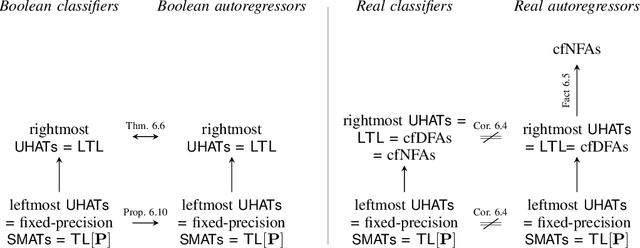
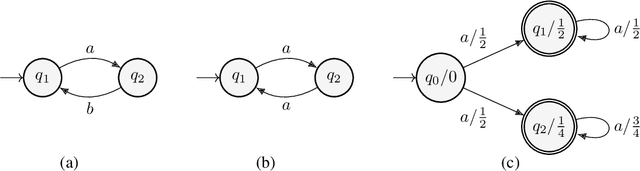
Most expressivity results for transformers treat them as language recognizers (which accept or reject strings), and not as they are used in practice, as language models (which generate strings autoregressively and probabilistically). Here, we characterize the probability distributions that transformer language models can express. We show that making transformer language recognizers autoregressive can sometimes increase their expressivity, and that making them probabilistic can break equivalences that hold in the non-probabilistic case. Our overall contribution is to tease apart what functions transformers are capable of expressing, in their most common use-case as language models.
Information Locality as an Inductive Bias for Neural Language Models
Jun 05, 2025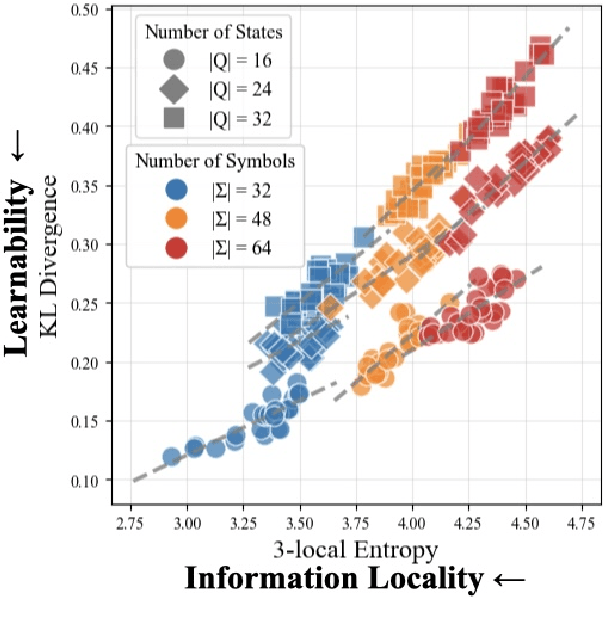
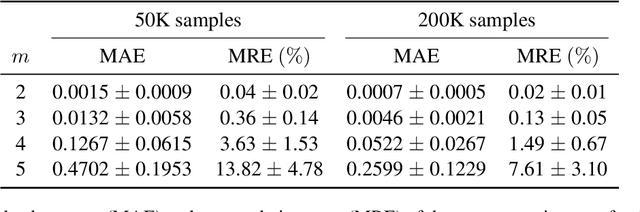
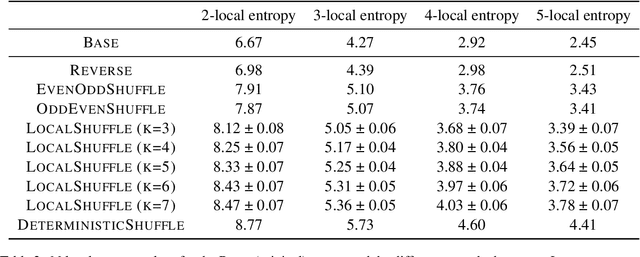
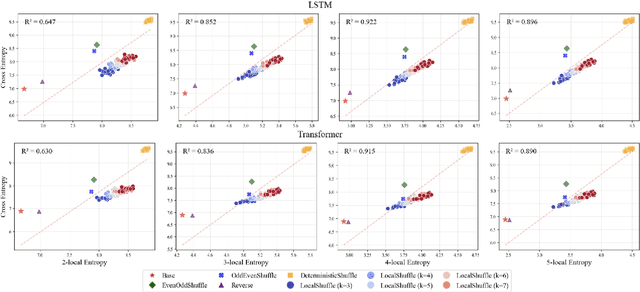
Inductive biases are inherent in every machine learning system, shaping how models generalize from finite data. In the case of neural language models (LMs), debates persist as to whether these biases align with or diverge from human processing constraints. To address this issue, we propose a quantitative framework that allows for controlled investigations into the nature of these biases. Within our framework, we introduce $m$-local entropy$\unicode{x2013}$an information-theoretic measure derived from average lossy-context surprisal$\unicode{x2013}$that captures the local uncertainty of a language by quantifying how effectively the $m-1$ preceding symbols disambiguate the next symbol. In experiments on both perturbed natural language corpora and languages defined by probabilistic finite-state automata (PFSAs), we show that languages with higher $m$-local entropy are more difficult for Transformer and LSTM LMs to learn. These results suggest that neural LMs, much like humans, are highly sensitive to the local statistical structure of a language.