 Add to Chrome
 Add to Firefox
 Add to Edge
Vision-Language Modelling For Radiological Imaging and Reports In The Low Data Regime
Mar 30, 2023
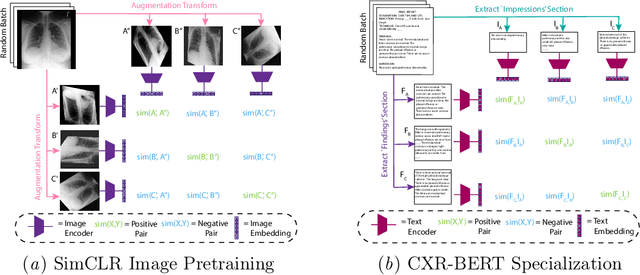
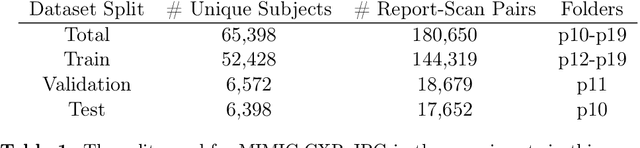
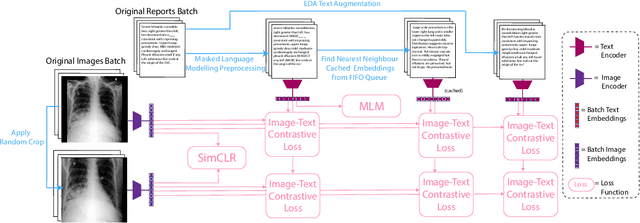
This paper explores training medical vision-language models (VLMs) -- where the visual and language inputs are embedded into a common space -- with a particular focus on scenarios where training data is limited, as is often the case in clinical datasets. We explore several candidate methods to improve low-data performance, including: (i) adapting generic pre-trained models to novel image and text domains (i.e. medical imaging and reports) via unimodal self-supervision; (ii) using local (e.g. GLoRIA) & global (e.g. InfoNCE) contrastive loss functions as well as a combination of the two; (iii) extra supervision during VLM training, via: (a) image- and text-only self-supervision, and (b) creating additional positive image-text pairs for training through augmentation and nearest-neighbour search. Using text-to-image retrieval as a benchmark, we evaluate the performance of these methods with variable sized training datasets of paired chest X-rays and radiological reports. Combined, they significantly improve retrieval compared to fine-tuning CLIP, roughly equivalent to training with the data. A similar pattern is found in the downstream task classification of CXR-related conditions with our method outperforming CLIP and also BioVIL, a strong CXR VLM benchmark, in the zero-shot and linear probing settings. We conclude with a set of recommendations for researchers aiming to train vision-language models on other medical imaging modalities when training data is scarce. To facilitate further research, we will make our code and models publicly available.

AutoAD: Movie Description in Context
Mar 29, 2023The objective of this paper is an automatic Audio Description (AD) model that ingests movies and outputs AD in text form. Generating high-quality movie AD is challenging due to the dependency of the descriptions on context, and the limited amount of training data available. In this work, we leverage the power of pretrained foundation models, such as GPT and CLIP, and only train a mapping network that bridges the two models for visually-conditioned text generation. In order to obtain high-quality AD, we make the following four contributions: (i) we incorporate context from the movie clip, AD from previous clips, as well as the subtitles; (ii) we address the lack of training data by pretraining on large-scale datasets, where visual or contextual information is unavailable, e.g. text-only AD without movies or visual captioning datasets without context; (iii) we improve on the currently available AD datasets, by removing label noise in the MAD dataset, and adding character naming information; and (iv) we obtain strong results on the movie AD task compared with previous methods.
Three ways to improve feature alignment for open vocabulary detection
Mar 23, 2023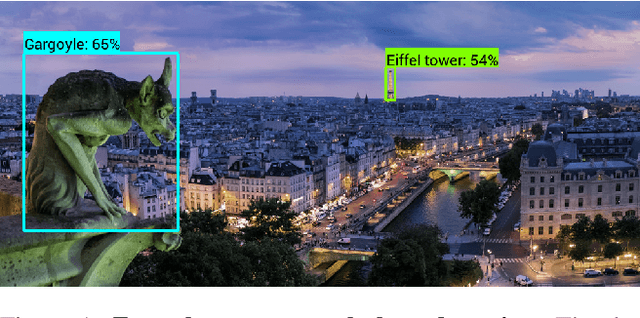
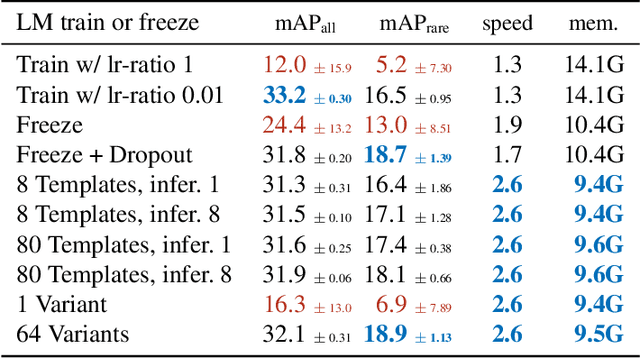
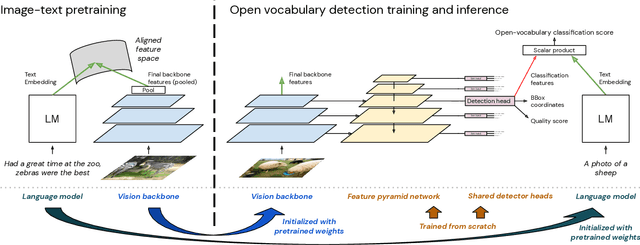
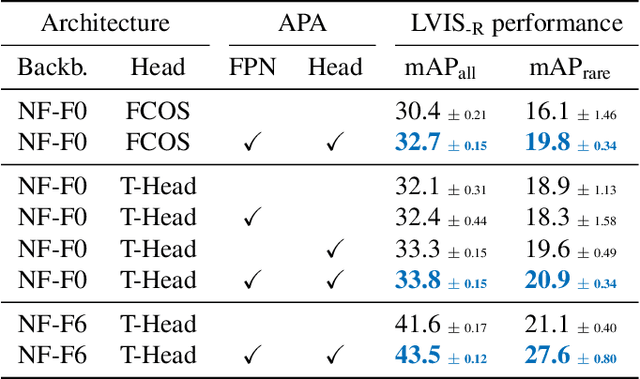
The core problem in zero-shot open vocabulary detection is how to align visual and text features, so that the detector performs well on unseen classes. Previous approaches train the feature pyramid and detection head from scratch, which breaks the vision-text feature alignment established during pretraining, and struggles to prevent the language model from forgetting unseen classes. We propose three methods to alleviate these issues. Firstly, a simple scheme is used to augment the text embeddings which prevents overfitting to a small number of classes seen during training, while simultaneously saving memory and computation. Secondly, the feature pyramid network and the detection head are modified to include trainable gated shortcuts, which encourages vision-text feature alignment and guarantees it at the start of detection training. Finally, a self-training approach is used to leverage a larger corpus of image-text pairs thus improving detection performance on classes with no human annotated bounding boxes. Our three methods are evaluated on the zero-shot version of the LVIS benchmark, each of them showing clear and significant benefits. Our final network achieves the new stateof-the-art on the mAP-all metric and demonstrates competitive performance for mAP-rare, as well as superior transfer to COCO and Objects365.
VoxSRC 2022: The Fourth VoxCeleb Speaker Recognition Challenge
Mar 06, 2023This paper summarises the findings from the VoxCeleb Speaker Recognition Challenge 2022 (VoxSRC-22), which was held in conjunction with INTERSPEECH 2022. The goal of this challenge was to evaluate how well state-of-the-art speaker recognition systems can diarise and recognise speakers from speech obtained "in the wild". The challenge consisted of: (i) the provision of publicly available speaker recognition and diarisation data from YouTube videos together with ground truth annotation and standardised evaluation software; and (ii) a public challenge and hybrid workshop held at INTERSPEECH 2022. We describe the four tracks of our challenge along with the baselines, methods, and results. We conclude with a discussion on the new domain-transfer focus of VoxSRC-22, and on the progression of the challenge from the previous three editions.
WhisperX: Time-Accurate Speech Transcription of Long-Form Audio
Mar 01, 2023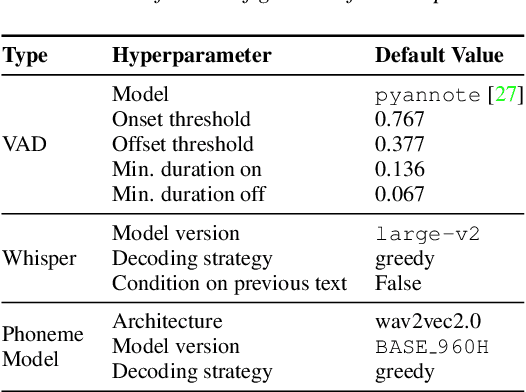

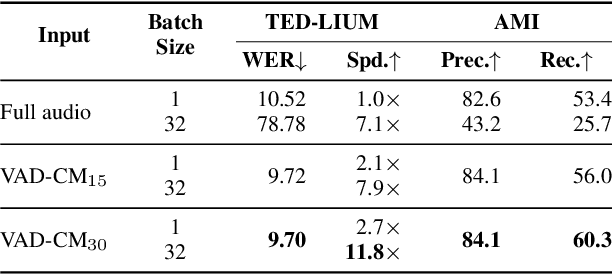
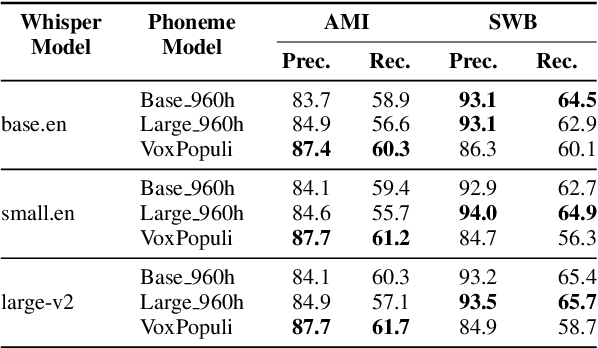
Large-scale, weakly-supervised speech recognition models, such as Whisper, have demonstrated impressive results on speech recognition across domains and languages. However, their application to long audio transcription via buffered or sliding window approaches is prone to drifting, hallucination & repetition; and prohibits batched transcription due to their sequential nature. Further, timestamps corresponding each utterance are prone to inaccuracies and word-level timestamps are not available out-of-the-box. To overcome these challenges, we present WhisperX, a time-accurate speech recognition system with word-level timestamps utilising voice activity detection and forced phoneme alignment. In doing so, we demonstrate state-of-the-art performance on long-form transcription and word segmentation benchmarks. Additionally, we show that pre-segmenting audio with our proposed VAD Cut & Merge strategy improves transcription quality and enables a twelve-fold transcription speedup via batched inference.
Epic-Sounds: A Large-scale Dataset of Actions That Sound
Feb 01, 2023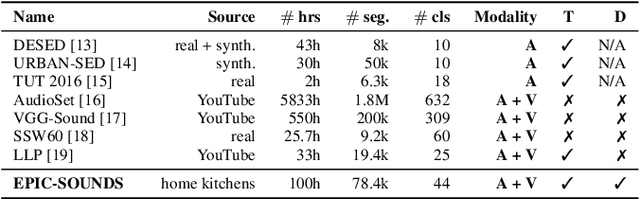
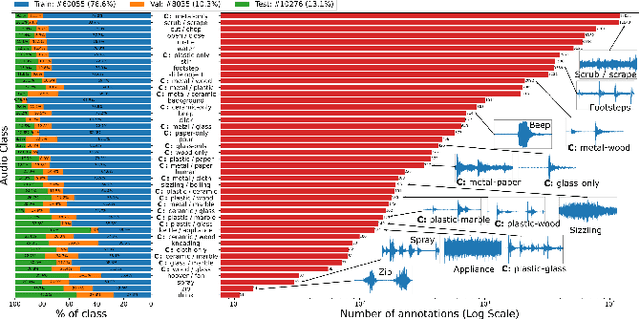
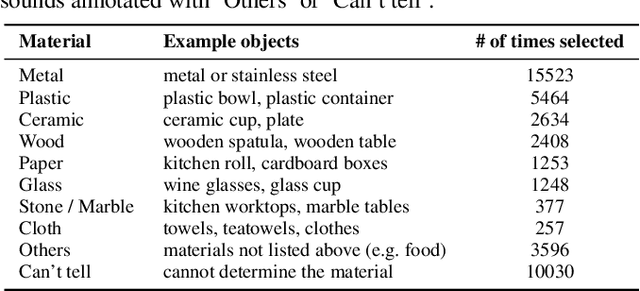
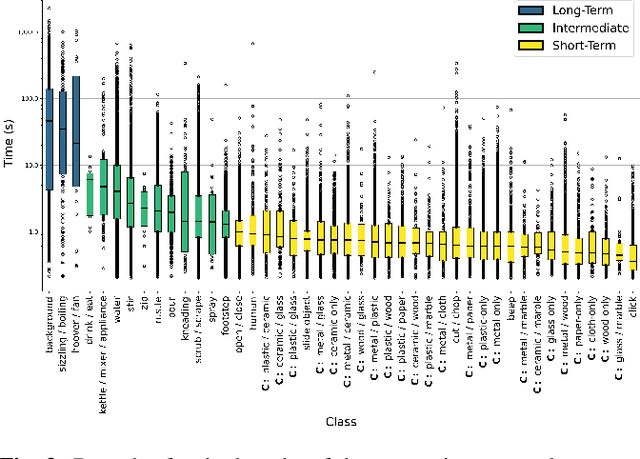
We introduce EPIC-SOUNDS, a large-scale dataset of audio annotations capturing temporal extents and class labels within the audio stream of the egocentric videos. We propose an annotation pipeline where annotators temporally label distinguishable audio segments and describe the action that could have caused this sound. We identify actions that can be discriminated purely from audio, through grouping these free-form descriptions of audio into classes. For actions that involve objects colliding, we collect human annotations of the materials of these objects (e.g. a glass object being placed on a wooden surface), which we verify from visual labels, discarding ambiguities. Overall, EPIC-SOUNDS includes 78.4k categorised segments of audible events and actions, distributed across 44 classes as well as 39.2k non-categorised segments. We train and evaluate two state-of-the-art audio recognition models on our dataset, highlighting the importance of audio-only labels and the limitations of current models to recognise actions that sound.
Zorro: the masked multimodal transformer
Jan 23, 2023

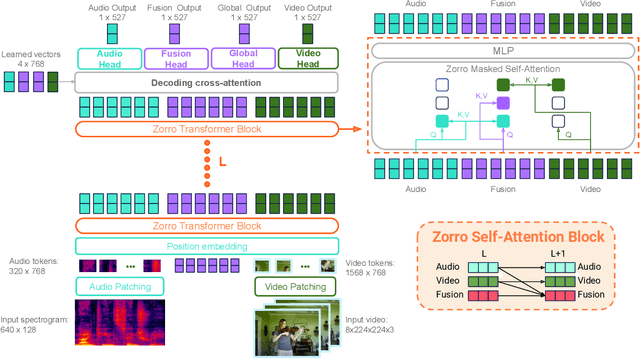

Attention-based models are appealing for multimodal processing because inputs from multiple modalities can be concatenated and fed to a single backbone network - thus requiring very little fusion engineering. The resulting representations are however fully entangled throughout the network, which may not always be desirable: in learning, contrastive audio-visual self-supervised learning requires independent audio and visual features to operate, otherwise learning collapses; in inference, evaluation of audio-visual models should be possible on benchmarks having just audio or just video. In this paper, we introduce Zorro, a technique that uses masks to control how inputs from each modality are routed inside Transformers, keeping some parts of the representation modality-pure. We apply this technique to three popular transformer-based architectures (ViT, Swin and HiP) and show that with contrastive pre-training Zorro achieves state-of-the-art results on most relevant benchmarks for multimodal tasks (AudioSet and VGGSound). Furthermore, the resulting models are able to perform unimodal inference on both video and audio benchmarks such as Kinetics-400 or ESC-50.
A Light Touch Approach to Teaching Transformers Multi-view Geometry
Nov 28, 2022Transformers are powerful visual learners, in large part due to their conspicuous lack of manually-specified priors. This flexibility can be problematic in tasks that involve multiple-view geometry, due to the near-infinite possible variations in 3D shapes and viewpoints (requiring flexibility), and the precise nature of projective geometry (obeying rigid laws). To resolve this conundrum, we propose a "light touch" approach, guiding visual Transformers to learn multiple-view geometry but allowing them to break free when needed. We achieve this by using epipolar lines to guide the Transformer's cross-attention maps, penalizing attention values outside the epipolar lines and encouraging higher attention along these lines since they contain geometrically plausible matches. Unlike previous methods, our proposal does not require any camera pose information at test-time. We focus on pose-invariant object instance retrieval, where standard Transformer networks struggle, due to the large differences in viewpoint between query and retrieved images. Experimentally, our method outperforms state-of-the-art approaches at object retrieval, without needing pose information at test-time.
Weakly-supervised Fingerspelling Recognition in British Sign Language Videos
Nov 16, 2022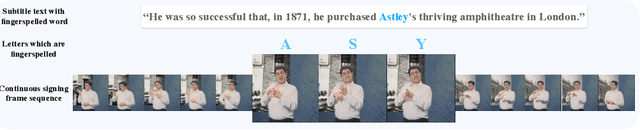

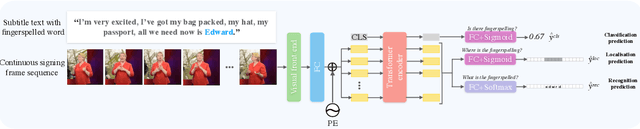

The goal of this work is to detect and recognize sequences of letters signed using fingerspelling in British Sign Language (BSL). Previous fingerspelling recognition methods have not focused on BSL, which has a very different signing alphabet (e.g., two-handed instead of one-handed) to American Sign Language (ASL). They also use manual annotations for training. In contrast to previous methods, our method only uses weak annotations from subtitles for training. We localize potential instances of fingerspelling using a simple feature similarity method, then automatically annotate these instances by querying subtitle words and searching for corresponding mouthing cues from the signer. We propose a Transformer architecture adapted to this task, with a multiple-hypothesis CTC loss function to learn from alternative annotation possibilities. We employ a multi-stage training approach, where we make use of an initial version of our trained model to extend and enhance our training data before re-training again to achieve better performance. Through extensive evaluations, we verify our method for automatic annotation and our model architecture. Moreover, we provide a human expert annotated test set of 5K video clips for evaluating BSL fingerspelling recognition methods to support sign language research.
TAP-Vid: A Benchmark for Tracking Any Point in a Video
Nov 07, 2022Generic motion understanding from video involves not only tracking objects, but also perceiving how their surfaces deform and move. This information is useful to make inferences about 3D shape, physical properties and object interactions. While the problem of tracking arbitrary physical points on surfaces over longer video clips has received some attention, no dataset or benchmark for evaluation existed, until now. In this paper, we first formalize the problem, naming it tracking any point (TAP). We introduce a companion benchmark, TAP-Vid, which is composed of both real-world videos with accurate human annotations of point tracks, and synthetic videos with perfect ground-truth point tracks. Central to the construction of our benchmark is a novel semi-automatic crowdsourced pipeline which uses optical flow estimates to compensate for easier, short-term motion like camera shake, allowing annotators to focus on harder sections of video. We validate our pipeline on synthetic data and propose a simple end-to-end point tracking model TAP-Net, showing that it outperforms all prior methods on our benchmark when trained on synthetic data.