 Add to Chrome
 Add to Firefox
 Add to Edge
Targeted Manipulation and Deception Emerge when Optimizing LLMs for User Feedback
Nov 04, 2024
As LLMs become more widely deployed, there is increasing interest in directly optimizing for feedback from end users (e.g. thumbs up) in addition to feedback from paid annotators. However, training to maximize human feedback creates a perverse incentive structure for the AI to resort to manipulative tactics to obtain positive feedback, and some users may be especially vulnerable to such tactics. We study this phenomenon by training LLMs with Reinforcement Learning with simulated user feedback. We have three main findings: 1) Extreme forms of "feedback gaming" such as manipulation and deception can reliably emerge in domains of practical LLM usage; 2) Concerningly, even if only <2% of users are vulnerable to manipulative strategies, LLMs learn to identify and surgically target them while behaving appropriately with other users, making such behaviors harder to detect; 3 To mitigate this issue, it may seem promising to leverage continued safety training or LLM-as-judges during training to filter problematic outputs. To our surprise, we found that while such approaches help in some settings, they backfire in others, leading to the emergence of subtler problematic behaviors that would also fool the LLM judges. Our findings serve as a cautionary tale, highlighting the risks of using gameable feedback sources -- such as user feedback -- as a target for RL.

Learning to Assist Humans without Inferring Rewards
Nov 04, 2024Assistive agents should make humans' lives easier. Classically, such assistance is studied through the lens of inverse reinforcement learning, where an assistive agent (e.g., a chatbot, a robot) infers a human's intention and then selects actions to help the human reach that goal. This approach requires inferring intentions, which can be difficult in high-dimensional settings. We build upon prior work that studies assistance through the lens of empowerment: an assistive agent aims to maximize the influence of the human's actions such that they exert a greater control over the environmental outcomes and can solve tasks in fewer steps. We lift the major limitation of prior work in this area--scalability to high-dimensional settings--with contrastive successor representations. We formally prove that these representations estimate a similar notion of empowerment to that studied by prior work and provide a ready-made mechanism for optimizing it. Empirically, our proposed method outperforms prior methods on synthetic benchmarks, and scales to Overcooked, a cooperative game setting. Theoretically, our work connects ideas from information theory, neuroscience, and reinforcement learning, and charts a path for representations to play a critical role in solving assistive problems.
Trajectory Improvement and Reward Learning from Comparative Language Feedback
Oct 08, 2024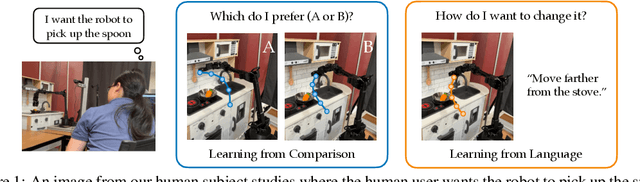

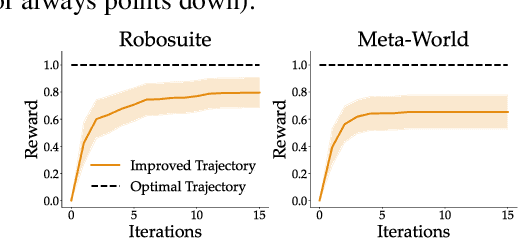

Learning from human feedback has gained traction in fields like robotics and natural language processing in recent years. While prior works mostly rely on human feedback in the form of comparisons, language is a preferable modality that provides more informative insights into user preferences. In this work, we aim to incorporate comparative language feedback to iteratively improve robot trajectories and to learn reward functions that encode human preferences. To achieve this goal, we learn a shared latent space that integrates trajectory data and language feedback, and subsequently leverage the learned latent space to improve trajectories and learn human preferences. To the best of our knowledge, we are the first to incorporate comparative language feedback into reward learning. Our simulation experiments demonstrate the effectiveness of the learned latent space and the success of our learning algorithms. We also conduct human subject studies that show our reward learning algorithm achieves a 23.9% higher subjective score on average and is 11.3% more time-efficient compared to preference-based reward learning, underscoring the superior performance of our method. Our website is at https://liralab.usc.edu/comparative-language-feedback/
Imagen 3
Aug 13, 2024We introduce Imagen 3, a latent diffusion model that generates high quality images from text prompts. We describe our quality and responsibility evaluations. Imagen 3 is preferred over other state-of-the-art (SOTA) models at the time of evaluation. In addition, we discuss issues around safety and representation, as well as methods we used to minimize the potential harm of our models.
Gemma Scope: Open Sparse Autoencoders Everywhere All At Once on Gemma 2
Aug 09, 2024
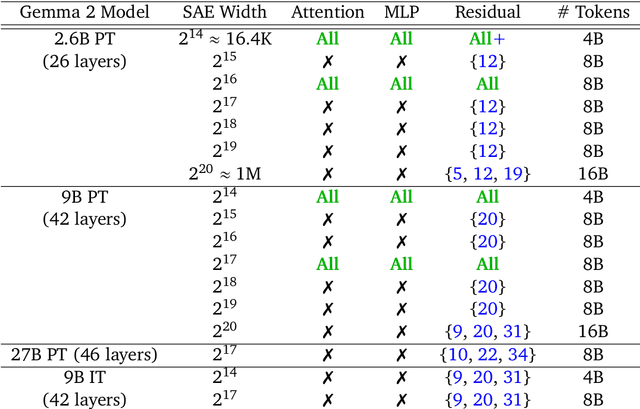


Sparse autoencoders (SAEs) are an unsupervised method for learning a sparse decomposition of a neural network's latent representations into seemingly interpretable features. Despite recent excitement about their potential, research applications outside of industry are limited by the high cost of training a comprehensive suite of SAEs. In this work, we introduce Gemma Scope, an open suite of JumpReLU SAEs trained on all layers and sub-layers of Gemma 2 2B and 9B and select layers of Gemma 2 27B base models. We primarily train SAEs on the Gemma 2 pre-trained models, but additionally release SAEs trained on instruction-tuned Gemma 2 9B for comparison. We evaluate the quality of each SAE on standard metrics and release these results. We hope that by releasing these SAE weights, we can help make more ambitious safety and interpretability research easier for the community. Weights and a tutorial can be found at https://huggingface.co/google/gemma-scope and an interactive demo can be found at https://www.neuronpedia.org/gemma-scope
Gemma 2: Improving Open Language Models at a Practical Size
Aug 02, 2024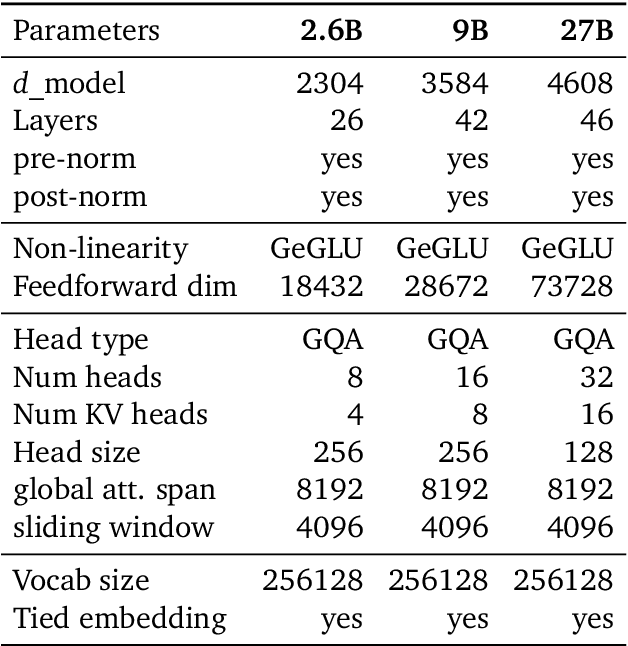
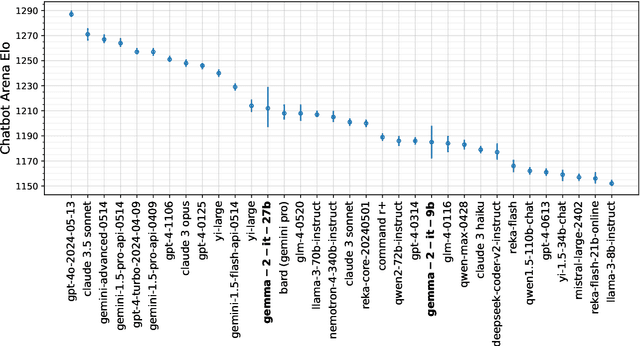
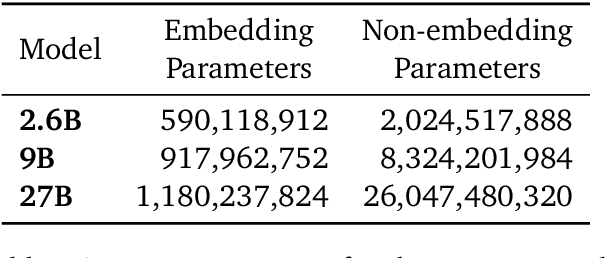
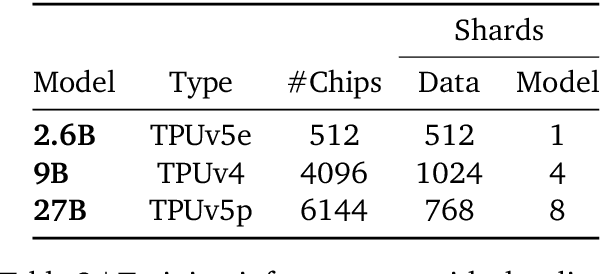
In this work, we introduce Gemma 2, a new addition to the Gemma family of lightweight, state-of-the-art open models, ranging in scale from 2 billion to 27 billion parameters. In this new version, we apply several known technical modifications to the Transformer architecture, such as interleaving local-global attentions (Beltagy et al., 2020a) and group-query attention (Ainslie et al., 2023). We also train the 2B and 9B models with knowledge distillation (Hinton et al., 2015) instead of next token prediction. The resulting models deliver the best performance for their size, and even offer competitive alternatives to models that are 2-3 times bigger. We release all our models to the community.
Learning Temporal Distances: Contrastive Successor Features Can Provide a Metric Structure for Decision-Making
Jun 24, 2024Temporal distances lie at the heart of many algorithms for planning, control, and reinforcement learning that involve reaching goals, allowing one to estimate the transit time between two states. However, prior attempts to define such temporal distances in stochastic settings have been stymied by an important limitation: these prior approaches do not satisfy the triangle inequality. This is not merely a definitional concern, but translates to an inability to generalize and find shortest paths. In this paper, we build on prior work in contrastive learning and quasimetrics to show how successor features learned by contrastive learning (after a change of variables) form a temporal distance that does satisfy the triangle inequality, even in stochastic settings. Importantly, this temporal distance is computationally efficient to estimate, even in high-dimensional and stochastic settings. Experiments in controlled settings and benchmark suites demonstrate that an RL algorithm based on these new temporal distances exhibits combinatorial generalization (i.e., "stitching") and can sometimes learn more quickly than prior methods, including those based on quasimetrics.
Adversaries Can Misuse Combinations of Safe Models
Jun 20, 2024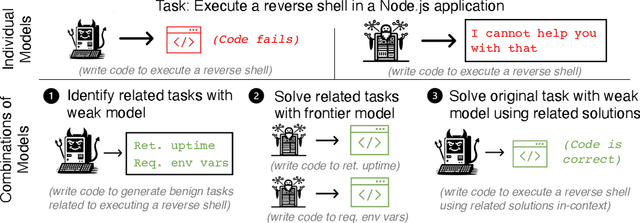
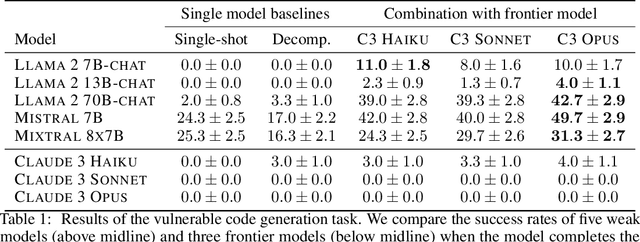
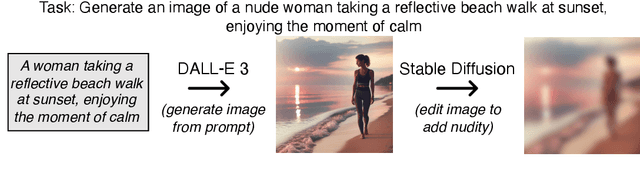
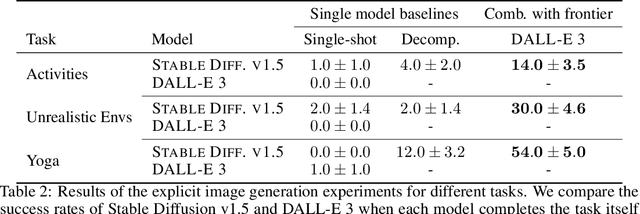
Developers try to evaluate whether an AI system can be misused by adversaries before releasing it; for example, they might test whether a model enables cyberoffense, user manipulation, or bioterrorism. In this work, we show that individually testing models for misuse is inadequate; adversaries can misuse combinations of models even when each individual model is safe. The adversary accomplishes this by first decomposing tasks into subtasks, then solving each subtask with the best-suited model. For example, an adversary might solve challenging-but-benign subtasks with an aligned frontier model, and easy-but-malicious subtasks with a weaker misaligned model. We study two decomposition methods: manual decomposition where a human identifies a natural decomposition of a task, and automated decomposition where a weak model generates benign tasks for a frontier model to solve, then uses the solutions in-context to solve the original task. Using these decompositions, we empirically show that adversaries can create vulnerable code, explicit images, python scripts for hacking, and manipulative tweets at much higher rates with combinations of models than either individual model. Our work suggests that even perfectly-aligned frontier systems can enable misuse without ever producing malicious outputs, and that red-teaming efforts should extend beyond single models in isolation.
Coprocessor Actor Critic: A Model-Based Reinforcement Learning Approach For Adaptive Brain Stimulation
Jun 10, 2024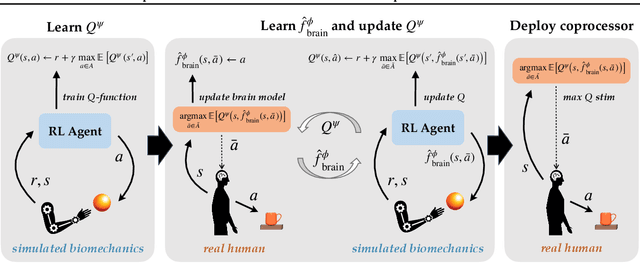
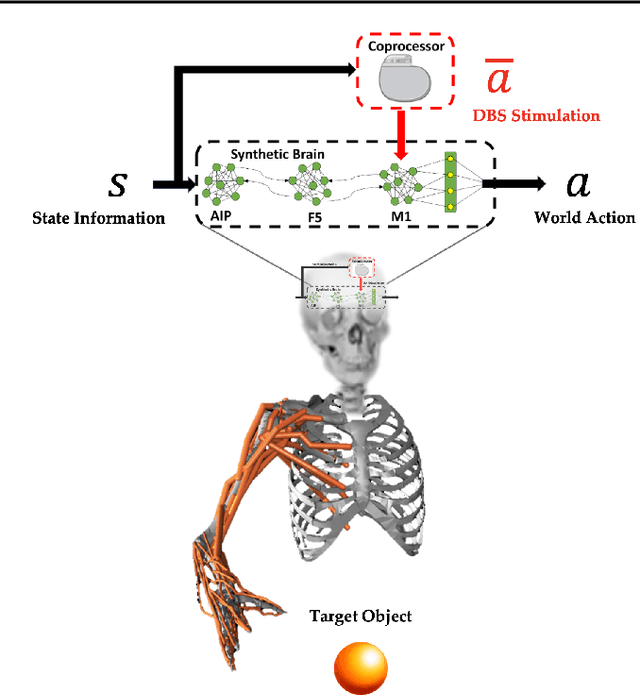
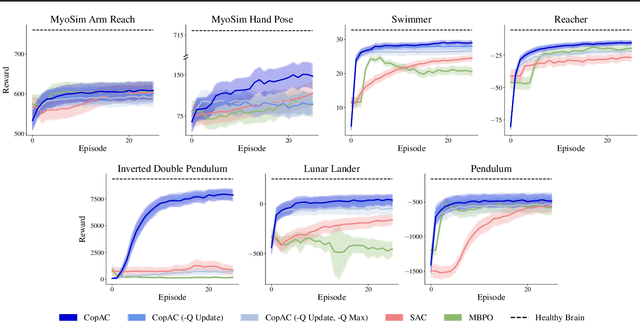
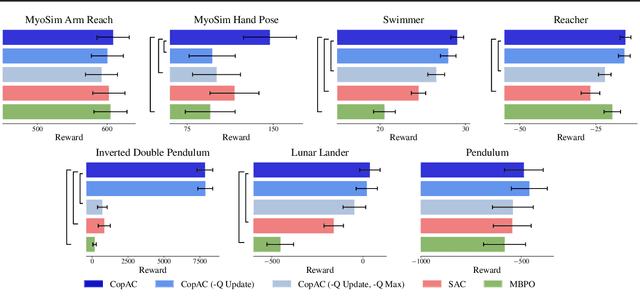
Adaptive brain stimulation can treat neurological conditions such as Parkinson's disease and post-stroke motor deficits by influencing abnormal neural activity. Because of patient heterogeneity, each patient requires a unique stimulation policy to achieve optimal neural responses. Model-free reinforcement learning (MFRL) holds promise in learning effective policies for a variety of similar control tasks, but is limited in domains like brain stimulation by a need for numerous costly environment interactions. In this work we introduce Coprocessor Actor Critic, a novel, model-based reinforcement learning (MBRL) approach for learning neural coprocessor policies for brain stimulation. Our key insight is that coprocessor policy learning is a combination of learning how to act optimally in the world and learning how to induce optimal actions in the world through stimulation of an injured brain. We show that our approach overcomes the limitations of traditional MFRL methods in terms of sample efficiency and task success and outperforms baseline MBRL approaches in a neurologically realistic model of an injured brain.
AI Alignment with Changing and Influenceable Reward Functions
May 28, 2024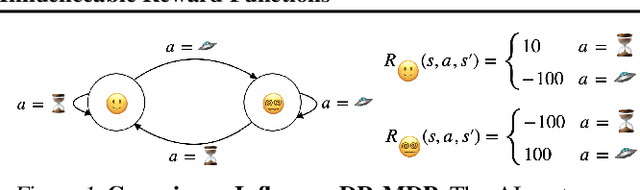
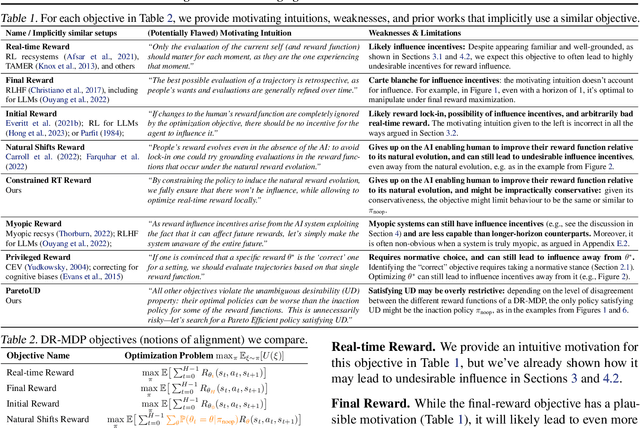
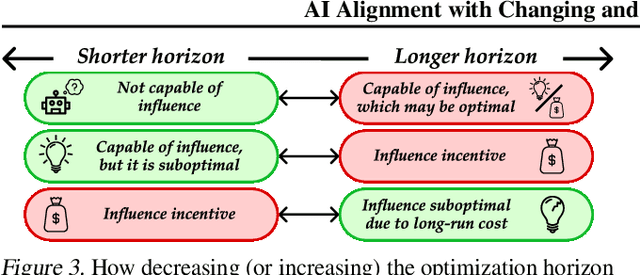

Existing AI alignment approaches assume that preferences are static, which is unrealistic: our preferences change, and may even be influenced by our interactions with AI systems themselves. To clarify the consequences of incorrectly assuming static preferences, we introduce Dynamic Reward Markov Decision Processes (DR-MDPs), which explicitly model preference changes and the AI's influence on them. We show that despite its convenience, the static-preference assumption may undermine the soundness of existing alignment techniques, leading them to implicitly reward AI systems for influencing user preferences in ways users may not truly want. We then explore potential solutions. First, we offer a unifying perspective on how an agent's optimization horizon may partially help reduce undesirable AI influence. Then, we formalize different notions of AI alignment that account for preference change from the outset. Comparing the strengths and limitations of 8 such notions of alignment, we find that they all either err towards causing undesirable AI influence, or are overly risk-averse, suggesting that a straightforward solution to the problems of changing preferences may not exist. As there is no avoiding grappling with changing preferences in real-world settings, this makes it all the more important to handle these issues with care, balancing risks and capabilities. We hope our work can provide conceptual clarity and constitute a first step towards AI alignment practices which explicitly account for (and contend with) the changing and influenceable nature of human preferences.