 Add to Chrome
 Add to Firefox
 Add to Edge
ReasoningFlow: Discourse Structures for Understanding LLM Reasoning Traces
Jun 03, 2026
Large reasoning models (LRMs) produce reasoning traces with non-linear structures, such as backtracking and self-correction, that complicate the evaluation and monitoring of the reasoning process. We introduce ReasoningFlow, a framework that captures the discourse structures of LRM reasoning traces into fine-grained directed acyclic graphs (DAGs). We develop and validate our annotation schema through careful manual annotation of 31 traces (2.1k steps), achieving high inter-annotator agreement, then scale to automatic annotation of 1,260 traces (247.7k steps) spanning three tasks (math, science, argumentation) and five models (Qwen2.5-32B-Inst, QwQ-32B, DeepSeek-V3, DeepSeek-R1, GPT-oss-120B). By analyzing ReasoningFlow graphs, we find: (1) LRMs exhibit structurally similar traces, despite being trained from different base models and potentially non-overlapping post-training data. (2) ReasoningFlow reveals diverse fine-grained reasoning behaviors (e.g., local verification, self-reflection, and assumptions) that can be used for better reasoning trace monitorability. (3) In LRMs, most of the erroneous steps are not used to derive final answers. (4) Mechanistic causal dependencies between steps do not reflect the language-level discourse structure. We release the dataset and code in: https://github.com/jinulee-v/reasoningflow.

Toxic HallucinAItions: Perturbing Prompts and Tracing LLM Circuits
May 29, 2026Large language models (LLMs) are increasingly deployed in conversational settings where user tone ranges from polite to adversarial or toxic, yet less is known about whether toxic language in otherwise semantically equivalent prompts can degrade factual reliability. We study how lexical and tone-based prompt perturbations affect the factual reliability of LLMs. Using controlled prompt variations across polite, random, and three toxicity levels, we evaluate five LLMs on ARC-Easy, GSM8K, and MMLU. We find that toxic lexical perturbations consistently reduce factual accuracy and increase uncertainty, while polite phrasing yields limited and inconsistent changes. To examine whether these answer inconsistencies correspond to internal changes, we conduct attribution-graph analyses of model activations and influences. We find that increasing toxicity selectively amplifies perturbation-sensitive variant nodes while relatively stable core reasoning nodes remain more invariant. These findings position prompt tone as a critical dimension of LLM reliability and provide behavioral and mechanistic evidence that surface-level lexical variation can alter factual outputs and internal computation.
Too Polite to Disagree: Understanding Sycophancy Propagation in Multi-Agent Systems
Apr 03, 2026Large language models (LLMs) often exhibit sycophancy: agreement with user stance even when it conflicts with the model's opinion. While prior work has mostly studied this in single-agent settings, it remains underexplored in collaborative multi-agent systems. We ask whether awareness of other agents' sycophancy levels influences discussion outcomes. To investigate this, we run controlled experiments with six open-source LLMs, providing agents with peer sycophancy rankings that estimate each peer's tendency toward sycophancy. These rankings are based on scores calculated using various static (pre-discussion) and dynamic (online) strategies. We find that providing sycophancy priors reduces the influence of sycophancy-prone peers, mitigates error-cascades, and improves final discussion accuracy by an absolute 10.5%. Thus, this is a lightweight, effective way to reduce discussion sycophancy and improve downstream accuracy.
AMPS: ASR with Multimodal Paraphrase Supervision
Nov 27, 2024Spontaneous or conversational multilingual speech presents many challenges for state-of-the-art automatic speech recognition (ASR) systems. In this work, we present a new technique AMPS that augments a multilingual multimodal ASR system with paraphrase-based supervision for improved conversational ASR in multiple languages, including Hindi, Marathi, Malayalam, Kannada, and Nyanja. We use paraphrases of the reference transcriptions as additional supervision while training the multimodal ASR model and selectively invoke this paraphrase objective for utterances with poor ASR performance. Using AMPS with a state-of-the-art multimodal model SeamlessM4T, we obtain significant relative reductions in word error rates (WERs) of up to 5%. We present detailed analyses of our system using both objective and human evaluation metrics.
PathoGen-X: A Cross-Modal Genomic Feature Trans-Align Network for Enhanced Survival Prediction from Histopathology Images
Nov 01, 2024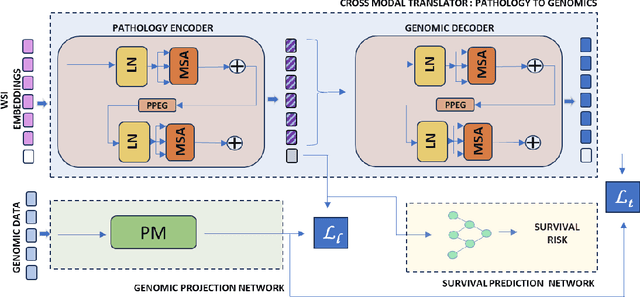

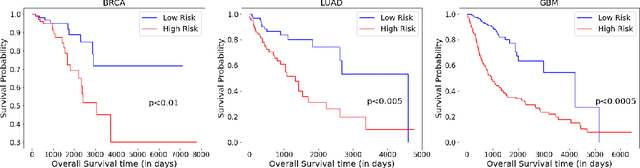

Accurate survival prediction is essential for personalized cancer treatment. However, genomic data - often a more powerful predictor than pathology data - is costly and inaccessible. We present the cross-modal genomic feature translation and alignment network for enhanced survival prediction from histopathology images (PathoGen-X). It is a deep learning framework that leverages both genomic and imaging data during training, relying solely on imaging data at testing. PathoGen-X employs transformer-based networks to align and translate image features into the genomic feature space, enhancing weaker imaging signals with stronger genomic signals. Unlike other methods, PathoGen-X translates and aligns features without projecting them to a shared latent space and requires fewer paired samples. Evaluated on TCGA-BRCA, TCGA-LUAD, and TCGA-GBM datasets, PathoGen-X demonstrates strong survival prediction performance, emphasizing the potential of enriched imaging models for accessible cancer prognosis.
Parameter-efficient Adaptation of Multilingual Multimodal Models for Low-resource ASR
Oct 17, 2024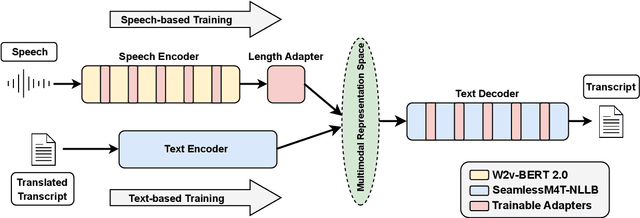

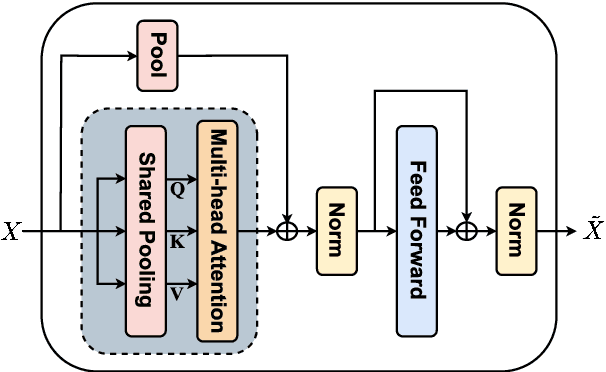

Automatic speech recognition (ASR) for low-resource languages remains a challenge due to the scarcity of labeled training data. Parameter-efficient fine-tuning and text-only adaptation are two popular methods that have been used to address such low-resource settings. In this work, we investigate how these techniques can be effectively combined using a multilingual multimodal model like SeamlessM4T. Multimodal models are able to leverage unlabeled text via text-only adaptation with further parameter-efficient ASR fine-tuning, thus boosting ASR performance. We also show cross-lingual transfer from a high-resource language, achieving up to a relative 17% WER reduction over a baseline in a zero-shot setting without any labeled speech.
Combining Datasets with Different Label Sets for Improved Nucleus Segmentation and Classification
Oct 05, 2023

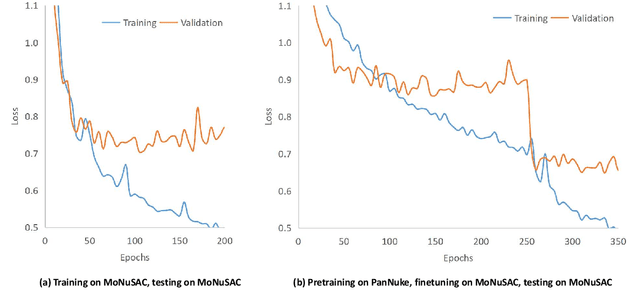

Segmentation and classification of cell nuclei in histopathology images using deep neural networks (DNNs) can save pathologists' time for diagnosing various diseases, including cancers, by automating cell counting and morphometric assessments. It is now well-known that the accuracy of DNNs increases with the sizes of annotated datasets available for training. Although multiple datasets of histopathology images with nuclear annotations and class labels have been made publicly available, the set of class labels differ across these datasets. We propose a method to train DNNs for instance segmentation and classification on multiple datasets where the set of classes across the datasets are related but not the same. Specifically, our method is designed to utilize a coarse-to-fine class hierarchy, where the set of classes labeled and annotated in a dataset can be at any level of the hierarchy, as long as the classes are mutually exclusive. Within a dataset, the set of classes need not even be at the same level of the class hierarchy tree. Our results demonstrate that segmentation and classification metrics for the class set used by the test split of a dataset can improve by pre-training on another dataset that may even have a different set of classes due to the expansion of the training set enabled by our method. Furthermore, generalization to previously unseen datasets also improves by combining multiple other datasets with different sets of classes for training. The improvement is both qualitative and quantitative. The proposed method can be adapted for various loss functions, DNN architectures, and application domains.
Artificial Intelligence-based Eosinophil Counting in Gastrointestinal Biopsies
Nov 25, 2022Normally eosinophils are present in the gastrointestinal (GI) tract of healthy individuals. When the eosinophils increase beyond their usual amount in the GI tract, a patient gets varied symptoms. Clinicians find it difficult to diagnose this condition called eosinophilia. Early diagnosis can help in treating patients. Histopathology is the gold standard in the diagnosis for this condition. As this is an under-diagnosed condition, counting eosinophils in the GI tract biopsies is important. In this study, we trained and tested a deep neural network based on UNet to detect and count eosinophils in GI tract biopsies. We used connected component analysis to extract the eosinophils. We studied correlation of eosinophilic infiltration counted by AI with a manual count. GI tract biopsy slides were stained with H&E stain. Slides were scanned using a camera attached to a microscope and five high-power field images were taken per slide. Pearson correlation coefficient was 85% between the machine-detected and manual eosinophil counts on 300 held-out (test) images.