 Add to Chrome
 Add to Firefox
 Add to Edge
Toxic HallucinAItions: Perturbing Prompts and Tracing LLM Circuits
May 29, 2026
Large language models (LLMs) are increasingly deployed in conversational settings where user tone ranges from polite to adversarial or toxic, yet less is known about whether toxic language in otherwise semantically equivalent prompts can degrade factual reliability. We study how lexical and tone-based prompt perturbations affect the factual reliability of LLMs. Using controlled prompt variations across polite, random, and three toxicity levels, we evaluate five LLMs on ARC-Easy, GSM8K, and MMLU. We find that toxic lexical perturbations consistently reduce factual accuracy and increase uncertainty, while polite phrasing yields limited and inconsistent changes. To examine whether these answer inconsistencies correspond to internal changes, we conduct attribution-graph analyses of model activations and influences. We find that increasing toxicity selectively amplifies perturbation-sensitive variant nodes while relatively stable core reasoning nodes remain more invariant. These findings position prompt tone as a critical dimension of LLM reliability and provide behavioral and mechanistic evidence that surface-level lexical variation can alter factual outputs and internal computation.

LLUMI: Improving LLM Writing Assistance for Mental Health Support with Online Community Feedback
May 28, 2026Large language models (LLMs) show promise in generating supportive responses for mental health queries, but improving their usefulness, empathy, and safety often requires substantial compute, expert input, and labeled data. At the same time, deploying proprietary, cloud-based models for mental health-related interactions raises important privacy and data-governance concerns, given the sensitivities. To address this challenge, we introduce LLUMI setup that can be hosted in-house within protected environments. LLUMI consists of two complementary components: a generation model (GM), which drafts supportive responses to mental health queries, and an improvement model (IM), which revises an initial human-crafted response. We leverage feedback signals from Reddit mental health communities, using community endorsement patterns such as upvotes and downvotes to construct chosen-rejected response pairs for Supervised Fine Tuning (SFT) and Direct Preference Optimization (DPO). We further align LLUMI using human evaluation across five dimensions: readability, empathy, connection, actionability, and safety. Our results show that, despite relying on smaller open-source models rather than proprietary cloud-based GPT models, LLUMI achieves comparable performance across linguistic analyses and human evaluations. These findings suggest that open-source models, when trained with community-derived preference signals, can support high-quality mental health support assistance while offering a more privacy-preserving alternative for sensitive support contexts.
Masking or Mitigating? Deconstructing the Impact of Query Rewriting on Retriever Biases in RAG
Apr 07, 2026Dense retrievers in retrieval-augmented generation (RAG) systems exhibit systematic biases -- including brevity, position, literal matching, and repetition biases -- that can compromise retrieval quality. Query rewriting techniques are now standard in RAG pipelines, yet their impact on these biases remains unexplored. We present the first systematic study of how query enhancement techniques affect dense retrieval biases, evaluating five methods across six retrievers. Our findings reveal that simple LLM-based rewriting achieves the strongest aggregate bias reduction (54\%), yet fails under adversarial conditions where multiple biases combine. Mechanistic analysis uncovers two distinct mechanisms: simple rewriting reduces bias through increased score variance, while pseudo-document generation methods achieve reduction through genuine decorrelation from bias-inducing features. However, no technique uniformly addresses all biases, and effects vary substantially across retrievers. Our results provide practical guidance for selecting query enhancement strategies based on specific bias vulnerabilities. More broadly, we establish a taxonomy distinguishing query-document interaction biases from document encoding biases, clarifying the limits of query-side interventions for debiasing RAG systems.
From Plausible to Causal: Counterfactual Semantics for Policy Evaluation in Simulated Online Communities
Apr 05, 2026LLM-based social simulations can generate believable community interactions, enabling ``policy wind tunnels'' where governance interventions are tested before deployment. But believability is not causality. Claims like ``intervention $A$ reduces escalation'' require causal semantics that current simulation work typically does not specify. We propose adopting the causal counterfactual framework, distinguishing \textit{necessary causation} (would the outcome have occurred without the intervention?) from \textit{sufficient causation} (does the intervention reliably produce the outcome?). This distinction maps onto different stakeholder needs: moderators diagnosing incidents require evidence about necessity, while platform designers choosing policies require evidence about sufficiency. We formalize this mapping, show how simulation design can support estimation under explicit assumptions, and argue that the resulting quantities should be interpreted as simulator-conditional causal estimates whose policy relevance depends on simulator fidelity. Establishing this framework now is essential: it helps define what adequate fidelity means and moves the field from simulations that look realistic toward simulations that can support policy changes.
Answer Bubbles: Information Exposure in AI-Mediated Search
Mar 17, 2026Generative search systems are increasingly replacing link-based retrieval with AI-generated summaries, yet little is known about how these systems differ in sources, language, and fidelity to cited material. We examine responses to 11,000 real search queries across four systems -- vanilla GPT, Search GPT, Google AI Overviews, and traditional Google Search -- at three levels: source diversity, linguistic characterization of the generated summary, and source-summary fidelity. We find that generative search systems exhibit significant \textit{source-selection} biases in their citations, favoring certain sources over others. Incorporating search also selectively attenuates epistemic markers, reducing hedging by up to 60\% while preserving confidence language in the AI-generated summaries. At the same time, AI summaries further compound the citation biases: Wikipedia and longer sources are disproportionately overrepresented, whereas cited social media content and negatively framed sources are substantially underrepresented. Our findings highlight the potential for \textit{answer bubbles}, in which identical queries yield structurally different information realities across systems, with implications for user trust, source visibility, and the transparency of AI-mediated information access.
Social Simulacra in the Wild: AI Agent Communities on Moltbook
Mar 17, 2026As autonomous LLM-based agents increasingly populate social platforms, understanding the dynamics of AI-agent communities becomes essential for both communication research and platform governance. We present the first large-scale empirical comparison of AI-agent and human online communities, analyzing 73,899 Moltbook and 189,838 Reddit posts across five matched communities. Structurally, we find that Moltbook exhibits extreme participation inequality (Gini = 0.84 vs. 0.47) and high cross-community author overlap (33.8\% vs. 0.5\%). In terms of linguistic attributes, content generated by AI-agents is emotionally flattened, cognitively shifted toward assertion over exploration, and socially detached. These differences give rise to apparent community-level homogenization, but we show this is primarily a structural artifact of shared authorship. At the author level, individual agents are more identifiable than human users, driven by outlier stylistic profiles amplified by their extreme posting volume. As AI-mediated communication reshapes online discourse, our work offers an empirical foundation for understanding how multi-agent interaction gives rise to collective communication dynamics distinct from those of human communities.
The Hidden Toll of Social Media News: Causal Effects on Psychosocial Wellbeing
Jan 20, 2026News consumption on social media has become ubiquitous, yet how different forms of engagement shape psychosocial outcomes remains unclear. To address this gap, we leveraged a large-scale dataset of ~26M posts and ~45M comments on the BlueSky platform, and conducted a quasi-experimental study, matching 81,345 Treated users exposed to News feeds with 83,711 Control users using stratified propensity score analysis. We examined psychosocial wellbeing, in terms of affective, behavioral, and cognitive outcomes. Our findings reveal that news engagement produces systematic trade-offs: increased depression, stress, and anxiety, yet decreased loneliness and increased social interaction on the platform. Regression models reveal that News feed bookmarking is associated with greater psychosocial deterioration compared to commenting or quoting, with magnitude differences exceeding tenfold. These per-engagement effects accumulate with repeated exposure, showing significant psychosocial impacts. Our work extends theories of news effects beyond crisis-centric frameworks by demonstrating that routine consumption creates distinct psychological dynamics depending on engagement type, and bears implications for tools and interventions for mitigating the psychosocial costs of news consumption on social media.
PAIR-SAFE: A Paired-Agent Approach for Runtime Auditing and Refining AI-Mediated Mental Health Support
Jan 19, 2026Large language models (LLMs) are increasingly used for mental health support, yet they can produce responses that are overly directive, inconsistent, or clinically misaligned, particularly in sensitive or high-risk contexts. Existing approaches to mitigating these risks largely rely on implicit alignment through training or prompting, offering limited transparency and runtime accountability. We introduce PAIR-SAFE, a paired-agent framework for auditing and refining AI-generated mental health support that integrates a Responder agent with a supervisory Judge agent grounded in the clinically validated Motivational Interviewing Treatment Integrity (MITI-4) framework. The Judgeaudits each response and provides structuredALLOW or REVISE decisions that guide runtime response refinement. We simulate counseling interactions using a support-seeker simulator derived from human-annotated motivational interviewing data. We find that Judge-supervised interactions show significant improvements in key MITI dimensions, including Partnership, Seek Collaboration, and overall Relational quality. Our quantitative findings are supported by qualitative expert evaluation, which further highlights the nuances of runtime supervision. Together, our results reveal that such pairedagent approach can provide clinically grounded auditing and refinement for AI-assisted conversational mental health support.
ArgCMV: An Argument Summarization Benchmark for the LLM-era
Aug 27, 2025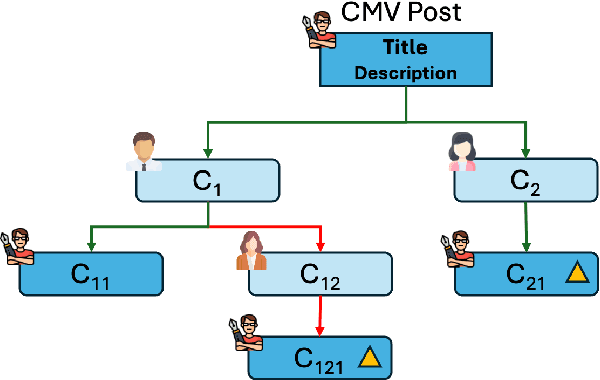
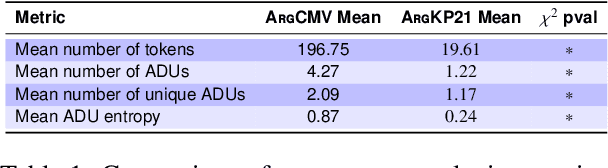
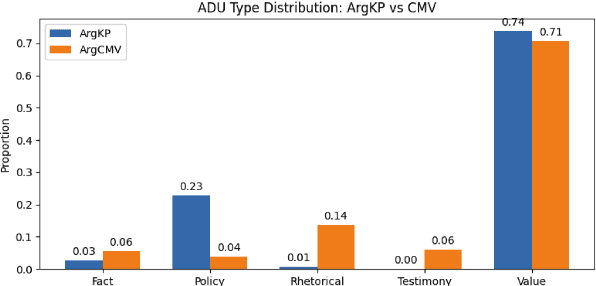
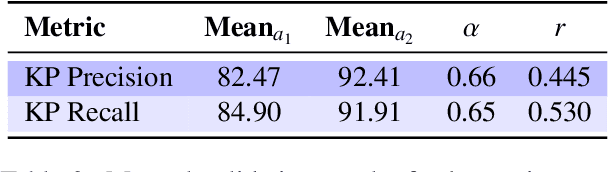
Key point extraction is an important task in argument summarization which involves extracting high-level short summaries from arguments. Existing approaches for KP extraction have been mostly evaluated on the popular ArgKP21 dataset. In this paper, we highlight some of the major limitations of the ArgKP21 dataset and demonstrate the need for new benchmarks that are more representative of actual human conversations. Using SoTA large language models (LLMs), we curate a new argument key point extraction dataset called ArgCMV comprising of around 12K arguments from actual online human debates spread across over 3K topics. Our dataset exhibits higher complexity such as longer, co-referencing arguments, higher presence of subjective discourse units, and a larger range of topics over ArgKP21. We show that existing methods do not adapt well to ArgCMV and provide extensive benchmark results by experimenting with existing baselines and latest open source models. This work introduces a novel KP extraction dataset for long-context online discussions, setting the stage for the next generation of LLM-driven summarization research.
MoMoE: Mixture of Moderation Experts Framework for AI-Assisted Online Governance
May 20, 2025Large language models (LLMs) have shown great potential in flagging harmful content in online communities. Yet, existing approaches for moderation require a separate model for every community and are opaque in their decision-making, limiting real-world adoption. We introduce Mixture of Moderation Experts (MoMoE), a modular, cross-community framework that adds post-hoc explanations to scalable content moderation. MoMoE orchestrates four operators -- Allocate, Predict, Aggregate, Explain -- and is instantiated as seven community-specialized experts (MoMoE-Community) and five norm-violation experts (MoMoE-NormVio). On 30 unseen subreddits, the best variants obtain Micro-F1 scores of 0.72 and 0.67, respectively, matching or surpassing strong fine-tuned baselines while consistently producing concise and reliable explanations. Although community-specialized experts deliver the highest peak accuracy, norm-violation experts provide steadier performance across domains. These findings show that MoMoE yields scalable, transparent moderation without needing per-community fine-tuning. More broadly, they suggest that lightweight, explainable expert ensembles can guide future NLP and HCI research on trustworthy human-AI governance of online communities.