 Add to Chrome
 Add to Firefox
 Add to Edge
Tetris: Tile-level Sampling for Efficient and High-Fidelity Video Object Tracking
May 26, 2026
Track materialization converts raw video into reusable object tracks that downstream queries can run against without rerunning tracking, but extracting those tracks efficiently and with high fidelity remains expensive. Prior systems reduce cost through temporal frame sampling, erasing the inter-frame motion that fine-grained tracking requires. In stationary video, however, large portions of each frame contain no objects of interest, and the remaining regions tolerate different sampling rates. We present Tetris, a track-extraction system that decomposes videos into a tile-based polyomino data model, enabling fine-grained spatiotemporal pruning that reduces detector calls with minimal fidelity loss. Tetris runs three operators upstream of the user-provided detector: a classifier identifies relevant tiles and groups them into polyominoes, an integer linear program (ILP) prunes redundant polyominoes under a user-specified accuracy constraint, and a packer assembles the survivors into canvases that minimize detector calls. Across 7 stationary-video datasets, Tetris stays within a 5% tracking accuracy loss of a full-frame, every-frame reference pipeline, whereas prior systems exceed this bound on 3 of the 7 datasets. At this 5% bound, Tetris achieves up to 17.4x higher throughput than prior systems and up to 68.8x higher than the reference pipeline. The project page is at https://tetris-db.github.io .

Spatialyze: A Geospatial Video Analytics System with Spatial-Aware Optimizations
Aug 08, 2023


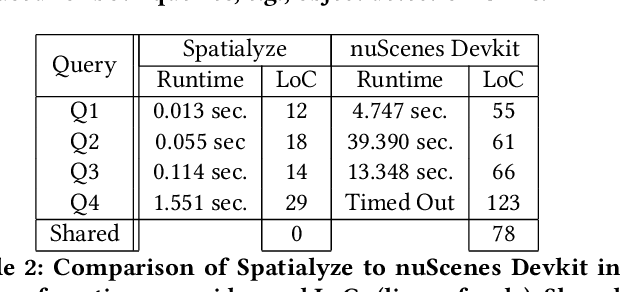
Videos that are shot using commodity hardware such as phones and surveillance cameras record various metadata such as time and location. We encounter such geospatial videos on a daily basis and such videos have been growing in volume significantly. Yet, we do not have data management systems that allow users to interact with such data effectively. In this paper, we describe Spatialyze, a new framework for end-to-end querying of geospatial videos. Spatialyze comes with a domain-specific language where users can construct geospatial video analytic workflows using a 3-step, declarative, build-filter-observe paradigm. Internally, Spatialyze leverages the declarative nature of such workflows, the temporal-spatial metadata stored with videos, and physical behavior of real-world objects to optimize the execution of workflows. Our results using real-world videos and workflows show that Spatialyze can reduce execution time by up to 5.3x, while maintaining up to 97.1% accuracy compared to unoptimized execution.