 Add to Chrome
 Add to Firefox
 Add to Edge
$π$, But Make It Fly: Physics-Guided Transfer of VLA Models to Aerial Manipulation
Mar 26, 2026
Vision-Language-Action (VLA) models such as $π_0$ have demonstrated remarkable generalization across diverse fixed-base manipulators. However, transferring these foundation models to aerial platforms remains an open challenge due to the fundamental mismatch between the quasi-static dynamics of fixed-base arms and the underactuated, highly dynamic nature of flight. In this work, we introduce AirVLA, a system that investigates the transferability of manipulation-pretrained VLAs to aerial pick-and-place tasks. We find that while visual representations transfer effectively, the specific control dynamics required for flight do not. To bridge this "dynamics gap" without retraining the foundation model, we introduce a Payload-Aware Guidance mechanism that injects payload constraints directly into the policy's flow-matching sampling process. To overcome data scarcity, we further utilize a Gaussian Splatting pipeline to synthesize navigation training data. We evaluate our method through a cumulative 460 real-world experiments which demonstrate that this synthetic data is a key enabler of performance, unlocking 100% success in navigation tasks where directly fine-tuning on teleoperation data alone attains 81% success. Our inference-time intervention, Payload-Aware Guidance, increases real-world pick-and-place task success from 23% to 50%. Finally, we evaluate the model on a long-horizon compositional task, achieving a 62% overall success rate. These results suggest that pre-trained manipulation VLAs, with appropriate data augmentation and physics-informed guidance, can transfer to aerial manipulation and navigation, as well as the composition of these tasks.

Learning to Learn Faster from Human Feedback with Language Model Predictive Control
Feb 18, 2024

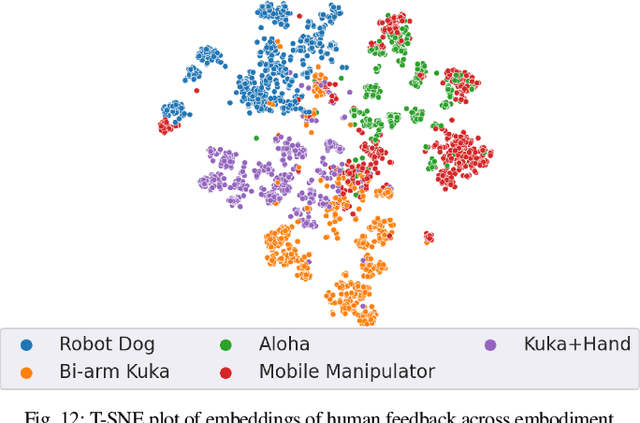

Large language models (LLMs) have been shown to exhibit a wide range of capabilities, such as writing robot code from language commands -- enabling non-experts to direct robot behaviors, modify them based on feedback, or compose them to perform new tasks. However, these capabilities (driven by in-context learning) are limited to short-term interactions, where users' feedback remains relevant for only as long as it fits within the context size of the LLM, and can be forgotten over longer interactions. In this work, we investigate fine-tuning the robot code-writing LLMs, to remember their in-context interactions and improve their teachability i.e., how efficiently they adapt to human inputs (measured by average number of corrections before the user considers the task successful). Our key observation is that when human-robot interactions are formulated as a partially observable Markov decision process (in which human language inputs are observations, and robot code outputs are actions), then training an LLM to complete previous interactions can be viewed as training a transition dynamics model -- that can be combined with classic robotics techniques such as model predictive control (MPC) to discover shorter paths to success. This gives rise to Language Model Predictive Control (LMPC), a framework that fine-tunes PaLM 2 to improve its teachability on 78 tasks across 5 robot embodiments -- improving non-expert teaching success rates of unseen tasks by 26.9% while reducing the average number of human corrections from 2.4 to 1.9. Experiments show that LMPC also produces strong meta-learners, improving the success rate of in-context learning new tasks on unseen robot embodiments and APIs by 31.5%. See videos, code, and demos at: https://robot-teaching.github.io/.