 Add to Chrome
 Add to Firefox
 Add to Edge
Learning Structurally Consistent Representations for Multi-View Radar Semantic Segmentation
Jun 30, 2026
Radar sensors provide reliable perception under adverse weather and lighting conditions, but their sparse, noisy, and weakly semantic measurements make dense semantic segmentation challenging. Most existing radar segmentation methods rely on grid-based encodings and pairwise interactions, which struggle to capture the higher-order relational structure formed by multiple radar returns from the same physical object. We introduce a unified higher-order structural alignment framework for multi-view radar segmentation. The proposed method refines radar feature representations using learnable hypergraphs to capture higher-order dependencies among spatially related responses. To ensure consistency across heterogeneous radar projections, we further align view-specific features using Unbalanced Optimal Transport (UOT), enabling correspondence-free alignment under varying measurement densities and partial observations. An adaptive attention mechanism then fuses complementary radar views while emphasising structurally informative responses under sparsity and noise. The resulting architecture learns structurally consistent representations across Range Angle (RA), Range Doppler (RD), and Angle Doppler (AD) views and is trained using supervised segmentation together with cross-view consistency regularisation. Experiments on the CARRADA and RADIal benchmarks demonstrate consistent improvements over strong radar-specific baselines, achieving 63.8% mIoU on CARRADA and 83.4% mIoU on RADIal, improving the previous best methods by +1.7 and +2.3 mIoU, respectively. These results highlight the importance of higher-order relational modelling for robust radar perception.

Learning Topology-Aware Representations via Test-Time Adaptation for Anomaly Segmentation
Jun 26, 2026Test-time adaptation (TTA) has emerged as a promising paradigm for mitigating distribution shifts in deep models. However, existing TTA approaches for anomaly segmentation remain limited by their reliance on pixel-level heuristics, such as confidence thresholding or entropy minimisation, which fail to preserve structural consistency under noise and texture variation. Moreover, they typically treat anomaly maps as flat intensity fields, ignoring the higher-order spatial relationships that characterise complex defect geometries. We introduce TopoTTA (Topological Test-Time Adaptation), a novel framework that integrates persistent homology, a tool from topological data analysis, into the TTA pipeline to enforce geometric and structural coherence during adaptation. By applying multi-level cubical complex filtration to anomaly score maps, TopoTTA derives robust topological pseudo-labels that guide a lightweight test-time classifier, enhancing segmentation quality without retraining the backbone model. The approach avoids reliance on method-specific raw-score thresholding for mask binarisation, preserves connectivity, and generalises across both 2D and 3D modalities. Extensive experiments across six standard benchmarks (MVTec AD, VisA, Real-IAD, MVTec 3D-AD, AnomalyShapeNet, and MVTec LOCO) demonstrate an average 15% F1 improvement over state-of-the-art unsupervised anomaly detection and segmentation methods, with the largest gains on anomalies exhibiting complex geometric or structural variations. These findings suggest that integrating topological reasoning into test-time adaptation provides a principled route to structure-aware generalisation, bridging the gap between geometric learning and robust adaptation.
Implicit spatial-frequency fusion of hyperspectral and lidar data via kolmogorov-arnold networks
May 14, 2026Hyperspectral image (HSI) classification is challenging in complex scenes due to spectral ambiguity, spatial heterogeneity, and the strong coupling between material properties and geometric structures. Although LiDAR provides complementary elevation information, most HSI-LiDAR fusion methods rely on CNNs or MLPs with fixed activation functions and linear weights. These methods struggle to model structural discontinuities in LiDAR data, intricate spectral features of HSI, and their interactions. In addition, fusion of the two modalities in both spatial and frequency domains with LiDAR guidance remains underexplored. To address these issues, we propose the Implicit Frequency-Geometry Fusion Network (IFGNet), which leverages Kolmogorov-Arnold Networks (KANs) with learnable spline-based functions to adaptively capture highly nonlinear relationships between hyperspectral and LiDAR features. Furthermore, IFGNet introduces a LiDAR-guided implicit aggregation module in both spatial and frequency domains, enhancing geometry-aware spatial representations while capturing global structural patterns. Experiments on the Houston 2013 and MUUFL benchmarks demonstrate that IFGNet consistently outperforms existing fusion methods in overall accuracy, average accuracy, and Cohen's Kappa, while maintaining an efficient architecture.
Component-Aware Sketch-to-Image Generation Using Self-Attention Encoding and Coordinate-Preserving Fusion
Mar 10, 2026Translating freehand sketches into photorealistic images remains a fundamental challenge in image synthesis, particularly due to the abstract, sparse, and stylistically diverse nature of sketches. Existing approaches, including GAN-based and diffusion-based models, often struggle to reconstruct fine-grained details, maintain spatial alignment, or adapt across different sketch domains. In this paper, we propose a component-aware, self-refining framework for sketch-to-image generation that addresses these challenges through a novel two-stage architecture. A Self-Attention-based Autoencoder Network (SA2N) first captures localised semantic and structural features from component-wise sketch regions, while a Coordinate-Preserving Gated Fusion (CGF) module integrates these into a coherent spatial layout. Finally, a Spatially Adaptive Refinement Revisor (SARR), built on a modified StyleGAN2 backbone, enhances realism and consistency through iterative refinement guided by spatial context. Extensive experiments across both facial (CelebAMask-HQ, CUFSF) and non-facial (Sketchy, ChairsV2, ShoesV2) datasets demonstrate the robustness and generalizability of our method. The proposed framework consistently outperforms state-of-the-art GAN and diffusion models, achieving significant gains in image fidelity, semantic accuracy, and perceptual quality. On CelebAMask-HQ, our model improves over prior methods by 21% (FID), 58% (IS), 41% (KID), and 20% (SSIM). These results, along with higher efficiency and visual coherence across diverse domains, position our approach as a strong candidate for applications in forensics, digital art restoration, and general sketch-based image synthesis.
Geometry-Aware Semantic Reasoning for Training Free Video Anomaly Detection
Mar 10, 2026Training-free video anomaly detection (VAD) has recently emerged as a scalable alternative to supervised approaches, yet existing methods largely rely on static prompting and geometry-agnostic feature fusion. As a result, anomaly inference is often reduced to shallow similarity matching over Euclidean embeddings, leading to unstable predictions and limited interpretability, especially in complex or hierarchically structured scenes. We introduce MM-VAD, a geometry-aware semantic reasoning framework for training free VAD that reframes anomaly detection as adaptive test-time inference rather than fixed feature comparison. Our approach projects caption-derived scene representations into hyperbolic space to better preserve hierarchical structure and performs anomaly assessment through an adaptive question answering process over a frozen large language model. A lightweight, learnable prompt is optimised at test time using an unsupervised confidence-sparsity objective, enabling context-specific calibration without updating any backbone parameters. To further ground semantic predictions in visual evidence, we incorporate a covariance-aware Mahalanobis refinement that stabilises cross-modal alignment. Across four benchmarks, MM-VAD consistently improves over prior training-free methods, achieving 90.03% AUC on XD-Violence and 83.24%, 96.95%, and 98.81% on UCF-Crime, ShanghaiTech, and UCSD Ped2, respectively. Our results demonstrate that geometry-aware representation and adaptive semantic calibration provide a principled and effective alternative to static Euclidean matching in training-free VAD.
WS-Net: Weak-Signal Representation Learning and Gated Abundance Reconstruction for Hyperspectral Unmixing via State-Space and Weak Signal Attention Fusion
Mar 10, 2026Weak spectral responses in hyperspectral images are often obscured by dominant endmembers and sensor noise, resulting in inaccurate abundance estimation. This paper introduces WS-Net, a deep unmixing framework specifically designed to address weak-signal collapse through state-space modelling and Weak Signal Attention fusion. The network features a multi-resolution wavelet-fused encoder that captures both high-frequency discontinuities and smooth spectral variations with a hybrid backbone that integrates a Mamba state-space branch for efficient long-range dependency modelling. It also incorporates a Weak Signal Attention branch that selectively enhances low-similarity spectral cues. A learnable gating mechanism adaptively fuses both representations, while the decoder leverages KL-divergence-based regularisation to enforce separability between dominant and weak endmembers. Experiments on one simulated and two real datasets (synthetic dataset, Samson, and Apex) demonstrate consistent improvements over six state-of-the-art baselines, achieving up to 55% and 63% reductions in RMSE and SAD, respectively. The framework maintains stable accuracy under low-SNR conditions, particularly for weak endmembers, establishing WS-Net as a robust and computationally efficient benchmark for weak-signal hyperspectral unmixing.
Representation Geometry as a Diagnostic for Out-of-Distribution Robustness
Feb 05, 2026Robust generalization under distribution shift remains difficult to monitor and optimize in the absence of target-domain labels, as models with similar in-distribution accuracy can exhibit markedly different out-of-distribution (OOD) performance. While prior work has focused on training-time regularization and low-order representation statistics, little is known about whether the geometric structure of learned embeddings provides reliable post-hoc signals of robustness. We propose a geometry-based diagnostic framework that constructs class-conditional mutual k-nearest-neighbor graphs from in-distribution embeddings and extracts two complementary invariants: a global spectral complexity proxy based on the reduced log-determinant of the normalized Laplacian, and a local smoothness measure based on Ollivier--Ricci curvature. Across multiple architectures, training regimes, and corruption benchmarks, we find that lower spectral complexity and higher mean curvature consistently predict stronger OOD accuracy across checkpoints. Controlled perturbations and topological analyses further show that these signals reflect meaningful representation structure rather than superficial embedding statistics. Our results demonstrate that representation geometry enables interpretable, label-free robustness diagnosis and supports reliable unsupervised checkpoint selection under distribution shift.
Test-Time Adaptation for Anomaly Segmentation via Topology-Aware Optimal Transport Chaining
Jan 28, 2026Deep topological data analysis (TDA) offers a principled framework for capturing structural invariants such as connectivity and cycles that persist across scales, making it a natural fit for anomaly segmentation (AS). Unlike thresholdbased binarisation, which produces brittle masks under distribution shift, TDA allows anomalies to be characterised as disruptions to global structure rather than local fluctuations. We introduce TopoOT, a topology-aware optimal transport (OT) framework that integrates multi-filtration persistence diagrams (PDs) with test-time adaptation (TTA). Our key innovation is Optimal Transport Chaining, which sequentially aligns PDs across thresholds and filtrations, yielding geodesic stability scores that identify features consistently preserved across scales. These stabilityaware pseudo-labels supervise a lightweight head trained online with OT-consistency and contrastive objectives, ensuring robust adaptation under domain shift. Across standard 2D and 3D anomaly detection benchmarks, TopoOT achieves state-of-the-art performance, outperforming the most competitive methods by up to +24.1% mean F1 on 2D datasets and +10.2% on 3D AS benchmarks.
Multi-Scale Target-Aware Representation Learning for Fundus Image Enhancement
May 03, 2025High-quality fundus images provide essential anatomical information for clinical screening and ophthalmic disease diagnosis. Yet, due to hardware limitations, operational variability, and patient compliance, fundus images often suffer from low resolution and signal-to-noise ratio. Recent years have witnessed promising progress in fundus image enhancement. However, existing works usually focus on restoring structural details or global characteristics of fundus images, lacking a unified image enhancement framework to recover comprehensive multi-scale information. Moreover, few methods pinpoint the target of image enhancement, e.g., lesions, which is crucial for medical image-based diagnosis. To address these challenges, we propose a multi-scale target-aware representation learning framework (MTRL-FIE) for efficient fundus image enhancement. Specifically, we propose a multi-scale feature encoder (MFE) that employs wavelet decomposition to embed both low-frequency structural information and high-frequency details. Next, we design a structure-preserving hierarchical decoder (SHD) to fuse multi-scale feature embeddings for real fundus image restoration. SHD integrates hierarchical fusion and group attention mechanisms to achieve adaptive feature fusion while retaining local structural smoothness. Meanwhile, a target-aware feature aggregation (TFA) module is used to enhance pathological regions and reduce artifacts. Experimental results on multiple fundus image datasets demonstrate the effectiveness and generalizability of MTRL-FIE for fundus image enhancement. Compared to state-of-the-art methods, MTRL-FIE achieves superior enhancement performance with a more lightweight architecture. Furthermore, our approach generalizes to other ophthalmic image processing tasks without supervised fine-tuning, highlighting its potential for clinical applications.
Determining Mosaic Resilience in Sugarcane Plants using Hyperspectral Images
Jan 28, 2025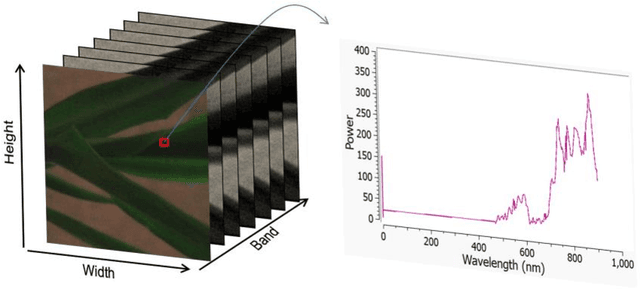
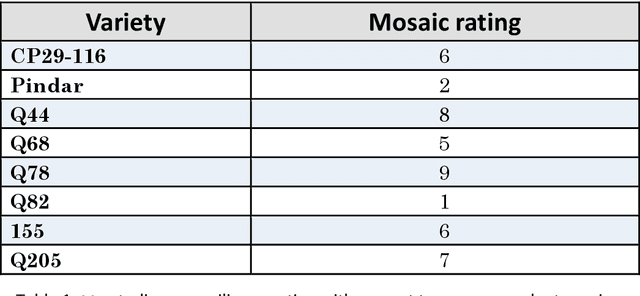
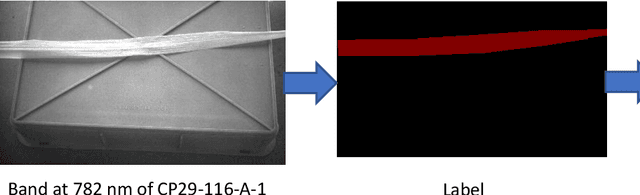
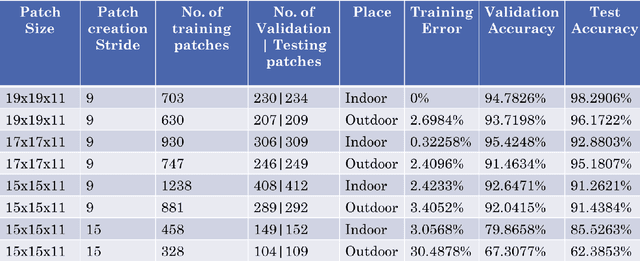
Sugarcane mosaic disease poses a serious threat to the Australian sugarcane industry, leading to yield losses of up to 30% in susceptible varieties. Existing manual inspection methods for detecting mosaic resilience are inefficient and impractical for large-scale application. This study introduces a novel approach using hyperspectral imaging and machine learning to detect mosaic resilience by leveraging global feature representation from local spectral patches. Hyperspectral data were collected from eight sugarcane varieties under controlled and field conditions. Local spectral patches were analyzed to capture spatial and spectral variations, which were then aggregated into global feature representations using a ResNet18 deep learning architecture. While classical methods like Support Vector Machines struggled to utilize spatial-spectral relationships effectively, the deep learning model achieved high classification accuracy, demonstrating its capacity to identify mosaic resilience from fine-grained hyperspectral data. This approach enhances early detection capabilities, enabling more efficient management of susceptible strains and contributing to sustainable sugarcane production.