 Add to Chrome
 Add to Firefox
 Add to Edge
Implicit spatial-frequency fusion of hyperspectral and lidar data via kolmogorov-arnold networks
May 14, 2026
Hyperspectral image (HSI) classification is challenging in complex scenes due to spectral ambiguity, spatial heterogeneity, and the strong coupling between material properties and geometric structures. Although LiDAR provides complementary elevation information, most HSI-LiDAR fusion methods rely on CNNs or MLPs with fixed activation functions and linear weights. These methods struggle to model structural discontinuities in LiDAR data, intricate spectral features of HSI, and their interactions. In addition, fusion of the two modalities in both spatial and frequency domains with LiDAR guidance remains underexplored. To address these issues, we propose the Implicit Frequency-Geometry Fusion Network (IFGNet), which leverages Kolmogorov-Arnold Networks (KANs) with learnable spline-based functions to adaptively capture highly nonlinear relationships between hyperspectral and LiDAR features. Furthermore, IFGNet introduces a LiDAR-guided implicit aggregation module in both spatial and frequency domains, enhancing geometry-aware spatial representations while capturing global structural patterns. Experiments on the Houston 2013 and MUUFL benchmarks demonstrate that IFGNet consistently outperforms existing fusion methods in overall accuracy, average accuracy, and Cohen's Kappa, while maintaining an efficient architecture.

WS-Net: Weak-Signal Representation Learning and Gated Abundance Reconstruction for Hyperspectral Unmixing via State-Space and Weak Signal Attention Fusion
Mar 10, 2026Weak spectral responses in hyperspectral images are often obscured by dominant endmembers and sensor noise, resulting in inaccurate abundance estimation. This paper introduces WS-Net, a deep unmixing framework specifically designed to address weak-signal collapse through state-space modelling and Weak Signal Attention fusion. The network features a multi-resolution wavelet-fused encoder that captures both high-frequency discontinuities and smooth spectral variations with a hybrid backbone that integrates a Mamba state-space branch for efficient long-range dependency modelling. It also incorporates a Weak Signal Attention branch that selectively enhances low-similarity spectral cues. A learnable gating mechanism adaptively fuses both representations, while the decoder leverages KL-divergence-based regularisation to enforce separability between dominant and weak endmembers. Experiments on one simulated and two real datasets (synthetic dataset, Samson, and Apex) demonstrate consistent improvements over six state-of-the-art baselines, achieving up to 55% and 63% reductions in RMSE and SAD, respectively. The framework maintains stable accuracy under low-SNR conditions, particularly for weak endmembers, establishing WS-Net as a robust and computationally efficient benchmark for weak-signal hyperspectral unmixing.
SSUMamba: Spatial-Spectral Selective State Space Model for Hyperspectral Image Denoising
May 06, 2024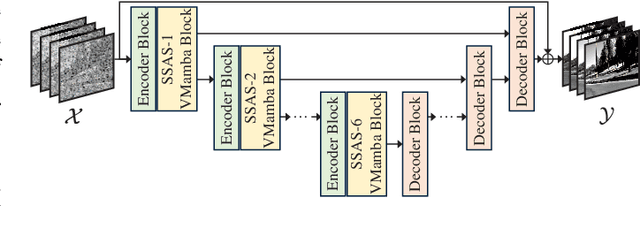
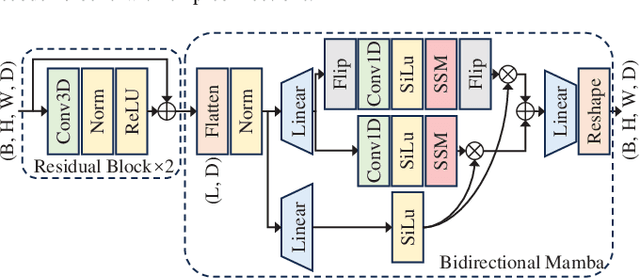

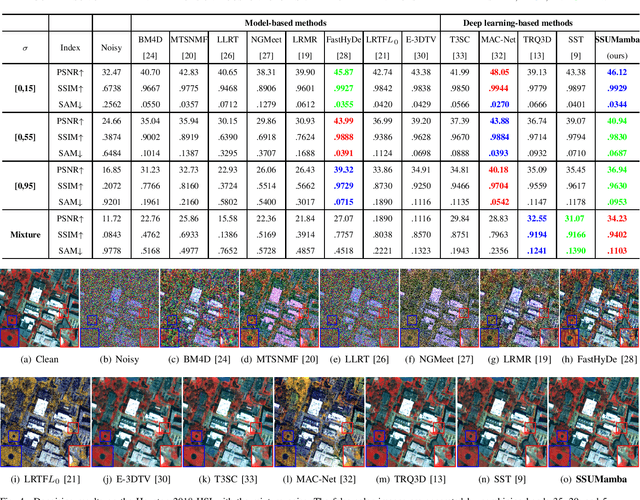
Denoising hyperspectral images (HSIs) is a crucial preprocessing procedure due to the noise originating from intra-imaging mechanisms and environmental factors. Utilizing domain-specific knowledge of HSIs, such as spectral correlation, spatial self-similarity, and spatial-spectral correlation, is essential for deep learning-based denoising. Existing methods are often constrained by running time, space complexity, and computational complexity, employing strategies that explore these priors separately. While these strategies can avoid some redundant information, they inevitably overlook broader and more underlying long-range spatial-spectral information that positively impacts image restoration. This paper proposes a Spatial-Spectral Selective State Space Model-based U-shaped network, termed Spatial-Spectral U-Mamba (SSUMamba), for hyperspectral image denoising. We can obtain complete global spatial-spectral correlation within a module thanks to the linear space complexity in State Space Model (SSM) computations. We introduce a Spatial-Spectral Alternating Scan (SSAS) strategy for HSIs, which helps model the information flow in multiple directions in 3-D HSIs. Experimental results demonstrate that our method outperforms compared methods. The source code will be available at https://github.com/lronkitty/SSUMamba.
Hyperspectral Image Denoising via Spatial-Spectral Recurrent Transformer
Jan 09, 2024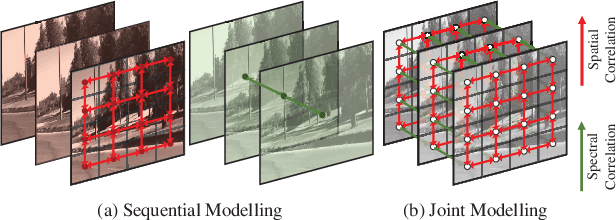
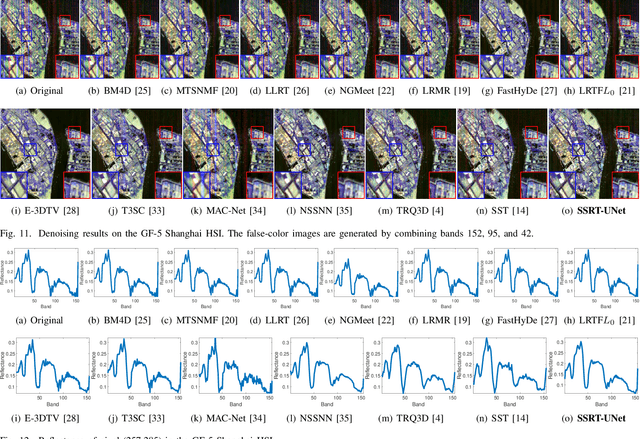
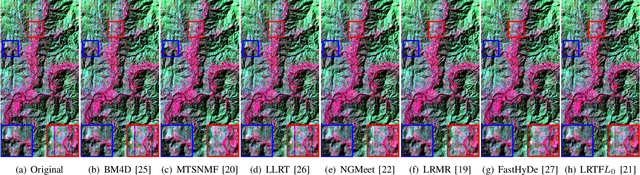
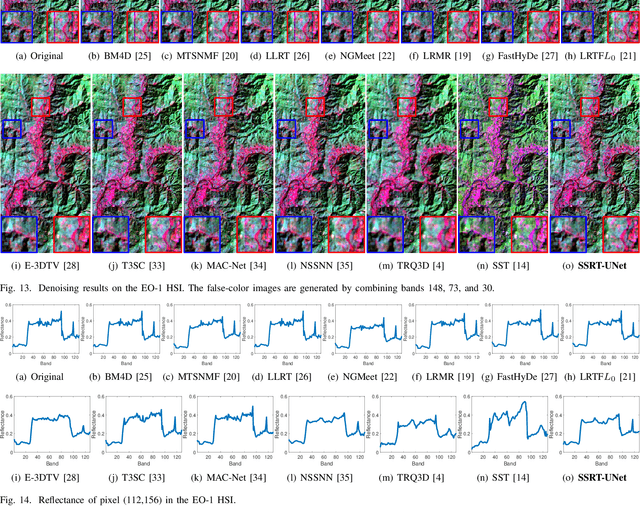
Hyperspectral images (HSIs) often suffer from noise arising from both intra-imaging mechanisms and environmental factors. Leveraging domain knowledge specific to HSIs, such as global spectral correlation (GSC) and non-local spatial self-similarity (NSS), is crucial for effective denoising. Existing methods tend to independently utilize each of these knowledge components with multiple blocks, overlooking the inherent 3D nature of HSIs where domain knowledge is strongly interlinked, resulting in suboptimal performance. To address this challenge, this paper introduces a spatial-spectral recurrent transformer U-Net (SSRT-UNet) for HSI denoising. The proposed SSRT-UNet integrates NSS and GSC properties within a single SSRT block. This block consists of a spatial branch and a spectral branch. The spectral branch employs a combination of transformer and recurrent neural network to perform recurrent computations across bands, allowing for GSC exploitation beyond a fixed number of bands. Concurrently, the spatial branch encodes NSS for each band by sharing keys and values with the spectral branch under the guidance of GSC. This interaction between the two branches enables the joint utilization of NSS and GSC, avoiding their independent treatment. Experimental results demonstrate that our method outperforms several alternative approaches. The source code will be available at https://github.com/lronkitty/SSRT.