 Add to Chrome
 Add to Firefox
 Add to Edge
From Triggers to Emotions: A CPM-Grounded Appraisal Multi-Agent for Dynamic Emotional Evolution in Persona-Based Dialogue
Jul 08, 2026
Large Language Models (LLMs) have substantially advanced persona-based dialogue agents for emotion-sensitive role simulation in healthcare, education, counseling, customer service, and interactive storytelling. However, two related lines of work leave a key gap. Persona-based dialogue systems often encode emotions as static traits or surface-level stylistic cues, and affective dialogue research has largely focused on empathetic response generation toward users rather than modeling the agent persona's own evolving emotional state. As a result, trigger-driven emotional evolution within a character remains underexplored. To address this limitation, we draw inspiration from the Component Process Model (CPM), a psychological theory that views emotion as a dynamic process shaped by the appraisal of external events. We propose CPM-MultiAgent, a CPM-grounded emotion evolution multi-agent framework for supporting emotional changes in persona-based dialogue. Instead of treating a character's emotion as a fixed attribute, CPM-MultiAgent represents it as a latent state that is continuously reshaped by dialogue triggers. Through affective trigger extraction, CPM-based collaborative appraisal, and emotion state updating, the framework enables more emotionally consistent role simulation in multi-turn interactions.Experiments with baseline comparisons, ablation studies, human evaluation, and case analyses demonstrate that CPM-MultiAgent effectively models dynamic emotional evolution in emotionally sensitive role-simulation settings.

Learning Structurally Consistent Representations for Multi-View Radar Semantic Segmentation
Jun 30, 2026Radar sensors provide reliable perception under adverse weather and lighting conditions, but their sparse, noisy, and weakly semantic measurements make dense semantic segmentation challenging. Most existing radar segmentation methods rely on grid-based encodings and pairwise interactions, which struggle to capture the higher-order relational structure formed by multiple radar returns from the same physical object. We introduce a unified higher-order structural alignment framework for multi-view radar segmentation. The proposed method refines radar feature representations using learnable hypergraphs to capture higher-order dependencies among spatially related responses. To ensure consistency across heterogeneous radar projections, we further align view-specific features using Unbalanced Optimal Transport (UOT), enabling correspondence-free alignment under varying measurement densities and partial observations. An adaptive attention mechanism then fuses complementary radar views while emphasising structurally informative responses under sparsity and noise. The resulting architecture learns structurally consistent representations across Range Angle (RA), Range Doppler (RD), and Angle Doppler (AD) views and is trained using supervised segmentation together with cross-view consistency regularisation. Experiments on the CARRADA and RADIal benchmarks demonstrate consistent improvements over strong radar-specific baselines, achieving 63.8% mIoU on CARRADA and 83.4% mIoU on RADIal, improving the previous best methods by +1.7 and +2.3 mIoU, respectively. These results highlight the importance of higher-order relational modelling for robust radar perception.
Learning Topology-Aware Representations via Test-Time Adaptation for Anomaly Segmentation
Jun 26, 2026Test-time adaptation (TTA) has emerged as a promising paradigm for mitigating distribution shifts in deep models. However, existing TTA approaches for anomaly segmentation remain limited by their reliance on pixel-level heuristics, such as confidence thresholding or entropy minimisation, which fail to preserve structural consistency under noise and texture variation. Moreover, they typically treat anomaly maps as flat intensity fields, ignoring the higher-order spatial relationships that characterise complex defect geometries. We introduce TopoTTA (Topological Test-Time Adaptation), a novel framework that integrates persistent homology, a tool from topological data analysis, into the TTA pipeline to enforce geometric and structural coherence during adaptation. By applying multi-level cubical complex filtration to anomaly score maps, TopoTTA derives robust topological pseudo-labels that guide a lightweight test-time classifier, enhancing segmentation quality without retraining the backbone model. The approach avoids reliance on method-specific raw-score thresholding for mask binarisation, preserves connectivity, and generalises across both 2D and 3D modalities. Extensive experiments across six standard benchmarks (MVTec AD, VisA, Real-IAD, MVTec 3D-AD, AnomalyShapeNet, and MVTec LOCO) demonstrate an average 15% F1 improvement over state-of-the-art unsupervised anomaly detection and segmentation methods, with the largest gains on anomalies exhibiting complex geometric or structural variations. These findings suggest that integrating topological reasoning into test-time adaptation provides a principled route to structure-aware generalisation, bridging the gap between geometric learning and robust adaptation.
Multilingual Hematology Visual Question Answering Dataset
Jun 24, 2026Vision Language Models (VLMs) have shown promising capabilities in medical image analysis by jointly understanding visual and textual information for tasks such as Visual Question Answering. However, existing hematology vision-language resources remain predominantly English centric, limiting their applicability in multilingual healthcare environments. This challenge is releveant generally to South Asia and specifically to Pakistan, where Urdu is widely used despite healthcare information and digital medical systems being largely dependent on English. To investigate this gap, we conducted a survey among healthcare professionals, which revealed substantial language mismatches between clinical documentation and patient communication, emphasizing the need for multilingual healthcare technologies. To address this limitation, we introduce WBCMor VQA, a clinically validated bilingual English, Urdu morphology aware VQA benchmark for leukemia and normal white blood cell analysis. The benchmark is constructed using morphology-aware annotations from LeukemiaAttri and WBCAtt datasets and supported by a domain specific Urdu hematology dictionary to ensure linguistic consistency and clinical correctness. The final benchmark contains 110K bilingual question answer pairs serving as VQA annotations for 20K leukemic and normal single-cell images. Furthermore, we establish baseline performance by evaluating multiple open-source VLMs on the proposed benchmark. The proposed resource aims to facilitate the development of accessible and clinically relevant AI systems for multilingual healthcare environments.
Critic-Guided Heterogeneous Multi-Agent Reasoning for Reliable Mathematical Problem Solving
Jun 04, 2026Recent Large Language Models (LLMs) have shown impressive reasoning abilities; but they are still susceptible to hallucinations, intermediate reasoning mistakes, and unreliable reasoning results in complex mathematical reasoning problems. In this study, we introduce a critic-based heterogeneous multi-agent approach to improve the dependability of mathematical reasoning. This framework incorporates several LLM agents of different specialties and employs a critic-driven adaptive learning system to assess and guide the reasoning process based on intermediate feedback. The system adopts a generator-validator framework, with the validator not only determining correctness but also offering critiques to guide regeneration of solutions. This allows for adaptive error correction and prevents error cascading. Our experiments on the GSM8K benchmark show that the proposed method achieves up to 13% accuracy improvement over single-shot and non-critic models. Additionally, findings suggest that heterogeneity and critique reduce the need for large models, allowing smaller models to perform on par. Ablation studies reveal the main performance gains are due to the critic-based feedback loop and not model size. In summary, the proposed approach showcases the benefits of combining heterogeneous multi-agent collaboration and critique to obtain reliable and interpretable reasoning systems.
Geometry-Aware Semantic Reasoning for Training Free Video Anomaly Detection
Mar 10, 2026Training-free video anomaly detection (VAD) has recently emerged as a scalable alternative to supervised approaches, yet existing methods largely rely on static prompting and geometry-agnostic feature fusion. As a result, anomaly inference is often reduced to shallow similarity matching over Euclidean embeddings, leading to unstable predictions and limited interpretability, especially in complex or hierarchically structured scenes. We introduce MM-VAD, a geometry-aware semantic reasoning framework for training free VAD that reframes anomaly detection as adaptive test-time inference rather than fixed feature comparison. Our approach projects caption-derived scene representations into hyperbolic space to better preserve hierarchical structure and performs anomaly assessment through an adaptive question answering process over a frozen large language model. A lightweight, learnable prompt is optimised at test time using an unsupervised confidence-sparsity objective, enabling context-specific calibration without updating any backbone parameters. To further ground semantic predictions in visual evidence, we incorporate a covariance-aware Mahalanobis refinement that stabilises cross-modal alignment. Across four benchmarks, MM-VAD consistently improves over prior training-free methods, achieving 90.03% AUC on XD-Violence and 83.24%, 96.95%, and 98.81% on UCF-Crime, ShanghaiTech, and UCSD Ped2, respectively. Our results demonstrate that geometry-aware representation and adaptive semantic calibration provide a principled and effective alternative to static Euclidean matching in training-free VAD.
Enhancing Psychologists' Understanding through Explainable Deep Learning Framework for ADHD Diagnosis
Jan 28, 2026Attention Deficit Hyperactivity Disorder (ADHD) is a neurodevelopmental disorder that is challenging to diagnose and requires advanced approaches for reliable and transparent identification and classification. It is characterized by a pattern of inattention, hyperactivity and impulsivity that is more severe and more frequent than in individuals with a comparable level of development. In this paper, an explainable framework based on a fine-tuned hybrid Deep Neural Network (DNN) and Recurrent Neural Network (RNN) called HyExDNN-RNN model is proposed for ADHD detection, multi-class categorization, and decision interpretation. This framework not only detects ADHD, but also provides interpretable insights into the diagnostic process so that psychologists can better understand and trust the results of the diagnosis. We use the Pearson correlation coefficient for optimal feature selection and machine and deep learning models for experimental analysis and comparison. We use a standardized technique for feature reduction, model selection and interpretation to accurately determine the diagnosis rate and ensure the interpretability of the proposed framework. Our framework provided excellent results on binary classification, with HyExDNN-RNN achieving an F1 score of 99% and 94.2% on multi-class categorization. XAI approaches, in particular SHapley Additive exPlanations (SHAP) and Permutation Feature Importance (PFI), provided important insights into the importance of features and the decision logic of models. By combining AI with human expertise, we aim to bridge the gap between advanced computational techniques and practical psychological applications. These results demonstrate the potential of our framework to assist in ADHD diagnosis and interpretation.
Test-Time Adaptation for Anomaly Segmentation via Topology-Aware Optimal Transport Chaining
Jan 28, 2026Deep topological data analysis (TDA) offers a principled framework for capturing structural invariants such as connectivity and cycles that persist across scales, making it a natural fit for anomaly segmentation (AS). Unlike thresholdbased binarisation, which produces brittle masks under distribution shift, TDA allows anomalies to be characterised as disruptions to global structure rather than local fluctuations. We introduce TopoOT, a topology-aware optimal transport (OT) framework that integrates multi-filtration persistence diagrams (PDs) with test-time adaptation (TTA). Our key innovation is Optimal Transport Chaining, which sequentially aligns PDs across thresholds and filtrations, yielding geodesic stability scores that identify features consistently preserved across scales. These stabilityaware pseudo-labels supervise a lightweight head trained online with OT-consistency and contrastive objectives, ensuring robust adaptation under domain shift. Across standard 2D and 3D anomaly detection benchmarks, TopoOT achieves state-of-the-art performance, outperforming the most competitive methods by up to +24.1% mean F1 on 2D datasets and +10.2% on 3D AS benchmarks.
Uni-Hema: Unified Model for Digital Hematopathology
Nov 19, 2025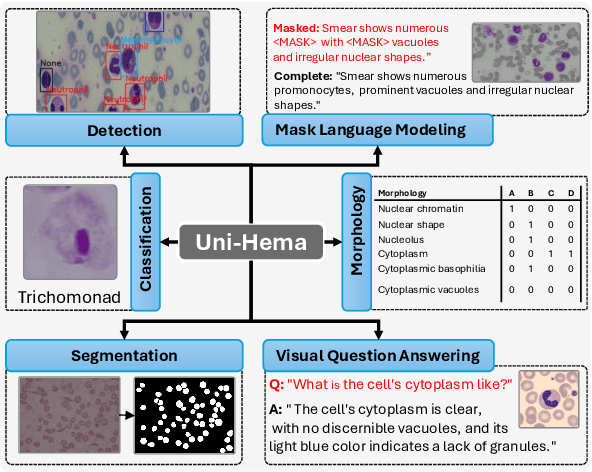
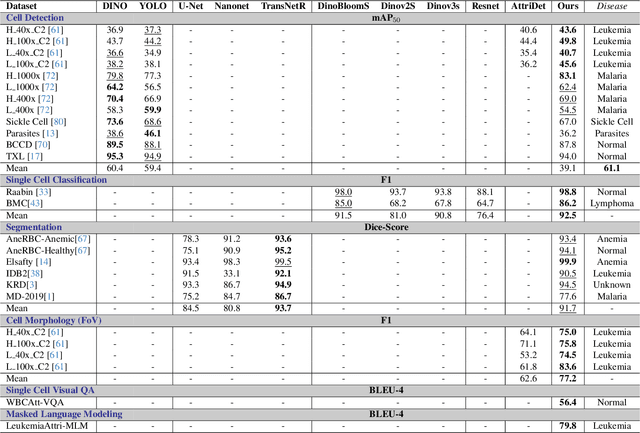

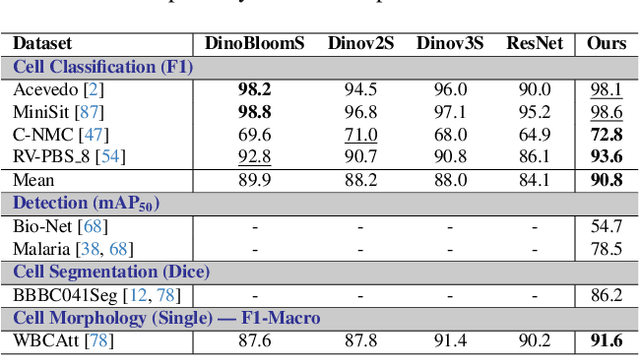
Digital hematopathology requires cell-level analysis across diverse disease categories, including malignant disorders (e.g., leukemia), infectious conditions (e.g., malaria), and non-malignant red blood cell disorders (e.g., sickle cell disease). Whether single-task, vision-language, WSI-optimized, or single-cell hematology models, these approaches share a key limitation, they cannot provide unified, multi-task, multi-modal reasoning across the complexities of digital hematopathology. To overcome these limitations, we propose Uni-Hema, a multi-task, unified model for digital hematopathology integrating detection, classification, segmentation, morphology prediction, and reasoning across multiple diseases. Uni-Hema leverages 46 publicly available datasets, encompassing over 700K images and 21K question-answer pairs, and is built upon Hema-Former, a multimodal module that bridges visual and textual representations at the hierarchy level for the different tasks (detection, classification, segmentation, morphology, mask language modeling and visual question answer) at different granularity. Extensive experiments demonstrate that Uni-Hema achieves comparable or superior performance to train on a single-task and single dataset models, across diverse hematological tasks, while providing interpretable, morphologically relevant insights at the single-cell level. Our framework establishes a new standard for multi-task and multi-modal digital hematopathology. The code will be made publicly available.
Explainable AI for Curie Temperature Prediction in Magnetic Materials
Aug 09, 2025We explore machine learning techniques for predicting Curie temperatures of magnetic materials using the NEMAD database. By augmenting the dataset with composition-based and domain-aware descriptors, we evaluate the performance of several machine learning models. We find that the Extra Trees Regressor delivers the best performance reaching an R^2 score of up to 0.85 $\pm$ 0.01 (cross-validated) for a balanced dataset. We employ the k-means clustering algorithm to gain insights into the performance of chemically distinct material groups. Furthermore, we perform the SHAP analysis to identify key physicochemical drivers of Curie behavior, such as average atomic number and magnetic moment. By employing explainable AI techniques, this analysis offers insights into the model's predictive behavior, thereby advancing scientific interpretability.