 Add to Chrome
 Add to Firefox
 Add to Edge
Statistical Channel Model for FSO Systems Assisted by a UAV-Mounted IRS
Aug 11, 2026
Integrating optical intelligent reflecting surfaces (IRSs) into aerial platforms, such as unmanned aerial vehicles (UAVs), has been proposed to relax the line-of-sight (LoS) constraint, extend coverage, and enhance deployment flexibility of free space optical (FSO) systems. However, misalignment errors induced by the UAV hovering, in both position and orientation, may degrade connectivity and impair the end-to-end channel quality. In this paper, we develop novel expressions for the electric fields incident on and reflected by an optical IRS, based on the Huygens-Fresnel principle. The resulting expressions are applicable for any combination of incident and reflected propagation directions. Building on this framework, we derive a closed-form statistical channel model that captures the geometric and misalignment losses of an FSO link assisted by a UAV-mounted IRS in the presence of random UAV fluctuations. In particular, we develop a statistical model for the beam misalignment at the receiver lens, assuming Gaussian fluctuations in both the UAV position and orientation. The proposed analytical model is validated through Monte Carlo (MC) simulations and is further used to provide practical design guidelines regarding the optimal placement of the UAV-mounted IRS for the minimization of the outage probability.

End-to-End Optical Propagation Modeling for Water-to-Air Channels under Sea Surface and UAV Effects
Mar 24, 2026Underwater observatories have recently emerged as an efficient mean of marine biodiversity monitoring. In order to conduct data muling from the underwater sensors in an efficient and cost-effective way, we consider the use of optical wireless communications to transmit the data from the underwater sensors to an aerial node close to the water surface, such as an unmanned aerial vehicle (UAV). More specifically, we utilize a direct water-to-air (W2A) optical communication link between the sensor node equipped with an LED emitter and the UAV equipped with an ultra-sensitive receiver, i.e., a silicon photomultiplier (SiPM). To characterize this particularly complex communication channel, we introduce a ray-tracing algorithm based on the Monte Carlo method, incorporating the impact of bubbles modeled through the Mie scattering theory and a realistic sea surface representation derived from the JONSWAP spectrum. Additionally, we incorporate into this model the channel losses resulting from UAV instability under windy weather conditions. Furthermore, we conduct a comprehensive analysis of the wireless channel, examining the influence of key parameters such as wind speed, transmitter configurations, and receiver characteristics. Finally, we evaluate the end-to-end performance of the system by analyzing the average bit-error rate at varying depths and data rates, providing valuable insights into the feasibility and efficiency of the proposed approach.
Single-Photon Counting Receivers for 6G Optical Wireless Communications
May 16, 2023


Optical wireless communication (OWC) offers several complementary advantages to radio-frequency (RF) wireless networks such as its massive available spectrum; hence, it is widely anticipated that OWC will assume a pivotal role in the forthcoming sixth generation (6G) wireless communication networks. Although significant progress has been achieved in OWC over the past decades, the outage induced by occasionally low received optical power continues to pose a key limiting factor for its deployment. In this work, we discuss the potential role of single-photon counting (SPC) receivers as a promising solution to overcome this limitation. We provide an overview of the state-of-the-art of OWC systems utilizing SPC receivers and identify several critical areas of open problems that warrant further research in the future.
Resource Allocation in a Quantum Key Distribution Network with LEO and GEO trusted-repeaters
Jul 15, 2021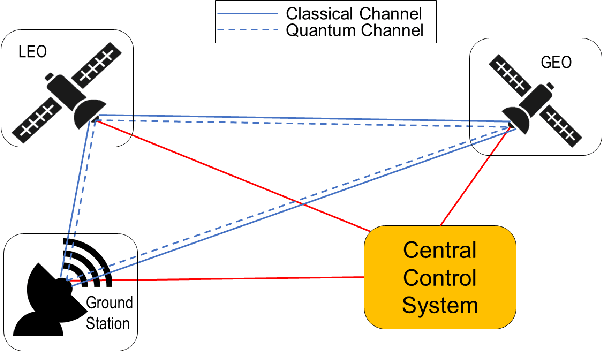
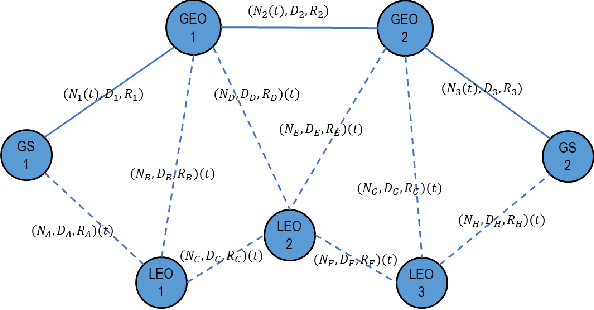
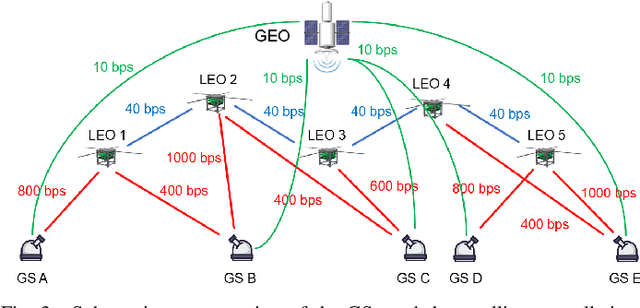
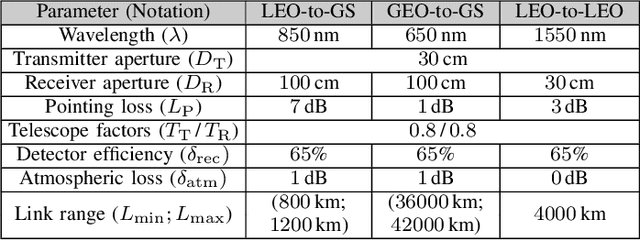
Quantum Key Distribution~(QKD) is a technology that enables the exchange of private encryption keys between two legitimate parties, using protocols that involve quantum mechanics principles. The rate at which secret keys can be exchanged depends on the attenuation that is experienced. Therefore, it is more convenient to replace many terrestrial fiber segments (and repeaters) by just few optical satellite links that would enable flexible global coverage. Then, the satellite nodes can take the role of trusted-relays, forwarding the secret keys from source to destination. However, since the rate at which secret keys can be generated in each quantum link is limited, it is very important to select the intermediate satellite nodes to inter-connect ground stations efficiently. This paper studies the most convenient allocation of resources in a QKD network that combines complementary connectivity services of GEO and LEO satellites. The aim of the centralized routing algorithm is to select the most convenient trusted-relays to forward the secret keys between pairs of ground stations, verifying the constraints that satellite-to-ground and inter-satellite quantum channels have.