 Add to Chrome
 Add to Firefox
 Add to Edge
Load Balancing in Non-Terrestrial Networks Using Free Space Optical Inter-satellite Links
Mar 13, 2026
Non-terrestrial networks (NTNs) increasingly rely on non-geostationary (NGSO) constellations that combine radio frequency (RF) feeder links (FLs) with free space optical (FSO) inter-satellite links (ISLs). Downlink performance in such systems is often constrained by uneven satellite-gateway visibility, data traffic congestion, and rain-induced FL attenuation, leaving the downlink capacity of some satellites underutilized while others become bottlenecks. To prevent such non-uniform load distribution, this paper presents a fairness-driven load balancing strategy that treats the satellite constellation in space as an anycast multi-commodity flow problem. Then, by solving an equivalent linear programming optimization problem, the proposed algorithm dynamically selects the most convenient ground station (GS) to serve each satellite and, when needed, offloads data traffic to adjacent satellites through FSO ISLs. Using a realistic MEO satellite constellation with 1550 nm FSO ISLs and Ka-band feeder links, the method stabilizes the reverse link data service, maintaining the average data rate but notably improving the worst-case throughput. Our proposed algorithm enhances the minimum downlink data rate by more than 25% in the presence of rain and by over 10% under no-rain conditions. These results demonstrate that the use of an ISL-assisted load-balancing scheme mitigates FL bottlenecks and enhances fairness across the satellite constellation, offering a scalable basis for resource allocation in future NTN systems.

Enhancing User Throughput in Multi-panel mmWave Radio Access Networks for Beam-based MU-MIMO Using a DRL Method
Mar 03, 2026Millimeter-wave (mmWave) communication systems, particularly those leveraging multi-user multiple-input and multiple-output (MU-MIMO) with hybrid beamforming, face challenges in optimizing user throughput and minimizing latency due to the high complexity of dynamic beam selection and management. This paper introduces a deep reinforcement learning (DRL) approach for enhancing user throughput in multi-panel mmWave radio access networks in a practical network setup. Our DRL-based formulation utilizes an adaptive beam management strategy that models the interaction between the communication agent and its environment as a Markov decision process (MDP), optimizing beam selection based on real-time observations. The proposed framework exploits spatial domain (SD) characteristics by incorporating the cross-correlation between the beams in different antenna panels, the measured reference signal received power (RSRP), and the beam usage statistics to dynamically adjust beamforming decisions. As a result, the spectral efficiency is improved and end-to-end latency is reduced. The numerical results demonstrate an increase in throughput of up to 16% and a reduction in latency by factors 3-7x compared to baseline (legacy beam management).
Symbol Rate Maximization in Rolling-Shutter OCC: Design and Implementation Considerations
Feb 09, 2026Optical Camera Communication (OCC) systems can take advantage of the row-by-row scanning process of rolling-shutter cameras to capture the fast variations of light intensity coming from Visible Light Communication (VLC) LED-based transmitters. In order to study the maximum data rate that is feasible in such kind of OCC systems, this paper presents its equivalent digital communication system model in which the rolling-shutter camera is modeled as a rectangular matched-filter whose time width is equal to the exposure time of the camera, followed by a sampling process at the pixel row sweep rate of the camera. Based on the proposed rolling-shutter camera model, the maximum symbol rate that such OCC systems can support is experimentally demonstrated, and the impact of imperfect time synchronization between the VLC transmitter and the rolling-shutter OCC receiver is characterized in the form of Inter-Symbol Interference (ISI). The equivalent three-tap channel model that results from this process is experimentally validated and the generated ISI is compensated with the use of linear equalization in reception. Simulation and experimental results show a strong correlation between them, demonstrating that the proposed approach can be used to make the OCC system work at the Nyquist sampling rate, which is equivalent to the pixel row sweep rate of the rolling-shutter camera used in reception.
On the Average Secrecy Performance of Satellite Networks in Short Packet Communication Systems
May 13, 2025This paper investigates the secrecy performance of satellite networks in short packet communication systems under shadowed Rician fading (SRF). We derive a lower bound on the average achievable secrecy rate in the finite blocklength regime (FBL) and provide analytical insights into the impact of key secrecy-related performance indicators (KPIs). Monte Carlo simulations validate the theoretical framework, and demonstrate that increasing the blocklength and improving the legitimate receiver's signal-to-noise ratio (SNR) enhance secrecy, while a stronger eavesdropper degrades it. Additionally, we show that directional antenna patterns can effectively reduce information leakage and provide secure satellite communications in the short packet regime. These findings offer valuable guidance for designing secure and efficient satellite-based communication systems, particularly in IoT and space-based networks.
Real-time Tracking System with partially coupled sources
Mar 27, 2025We consider a pull-based real-time tracking system consisting of multiple partially coupled sources and a sink. The sink monitors the sources in real-time and can request one source for an update at each time instant. The sources send updates over an unreliable wireless channel. The sources are partially coupled, and updates about one source can provide partial knowledge about other sources. We study the problem of minimizing the sum of an average distortion function and a transmission cost. Since the controller is at the sink side, the controller (sink) has only partial knowledge about the source states, and thus, we model the problem as a partially observable Markov decision process (POMDP) and then cast it as a belief-MDP problem. Using the relative value iteration algorithm, we solve the problem and propose a control policy. Simulation results show the proposed policy's effectiveness and superiority compared to a baseline policy.
3D Reconfigurable Intelligent Surfaces for Satellite-Terrestrial Networks
May 21, 2024


This paper proposes a three-dimensional (3D) satellite-terrestrial communication network assisted with reconfigurable intelligent surfaces (RISs). Using stochastic geometry models, we present an original framework to derive tractable yet accurate closed-form expressions for coverage probability and ergodic capacity in the presence of fading. A homogeneous Poisson point process models the satellites on a sphere, while RISs are randomly deployed in a 3D cylindrical region. We consider nonidentical channels that correspond to different RISs and follow the {\kappa}-{\mu} fading distribution. We verify the high accuracy of the adopted approach through Monte Carlo simulations and demonstrate the significant improvement in system performance due to using RISs. Furthermore, we comprehensively study the effect of the different system parameters on its performance using the derived analytical expressions, which enable system engineers to predict and optimize the expected downlink coverage and capacity performance analytically.
On array geometry and self-interference in full-duplex massive MIMO communications
Jan 12, 2024


This paper studies the role of the joint transmit-receive antenna array geometry in shaping the self-interference (SI) channel in full-duplex communications. We consider a simple spherical wave SI model and two prototypical linear array geometries with uniformly spaced transmit and receive antennas. We show that the resulting SI channel matrix has a regular (Toeplitz) structure in both of these cases. However, the number of significant singular values of these matrices - an indication of the severity of SI - can be markedly different. We demonstrate that both reduced SI and high angular resolution can be obtained by employing suitable sparse array configurations that fully leverage the available joint transmit-receive array aperture without suffering from angular ambiguities. Numerical electromagnetic simulations also suggest that the worst-case SI of such sparse arrays need not increase - but can actually decrease - with the number of antennas. Our findings provide preliminary insight into the extent to which the array geometry alone can mitigate SI in full-duplex massive MIMO communications systems employing a large number of antennas.
Index Modulation-based Information Harvesting for Far-Field RF Power Transfer
Sep 24, 2023While wireless information transmission (WIT) is evolving into its sixth generation (6G), maintaining terminal operations that rely on limited battery capacities has become one of the most paramount challenges for Internet-of-Things (IoT) platforms. In this respect, there exists a growing interest in energy harvesting technology from ambient resources, and wireless power transfer (WPT) can be the key solution towards enabling battery-less infrastructures referred to as zero-power communication technology. Indeed, eclectic integration approaches between WPT and WIT mechanisms are becoming a vital necessity to limit the need for replacing batteries. Beyond the conventional separation between data and power components of the emitted waveforms, as in simultaneous wireless information and power transfer (SWIPT) mechanisms, a novel protocol referred to as information harvesting (IH) has recently emerged. IH leverages existing WPT mechanisms for data communication by incorporating index modulation (IM) techniques on top of the existing far-field power transfer mechanism. In this paper, a unified framework for the IM-based IH mechanisms has been presented where the feasibility of various IM techniques are evaluated based on different performance metrics. The presented results demonstrate the substantial potential to enable data communication within existing far-field WPT systems, particularly in the context of next-generation IoT wireless networks.
Information Harvesting for Far-Field Wireless Power Transfer
May 26, 2021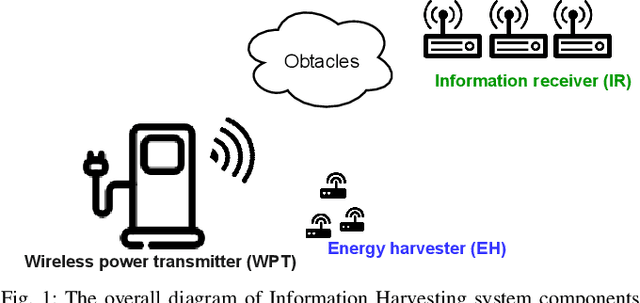
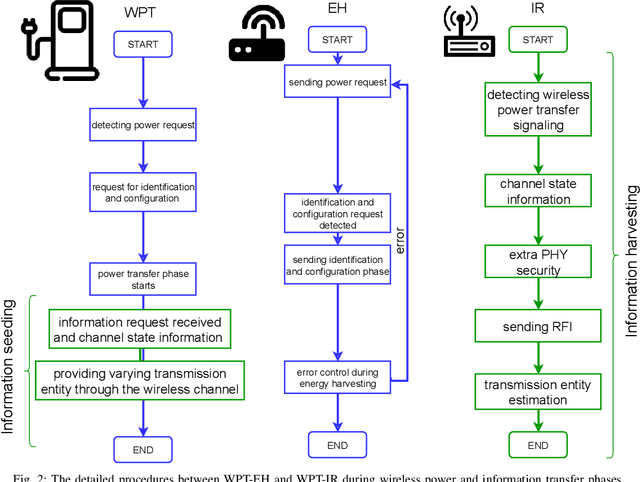
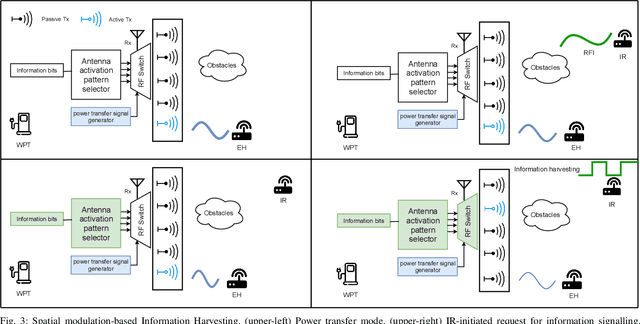
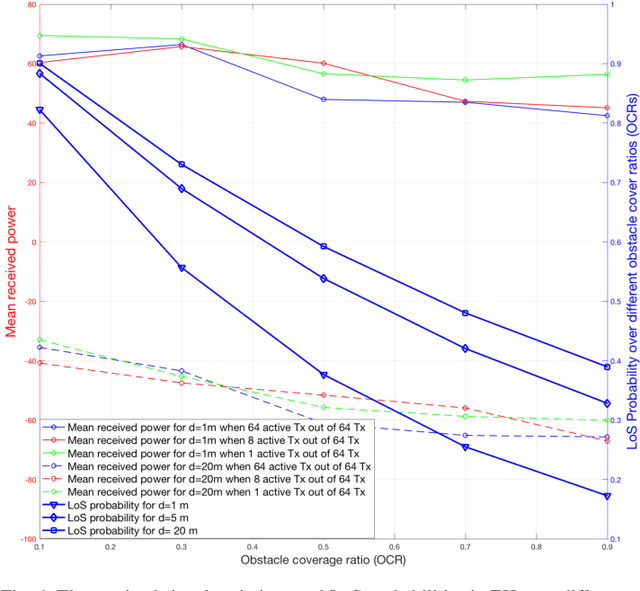
Considering ubiquitous connectivity and advanced information processing capability, huge amount of low-power IoT devices are deployed nowadays and the maintenance of those devices which includes firmware/software updates and recharging the units has become a bottleneck for IoT systems. For addressing limited battery constraints, wireless power transfer is a promising approach such that it does not require any physical link between energy harvester and power transfer. Furthermore, combining wireless power transfer with information transmission has become more appealing. In the systems that apply radio signals the wireless power transfer has become a popular trend to harvest RF-radiated energy from received information signal in IoT devices. For those systems, design frameworks mainly deal with the trade-off between information capacity and energy harvesting efficiency. Therein various signaling design frameworks have been proposed for different system preferences between power and information. In addition to this, protecting the information part from potential eavesdropping activity in a service area introduces security considerations for those systems. In this paper, we propose a novel concept, Information Harvesting, for wireless power transfer systems. It introduces a novel protocol design from opposite perspective compared to the existing studies. Particularly, Information Harvesting aims to transmit information through existing wireless power transfer mechanism without interfering/interrupting power transfer.
Visible light communication-based monitoring for indoor environments using unsupervised learning
Jan 20, 2021Visible Light Communication~(VLC) systems provide not only illumination and data communication, but also indoor monitoring services if the effect that different events create on the received optical signal is properly tracked. For this purpose, the Channel State Information that a VLC receiver computes to equalize the subcarriers of the OFDM signal can be also reused to train an Unsupervised Learning classifier. This way, different clusters can be created on the collected CSI data, which could be then mapped into relevant events to-be-monitored in the indoor environments, such as the presence of a new object in a given position or the change of the position of a given object. When compared to supervised learning algorithms, the proposed approach does not need to add tags in the training data, simplifying notably the implementation of the machine learning classifier. The practical validation the monitoring approach was done with the aid of a software-defined VLC link based on OFDM, in which a copy of the intensity modulated signal coming from a Phosphor-converted LED was captured by a pair of Photodetectors~(PDs). The performance evaluation of the experimental VLC-based monitoring demo achieved a positioning accuracy in the few-centimeter-range, without the necessity of deploying a large number of sensors and/or adding a VLC-enabled sensor on the object to-be-tracked.