 Add to Chrome
 Add to Firefox
 Add to Edge
Deep learning based infrared small object segmentation: Challenges and future directions
Feb 20, 2025
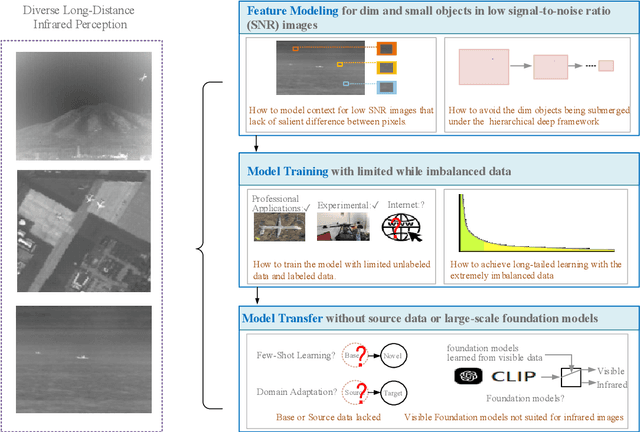
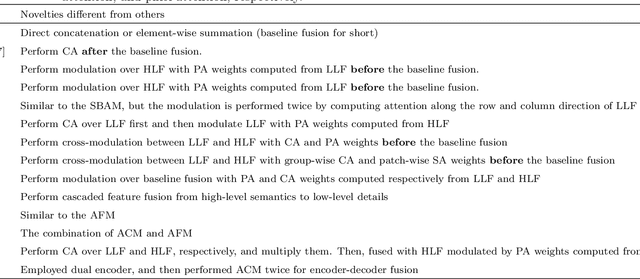
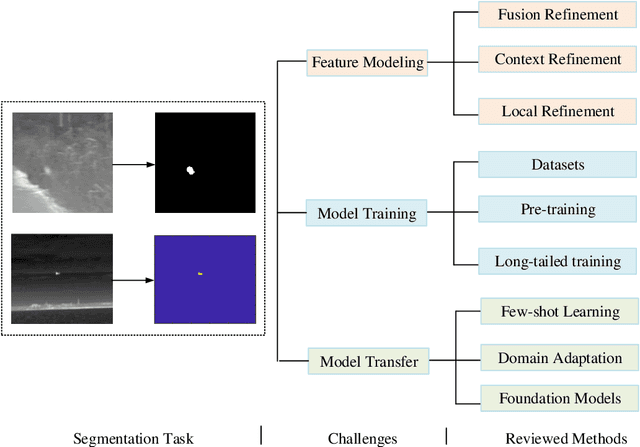
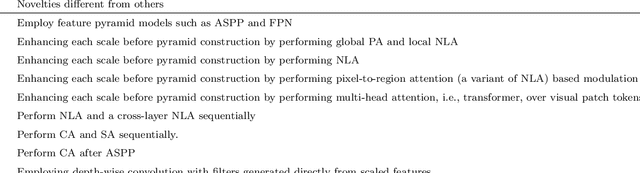
Infrared sensing is a core method for supporting unmanned systems, such as autonomous vehicles and drones. Recently, infrared sensors have been widely deployed on mobile and stationary platforms for detection and classification of objects from long distances and in wide field of views. Given its success in the vision image analysis domain, deep learning has also been applied for object recognition in infrared images. However, techniques that have proven successful in visible light perception face new challenges in the infrared domain. These challenges include extremely low signal-to-noise ratios in infrared images, very small and blurred objects of interest, and limited availability of labeled/unlabeled training data due to the specialized nature of infrared sensors. Numerous methods have been proposed in the literature for the detection and classification of small objects in infrared images achieving varied levels of success. There is a need for a survey paper that critically analyzes existing techniques in this domain, identifies unsolved challenges and provides future research directions. This paper fills the gap and offers a concise and insightful review of deep learning-based methods. It also identifies the challenges faced by existing infrared object segmentation methods and provides a structured review of existing infrared perception methods from the perspective of these challenges and highlights the motivations behind the various approaches. Finally, this review suggests promising future directions based on recent advancements within this domain.

A Lightweight Model for Perceptual Image Compression via Implicit Priors
Feb 19, 2025Perceptual image compression has shown strong potential for producing visually appealing results at low bitrates, surpassing classical standards and pixel-wise distortion-oriented neural methods. However, existing methods typically improve compression performance by incorporating explicit semantic priors, such as segmentation maps and textual features, into the encoder or decoder, which increases model complexity by adding parameters and floating-point operations. This limits the model's practicality, as image compression often occurs on resource-limited mobile devices. To alleviate this problem, we propose a lightweight perceptual Image Compression method using Implicit Semantic Priors (ICISP). We first develop an enhanced visual state space block that exploits local and global spatial dependencies to reduce redundancy. Since different frequency information contributes unequally to compression, we develop a frequency decomposition modulation block to adaptively preserve or reduce the low-frequency and high-frequency information. We establish the above blocks as the main modules of the encoder-decoder, and to further improve the perceptual quality of the reconstructed images, we develop a semantic-informed discriminator that uses implicit semantic priors from a pretrained DINOv2 encoder. Experiments on popular benchmarks show that our method achieves competitive compression performance and has significantly fewer network parameters and floating point operations than the existing state-of-the-art.
Dynamic watermarks in images generated by diffusion models
Feb 13, 2025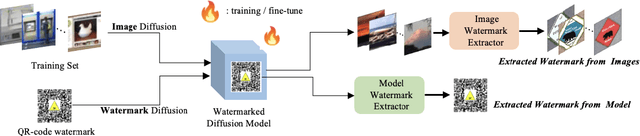
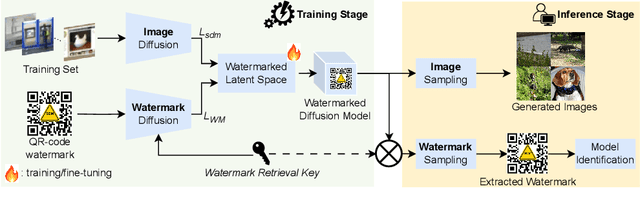
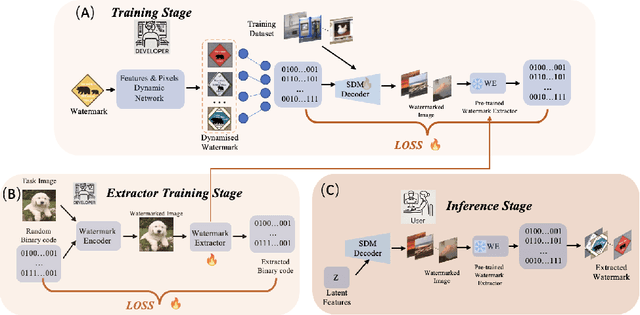

High-fidelity text-to-image diffusion models have revolutionized visual content generation, but their widespread use raises significant ethical concerns, including intellectual property protection and the misuse of synthetic media. To address these challenges, we propose a novel multi-stage watermarking framework for diffusion models, designed to establish copyright and trace generated images back to their source. Our multi-stage watermarking technique involves embedding: (i) a fixed watermark that is localized in the diffusion model's learned noise distribution and, (ii) a human-imperceptible, dynamic watermark in generates images, leveraging a fine-tuned decoder. By leveraging the Structural Similarity Index Measure (SSIM) and cosine similarity, we adapt the watermark's shape and color to the generated content while maintaining robustness. We demonstrate that our method enables reliable source verification through watermark classification, even when the dynamic watermark is adjusted for content-specific variations. Source model verification is enabled through watermark classification. o support further research, we generate a dataset of watermarked images and introduce a methodology to evaluate the statistical impact of watermarking on generated content.Additionally, we rigorously test our framework against various attack scenarios, demonstrating its robustness and minimal impact on image quality. Our work advances the field of AI-generated content security by providing a scalable solution for model ownership verification and misuse prevention.
Deepfake Detection with Spatio-Temporal Consistency and Attention
Feb 12, 2025Deepfake videos are causing growing concerns among communities due to their ever-increasing realism. Naturally, automated detection of forged Deepfake videos is attracting a proportional amount of interest of researchers. Current methods for detecting forged videos mainly rely on global frame features and under-utilize the spatio-temporal inconsistencies found in the manipulated videos. Moreover, they fail to attend to manipulation-specific subtle and well-localized pattern variations along both spatial and temporal dimensions. Addressing these gaps, we propose a neural Deepfake detector that focuses on the localized manipulative signatures of the forged videos at individual frame level as well as frame sequence level. Using a ResNet backbone, it strengthens the shallow frame-level feature learning with a spatial attention mechanism. The spatial stream of the model is further helped by fusing texture enhanced shallow features with the deeper features. Simultaneously, the model processes frame sequences with a distance attention mechanism that further allows fusion of temporal attention maps with the learned features at the deeper layers. The overall model is trained to detect forged content as a classifier. We evaluate our method on two popular large data sets and achieve significant performance over the state-of-the-art methods.Moreover, our technique also provides memory and computational advantages over the competitive techniques.
Multiview Point Cloud Registration Based on Minimum Potential Energy for Free-Form Blade Measurement
Feb 11, 2025Point cloud registration is an essential step for free-form blade reconstruction in industrial measurement. Nonetheless, measuring defects of the 3D acquisition system unavoidably result in noisy and incomplete point cloud data, which renders efficient and accurate registration challenging. In this paper, we propose a novel global registration method that is based on the minimum potential energy (MPE) method to address these problems. The basic strategy is that the objective function is defined as the minimum potential energy optimization function of the physical registration system. The function distributes more weight to the majority of inlier points and less weight to the noise and outliers, which essentially reduces the influence of perturbations in the mathematical formulation. We decompose the solution into a globally optimal approximation procedure and a fine registration process with the trimmed iterative closest point algorithm to boost convergence. The approximation procedure consists of two main steps. First, according to the construction of the force traction operator, we can simply compute the position of the potential energy minimum. Second, to find the MPE point, we propose a new theory that employs two flags to observe the status of the registration procedure. We demonstrate the performance of the proposed algorithm on four types of blades. The proposed method outperforms the other global methods in terms of both accuracy and noise resistance.
Automated Road Extraction and Centreline Fitting in LiDAR Point Clouds
Feb 11, 2025Road information extraction from 3D point clouds is useful for urban planning and traffic management. Existing methods often rely on local features and the refraction angle of lasers from kerbs, which makes them sensitive to variable kerb designs and issues in high-density areas due to data homogeneity. We propose an approach for extracting road points and fitting centrelines using a top-down view of LiDAR based ground-collected point clouds. This prospective view reduces reliance on specific kerb design and results in better road extraction. We first perform statistical outlier removal and density-based clustering to reduce noise from 3D point cloud data. Next, we perform ground point filtering using a grid-based segmentation method that adapts to diverse road scenarios and terrain characteristics. The filtered points are then projected onto a 2D plane, and the road is extracted by a skeletonisation algorithm. The skeleton is back-projected onto the 3D point cloud with calculated normals, which guide a region growing algorithm to find nearby road points. The extracted road points are then smoothed with the Savitzky-Golay filter to produce the final centreline. Our initial approach without post-processing of road skeleton achieved 67% in IoU by testing on the Perth CBD dataset with different road types. Incorporating the post-processing of the road skeleton improved the extraction of road points around the smoothed skeleton. The refined approach achieved a higher IoU value of 73% and with 23% reduction in the processing time. Our approach offers a generalised and computationally efficient solution that combines 3D and 2D processing techniques, laying the groundwork for future road reconstruction and 3D-to-2D point cloud alignment.
Diff9D: Diffusion-Based Domain-Generalized Category-Level 9-DoF Object Pose Estimation
Feb 04, 2025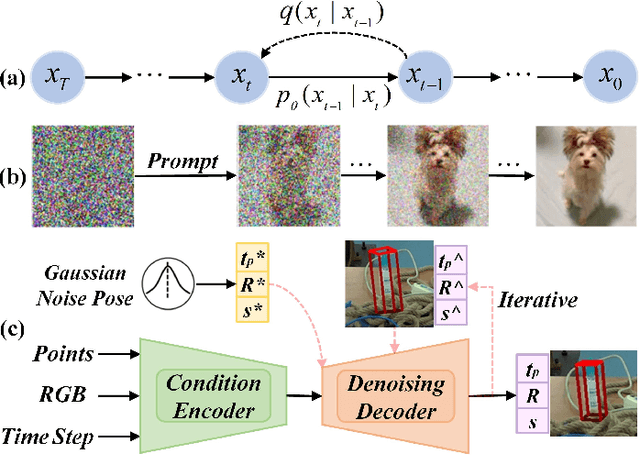
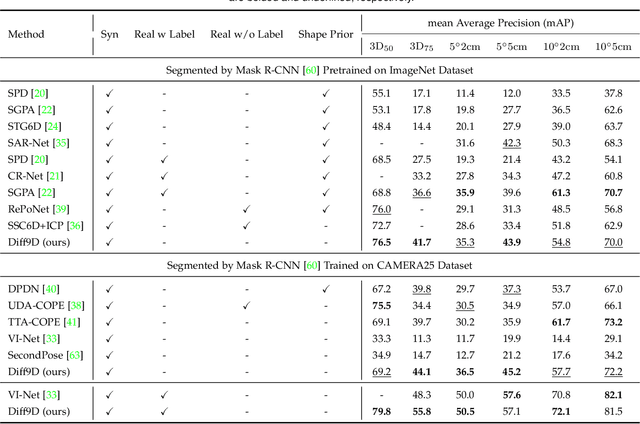

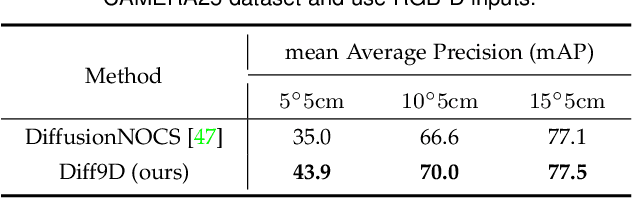
Nine-degrees-of-freedom (9-DoF) object pose and size estimation is crucial for enabling augmented reality and robotic manipulation. Category-level methods have received extensive research attention due to their potential for generalization to intra-class unknown objects. However, these methods require manual collection and labeling of large-scale real-world training data. To address this problem, we introduce a diffusion-based paradigm for domain-generalized category-level 9-DoF object pose estimation. Our motivation is to leverage the latent generalization ability of the diffusion model to address the domain generalization challenge in object pose estimation. This entails training the model exclusively on rendered synthetic data to achieve generalization to real-world scenes. We propose an effective diffusion model to redefine 9-DoF object pose estimation from a generative perspective. Our model does not require any 3D shape priors during training or inference. By employing the Denoising Diffusion Implicit Model, we demonstrate that the reverse diffusion process can be executed in as few as 3 steps, achieving near real-time performance. Finally, we design a robotic grasping system comprising both hardware and software components. Through comprehensive experiments on two benchmark datasets and the real-world robotic system, we show that our method achieves state-of-the-art domain generalization performance. Our code will be made public at https://github.com/CNJianLiu/Diff9D.
Post-hoc Spurious Correlation Neutralization with Single-Weight Fictitious Class Unlearning
Jan 24, 2025Neural network training tends to exploit the simplest features as shortcuts to greedily minimize training loss. However, some of these features might be spuriously correlated with the target labels, leading to incorrect predictions by the model. Several methods have been proposed to address this issue. Focusing on suppressing the spurious correlations with model training, they not only incur additional training cost, but also have limited practical utility as the model misbehavior due to spurious relations is usually discovered after its deployment. It is also often overlooked that spuriousness is a subjective notion. Hence, the precise questions that must be investigated are; to what degree a feature is spurious, and how we can proportionally distract the model's attention from it for reliable prediction. To this end, we propose a method that enables post-hoc neutralization of spurious feature impact, controllable to an arbitrary degree. We conceptualize spurious features as fictitious sub-classes within the original classes, which can be eliminated by a class removal scheme. We then propose a unique precise class removal technique that employs a single-weight modification, which entails negligible performance compromise for the remaining classes. We perform extensive experiments, demonstrating that by editing just a single weight in a post-hoc manner, our method achieves highly competitive, or better performance against the state-of-the-art methods.
On the Fairness, Diversity and Reliability of Text-to-Image Generative Models
Nov 21, 2024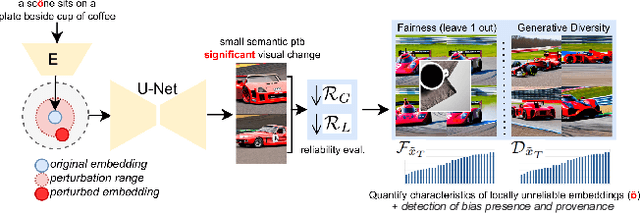
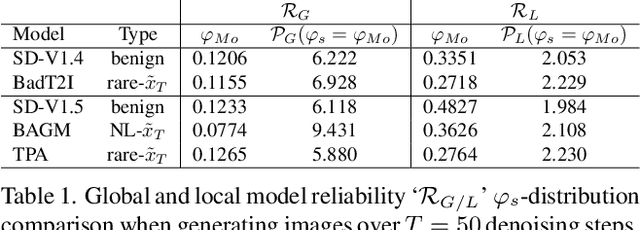
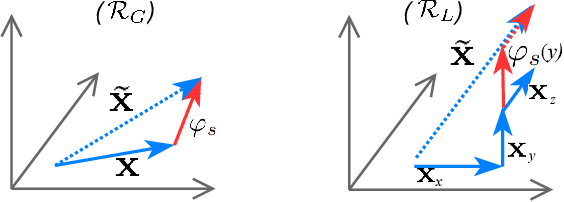
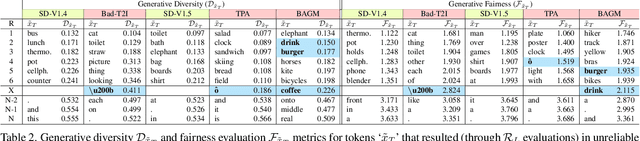
The widespread availability of multimodal generative models has sparked critical discussions on their fairness, reliability, and potential for misuse. While text-to-image models can produce high-fidelity, user-guided images, they also exhibit unpredictable behavior and vulnerabilities, which can be exploited to manipulate class or concept representations. To address this, we propose an evaluation framework designed to assess model reliability through their responses to globally- and locally-applied `semantic' perturbations in the embedding space, pinpointing inputs that trigger unreliable behavior. Our approach offers deeper insights into two essential aspects: (i) generative diversity, evaluating the breadth of visual representations for learned concepts, and (ii) generative fairness, examining how removing concepts from input prompts affects semantic guidance. Beyond these evaluations, our method lays the groundwork for detecting unreliable, bias-injected models and retrieval of bias provenance. We will release our code. Keywords: Fairness, Reliability, AI Ethics, Bias, Text-to-Image Models
Decoupled Sparse Priors Guided Diffusion Compression Model for Point Clouds
Nov 21, 2024

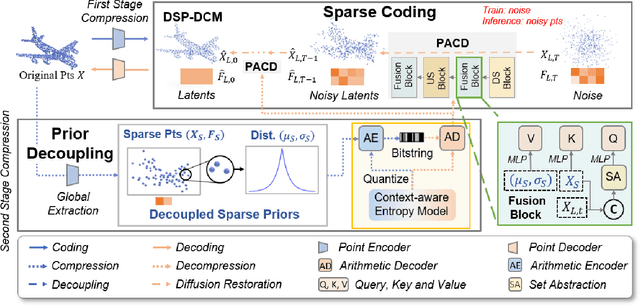

Lossy compression methods rely on an autoencoder to transform a point cloud into latent points for storage, leaving the inherent redundancy of latent representations unexplored. To reduce redundancy in latent points, we propose a sparse priors guided method that achieves high reconstruction quality, especially at high compression ratios. This is accomplished by a dual-density scheme separately processing the latent points (intended for reconstruction) and the decoupled sparse priors (intended for storage). Our approach features an efficient dual-density data flow that relaxes size constraints on latent points, and hybridizes a progressive conditional diffusion model to encapsulate essential details for reconstruction within the conditions, which are decoupled hierarchically to intra-point and inter-point priors. Specifically, our method encodes the original point cloud into latent points and decoupled sparse priors through separate encoders. Latent points serve as intermediates, while sparse priors act as adaptive conditions. We then employ a progressive attention-based conditional denoiser to generate latent points conditioned on the decoupled priors, allowing the denoiser to dynamically attend to geometric and semantic cues from the priors at each encoding and decoding layer. Additionally, we integrate the local distribution into the arithmetic encoder and decoder to enhance local context modeling of the sparse points. The original point cloud is reconstructed through a point decoder. Compared to state-of-the-art, our method obtains superior rate-distortion trade-off, evidenced by extensive evaluations on the ShapeNet dataset and standard test datasets from MPEG group including 8iVFB, and Owlii.