 Add to Chrome
 Add to Firefox
 Add to Edge
ReLA: Representation Learning and Aggregation for Job Scheduling with Reinforcement Learning
Jan 08, 2026
Job scheduling is widely used in real-world manufacturing systems to assign ordered job operations to machines under various constraints. Existing solutions remain limited by long running time or insufficient schedule quality, especially when problem scale increases. In this paper, we propose ReLA, a reinforcement-learning (RL) scheduler built on structured representation learning and aggregation. ReLA first learns diverse representations from scheduling entities, including job operations and machines, using two intra-entity learning modules with self-attention and convolution and one inter-entity learning module with cross-attention. These modules are applied in a multi-scale architecture, and their outputs are aggregated to support RL decision-making. Across experiments on small, medium, and large job instances, ReLA achieves the best makespan in most tested settings over the latest solutions. On non-large instances, ReLA reduces the optimality gap of the SOTA baseline by 13.0%, while on large-scale instances it reduces the gap by 78.6%, with the average optimality gaps lowered to 7.3% and 2.1%, respectively. These results confirm that ReLA's learned representations and aggregation provide strong decision support for RL scheduling, and enable fast job completion and decision-making for real-world applications.

Nutrition Estimation for Dietary Management: A Transformer Approach with Depth Sensing
Jun 04, 2024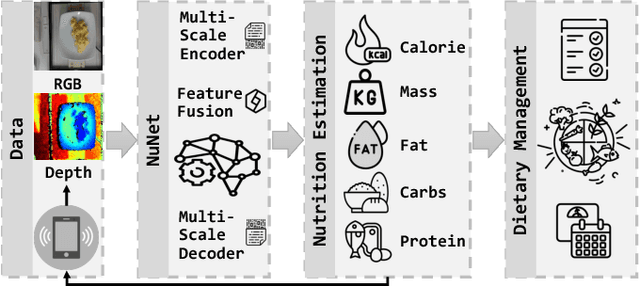
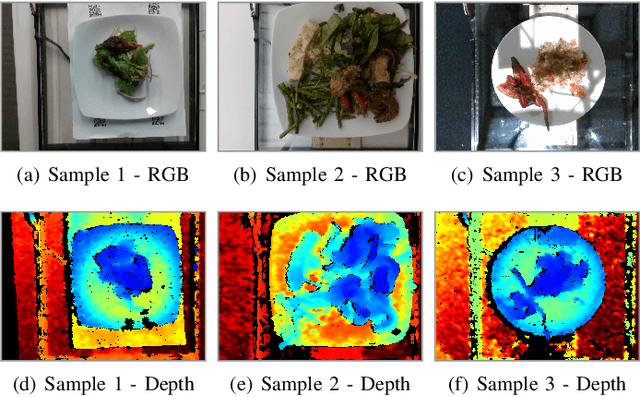
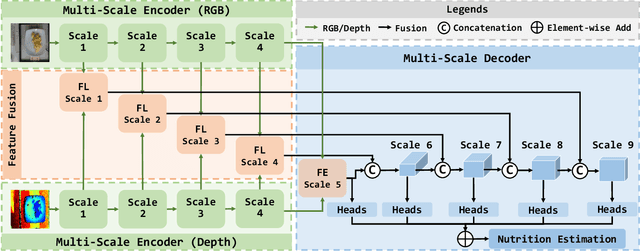
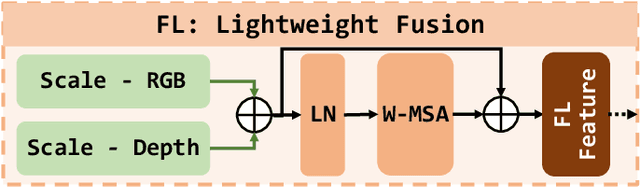
Nutrition estimation is crucial for effective dietary management and overall health and well-being. Existing methods often struggle with sub-optimal accuracy and can be time-consuming. In this paper, we propose NuNet, a transformer-based network designed for nutrition estimation that utilizes both RGB and depth information from food images. We have designed and implemented a multi-scale encoder and decoder, along with two types of feature fusion modules, specialized for estimating five nutritional factors. These modules effectively balance the efficiency and effectiveness of feature extraction with flexible usage of our customized attention mechanisms and fusion strategies. Our experimental study shows that NuNet outperforms its variants and existing solutions significantly for nutrition estimation. It achieves an error rate of 15.65%, the lowest known to us, largely due to our multi-scale architecture and fusion modules. This research holds practical values for dietary management with huge potential for transnational research and deployment and could inspire other applications involving multiple data types with varying degrees of importance.