 Add to Chrome
 Add to Firefox
 Add to Edge
TextNCA: Neural Cellular Automata for Language Modeling via Hierarchical Local Attention
Aug 03, 2026
Can a strictly local, iterated, weight-shared computation primitive support language modelling, and which of those three properties actually drives the model's behaviour? We define \textsc{TextNCA}, a 1D causal windowed-attention realisation of the Neural Cellular Automaton primitive, and study a hierarchical variant that cascades three stages with windows $w \in \{8, 32, 128\}$ and $T_s$ shared-weight iterations per stage, all on WikiText-103 at roughly 30M parameters and 60k training steps. The model does not match a parameter-matched Transformer at this scale (Hier-TextNCA $60.3$ vs.\ Transformer-6L $52.8$ and Transformer-12L $44.7$ PPL), so we treat it as an analytical probe rather than a proposed alternative. The behaviour we observe is largely explained by the staged narrow-to-wide schedule: a non-iterating sliding-window Transformer that reuses the same schedule comes within $+4.1$ PPL of the iterated model, while reversing, flattening, or breaking the monotonic ordering of the schedule costs between $+16.7$ and $+70.8$ PPL. Iteration adds a smaller bounded benefit on top of the schedule, with a clear optimum at $T_s{=}4$ and a U-shaped degradation beyond it. The GRU gate and learned per-step embeddings are required for that benefit to appear, and training with random $T_s$ yields an inference-time iteration-count knob at the cost of substantially higher absolute PPL. We position the work as a controlled reading of which parts of NCA-style computation carry the weight in language modelling.

Triadic Werewolf: A Jester Role for Multi-Hop Theory of Mind in LLMs
Jun 26, 2026Theory-of-mind evaluations of large language models typically use dyadic social-deduction games, where every observable cue points to a single hidden side, so a model with strong language priors can score well without ever simulating opponents' incentives. We extend the Werewolf game with a Jester, a third faction whose utility on peer suspicion is inverted because it wins by being voted out, so optimal play requires reasoning across three opposing utility functions. Across 60 games on GPT-4.1, DeepSeek-V3.1, and Llama-3.3-70B with Jester self-learning on and off, the Jester wins 60-70% of games while Werewolves never exceed 20%, and GPT-4.1 wolves vote the Jester out on day 1 in 60-70% of games, a strictly self-defeating action. Self-learning helps DeepSeek and Llama but hurts GPT-4.1, with the cost landing on Villagers rather than Werewolves. Only DeepSeek learns the subtle strategy of looking suspicious without looking intentionally suspicious, and it gains the most from the loop. Triadic incentive structure exposes a layer of multi-agent reasoning that dyadic deduction games leave invisible.
The Periodic Table of LLM Reasoning: A Structured Survey of Reasoning Paradigms, Methods, and Failure Modes
Jun 09, 2026Large Language Models (LLMs) have achieved strong performance across natural language processing tasks, yet reliable reasoning remains an open challenge. Although modern LLMs show progress in structured inference, multi-step problem solving, and contextual understanding, their reasoning behavior is often inconsistent and sensitive to prompting strategies, task design, and model scale. This survey provides a systematic analysis of more than 300 recent papers from arXiv, Semantic Scholar, Google Scholar, Papers with Code, and the ACL Anthology to examine how reasoning capabilities emerge in LLMs and where they fail. We make three main contributions. First, we introduce a structured taxonomy of LLM reasoning research, covering Chain-of-Thought reasoning, multi-hop reasoning, mathematical reasoning, common sense reasoning, visual and temporal reasoning, code and algorithmic reasoning, retrieval-augmented reasoning, tool-augmented and agentic reasoning, and reinforcement learning-based reasoning. Second, we analyze methodological trends across these paradigms, including prompting methods, model architectures, training objectives, reward modeling, and evaluation benchmarks. Third, we synthesize recurring limitations and failure modes, such as reasoning hallucinations, brittle multi-step inference, weak causal abstraction, and poor cross-domain generalization. By organizing a rapidly expanding literature, this survey offers a unified view of the current capabilities and limitations of reasoning in LLMs. We also identify emerging research directions, including meta-reasoning, self-evolving reasoning frameworks, multimodal reasoning, and socially grounded reasoning. Overall, this work aims to serve as a reference for developing more robust, interpretable, and generalizable reasoning systems in future language models.
Litmus (Re)Agent: A Benchmark and Agentic System for Predictive Evaluation of Multilingual Models
Apr 10, 2026We study predictive multilingual evaluation: estimating how well a model will perform on a task in a target language when direct benchmark results are missing. This problem is common in multilingual deployment, where evaluation coverage is sparse and published evidence is uneven across languages, tasks, and model families. We introduce a controlled benchmark of 1,500 questions spanning six tasks and five evidence scenarios. The benchmark separates accessible evidence from ground truth, enabling evaluation of systems that must infer missing results from incomplete literature evidence. We also present Litmus (Re)Agent, a DAG-orchestrated agentic system that decomposes queries into hypotheses, retrieves evidence, and synthesises predictions through feature-aware aggregation. Across six systems, Litmus (Re)Agent achieves the best overall performance, with the largest gains in transfer-heavy scenarios where direct evidence is weak or absent. These results show that structured agentic reasoning is a promising approach to multilingual performance estimation under incomplete evidence.
Do LLMs Follow Their Own Rules? A Reflexive Audit of Self-Stated Safety Policies
Apr 10, 2026LLMs internalize safety policies through RLHF, yet these policies are never formally specified and remain difficult to inspect. Existing benchmarks evaluate models against external standards but do not measure whether models understand and enforce their own stated boundaries. We introduce the Symbolic-Neural Consistency Audit (SNCA), a framework that (1) extracts a model's self-stated safety rules via structured prompts, (2) formalizes them as typed predicates (Absolute, Conditional, Adaptive), and (3) measures behavioral compliance via deterministic comparison against harm benchmarks. Evaluating four frontier models across 45 harm categories and 47,496 observations reveals systematic gaps between stated policy and observed behavior: models claiming absolute refusal frequently comply with harmful prompts, reasoning models achieve the highest self-consistency but fail to articulate policies for 29% of categories, and cross-model agreement on rule types is remarkably low (11%). These results demonstrate that the gap between what LLMs say and what they do is measurable and architecture-dependent, motivating reflexive consistency audits as a complement to behavioral benchmarks.
C2-Faith: Benchmarking LLM Judges for Causal and Coverage Faithfulness in Chain-of-Thought Reasoning
Mar 05, 2026Large language models (LLMs) are increasingly used as judges of chain-of-thought (CoT) reasoning, but it remains unclear whether they can reliably assess process faithfulness rather than just answer plausibility. We introduce C2-Faith, a benchmark built from PRM800K that targets two complementary dimensions of faithfulness: causality (does each step logically follow from prior context?) and coverage (are essential intermediate inferences present?). Using controlled perturbations, we create examples with known causal error positions by replacing a single step with an acausal variant, and with controlled coverage deletions at varying deletion rates (scored against reference labels). We evaluate three frontier judges under three tasks: binary causal detection, causal step localization, and coverage scoring. The results show that model rankings depend strongly on task framing, with no single judge dominating all settings; all judges exhibit a substantial gap between detecting an error and localizing it; and coverage judgments are systematically inflated for incomplete reasoning. These findings clarify when LLM judges are dependable and where they fail, and provide practical guidance for selecting judges in process-level evaluation
MedSegDiffNCA: Diffusion Models With Neural Cellular Automata for Skin Lesion Segmentation
Jan 05, 2025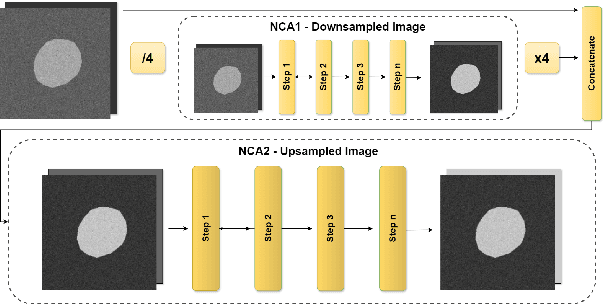
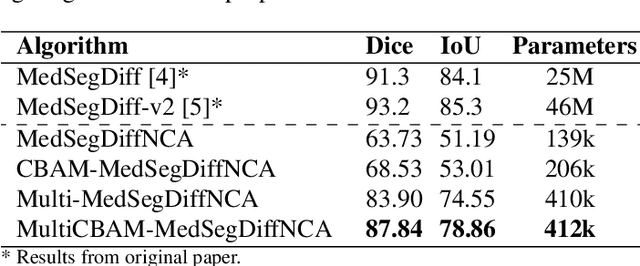
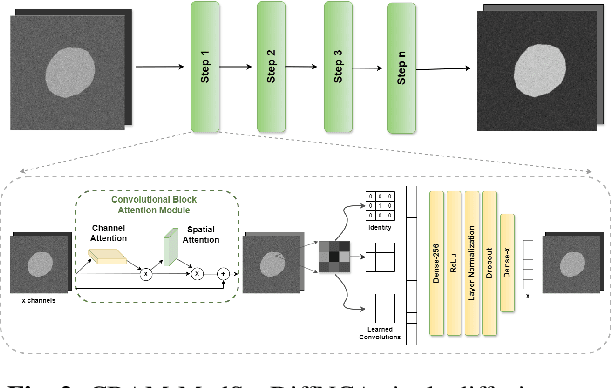
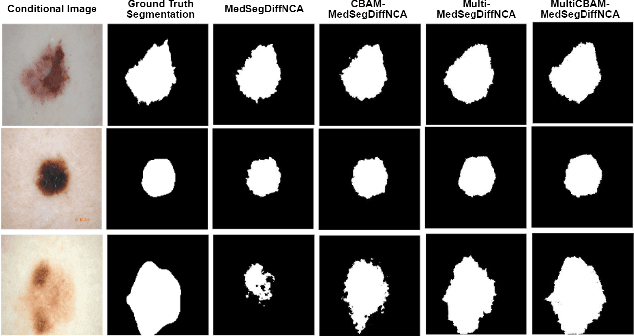
Denoising Diffusion Models (DDMs) are widely used for high-quality image generation and medical image segmentation but often rely on Unet-based architectures, leading to high computational overhead, especially with high-resolution images. This work proposes three NCA-based improvements for diffusion-based medical image segmentation. First, Multi-MedSegDiffNCA uses a multilevel NCA framework to refine rough noise estimates generated by lower level NCA models. Second, CBAM-MedSegDiffNCA incorporates channel and spatial attention for improved segmentation. Third, MultiCBAM-MedSegDiffNCA combines these methods with a new RGB channel loss for semantic guidance. Evaluations on Lesion segmentation show that MultiCBAM-MedSegDiffNCA matches Unet-based model performance with dice score of 87.84% while using 60-110 times fewer parameters, offering a more efficient solution for low resource medical settings.