 Add to Chrome
 Add to Firefox
 Add to Edge
Multi-Hop RIS ISAC for Target Positioning: A Tensor Decomposition-based Approach
Aug 03, 2026
Reconfigurable intelligent surface (RIS) has demon- strated remarkable potential to enhance the performance of integrated sensing and communication (ISAC), particularly when the line-of-sight (LoS) paths are obstructed. By controlling the reconfigurable elements on the surface, RIS can establish virtual LoS paths and provide considerable passive beamforming gains, thereby significantly improving the received signal quality. In this paper, we design a novel multi-hop RIS ISAC system for target positioning, where multiple RISs are deployed to assist the communication from a transmitter to associated users while simultaneously enhancing receiver sensing performance in target positioning. Specifically, we formulate an optimization problem to minimize the root mean square error (RMSE) of the target detection while guaranteeing the communication requirements of the users. To solve this problem, we first unfold the cascaded sens- ing channel through parallel factor decomposition, and develop a low-rank CANDECOMP/PARAFAC decomposition (CPD)-based scheme to extract the location parameters (i.e., angle of arrival, angle of departure and delay) of the sensing targets. Then, we develop a scheme for jointly selecting the transmit beamforming and RIS phase shift configurations to maximize the sensing energy at the receiver, which in turn leads to improved accuracy in target positioning. We also provide a uniqueness analysis, complexity analysis, and Cramér-Rao lower bound (CRLB) of the parameters estimated by our methodology. Simulation results validate the improvement in target positioning obtained by our design relative to baselines.

AISAC: Closing the Loop Between AI and Integrated Sensing and Communication for 6G
Jul 17, 2026Integrated sensing and communication (ISAC) and AI-and-communication (AIAC) are identified as separate usage scenarios in the ITU IMT-2030 vision for sixth-generation (6G) networks. In practice, however, these two directions are already beginning to merge. ISAC gives the network a way to observe the physical world, while AI gives the network a way to learn from those observations and act on them. This article introduces AI-integrated sensing and communication (AISAC) as a closed-loop framework for this merger. In AISAC, AI is not only a tool used to optimize an ISAC system. ISAC is also the physical substrate through which AI receives data, context, and connectivity. The key technical message is that AISAC requires a new physical-layer design principle, in which the ISAC waveform, beam, power, bandwidth, and sensing mode should be configured for learning alignment, not for sensing distortion or communication rate alone. In particular, the sensing configuration that is most accurate from a classical estimation viewpoint need not be the one that is most useful for training or inference. We present the AISAC landscape, explain why imperfect sensing changes the learning problem, develop the closed-loop architecture and its three-way sensing-communication-learning tension, and outline a vehicular edge-intelligence use case together with open problems for theory, implementation, and standardization.
Optimal Multi-RIS Placement: Coverage-Guaranteed Sum Rate Maximization Under Inhomogeneous User Distributions
Jul 08, 2026The realization of the full potential of Reconfigurable Intelligent Surfaces (RIS) in a wireless system is tied to their strategic spatial deployment. While existing literature primarily focuses on enabling fairness by maximizing coverage to navigate through obstacles, these approaches often fail to exploit the spatial distribution of user density to maximize throughput. Thus, to enable fairness without loss in throughput, we formulate a novel hierarchical problem that maximizes the expected sum rate of the system while guaranteeing probabilistic coverage with the least possible number of RISs deployed. To solve this multi-layered non-convex problem, firstly, we obtain optimal regions where we can deploy RISs to provide the coverage guarantee by solving a constrained set-cover problem on a visibility graph. Then, the minimum number of RISs we require to satisfy the coverage guarantee is obtained by a greedy minimum partitioning on an intersection hypergraph formed using the optimal regions. Finally, a Bayesian Optimization based approach is used to compute the final optimal RIS placement. Numerical results are provided to show that the proposed framework consistently identifies placements that jointly achieve good coverage and throughput, without impractical system assumptions.
Optimal RIS Placement in a Multi-User MISO System with User Randomness
Nov 06, 2025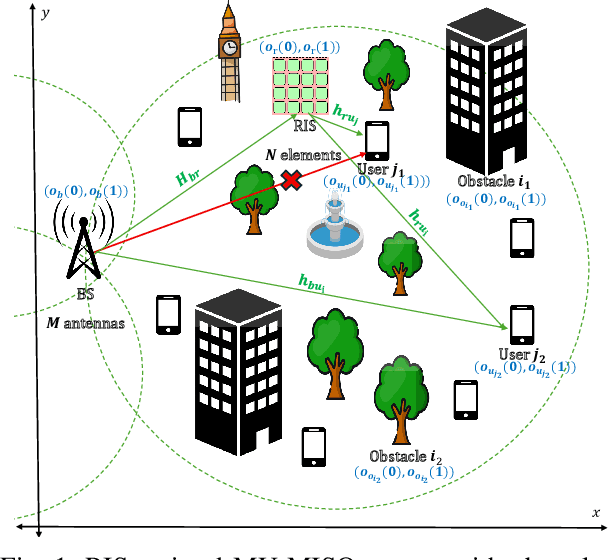
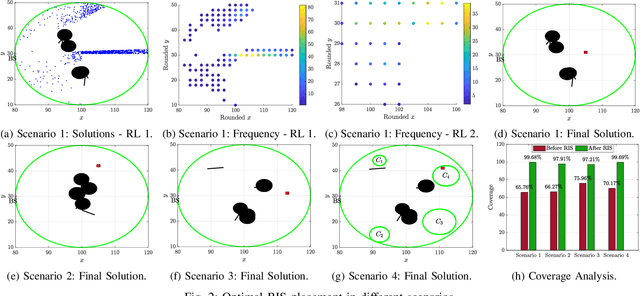
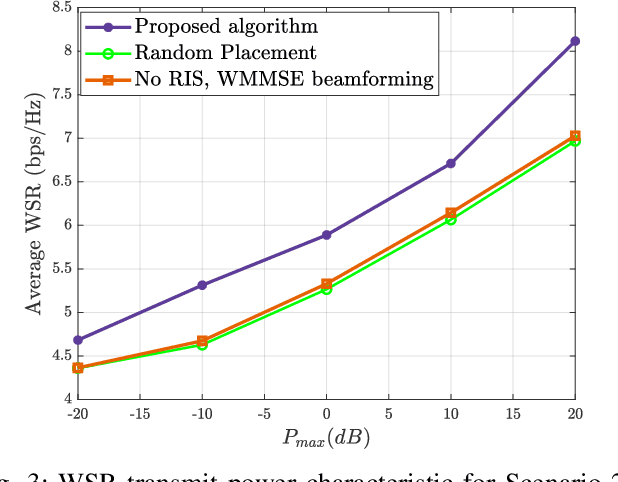
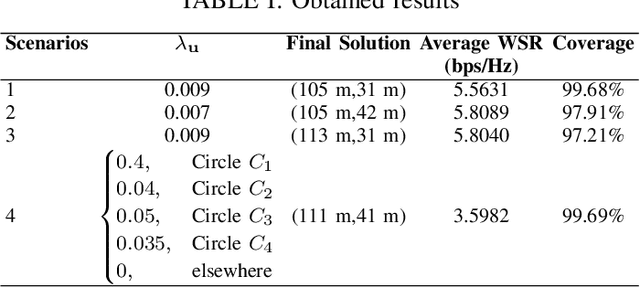
It is well established that the performance of reconfigurable intelligent surface (RIS)-assisted systems critically depends on the optimal placement of the RIS. Previous works consider either simple coverage maximization or simultaneous optimization of the placement of the RIS along with the beamforming and reflection coefficients, most of which assume that the location of the RIS, base station (BS), and users are known. However, in practice, only the spatial variation of user density and obstacle configuration are likely to be known prior to deployment of the system. Thus, we formulate a non-convex problem that optimizes the position of the RIS over the expected minimum signal-to-interference-plus-noise ratio (SINR) of the system with user randomness, assuming that the system employs joint beamforming after deployment. To solve this problem, we propose a recursive coarse-to-fine methodology that constructs a set of candidate locations for RIS placement based on the obstacle configuration and evaluates them over multiple instantiations from the user distribution. The search is recursively refined within the optimal region identified in each stage to determine the final optimal region for RIS deployment. Numerical results are presented to corroborate our findings.
Robust Beamforming Design for STAR-RIS Aided RSMA Network with Hardware Impairments
May 13, 2025In this article, we investigate the robust beamforming design for a simultaneous transmitting and reflecting reconfigurable intelligent surface (STAR-RIS) aided downlink rate-splitting multiple access (RSMA) communication system, where both transceivers and STAR-RIS suffer from the impact of hardware impairments (HWI). A base station (BS) is deployed to transmit messages concurrently to multiple users, utilizing a STAR-RIS to improve communication quality and expand user coverage. We aim to maximize the achievable sum rate of the users while ensuring the constraints of transmit power, STAR-RIS coefficients, and the actual rate of the common stream for all users. To solve this challenging high-coupling and non-convexity problem, we adopt a fractional programming (FP)-based alternating optimization (AO) approach, where each sub-problem is addressed via semidefinite relaxation (SDR) and successive convex approximation (SCA) methods. Numerical results demonstrate that the proposed scheme outperforms other multiple access schemes and conventional passive RIS in terms of the achievable sum rate. Additionally, considering the HWI of the transceiver and STAR-RIS makes our algorithm more robust than when such considerations are not included.
Joint Precoder and Reflector Design for RIS-assisted Multi-user OAM Communication Systems
Jan 24, 2025


Orbital angular momentum (OAM) can enhance the spectral efficiency by multiplying a set of orthogonal modes on the same frequency channel. To maintain the orthogonal among different OAM modes, perfect alignments between transmitters and receivers are strictly required. However, in multi-user OAM communications, the perfect alignments between the transmitter and all the receivers are impossible. The phase turbulence, caused by misaligned transmitters and receivers, leads to serious inter-mode interference, which greatly degrades the capacity of OAM transmissions. To eliminate the negative effects of phase turbulence and further enhance the transmission capacity, we introduce RIS into the system, and propose a joint precoder and reflector design for reconfigurable intelligent surface (RIS)-assisted multi-user OAM communication systems. Specifically, we propose a three-layer design at the transmitter side, which includes inter-user OAM mode interference cancellation, inter-mode self-interference elimination and the power allocation among different users. By analyzing the characteristics of the overall channels, we are able to give the specific expressions of the precoder designs, which significantly reduce the optimization complexity. We further leverage RIS to guarantee the line-ofsight (LoS) transmissions between the transmitter and users for better sum rate performance. To verify the superiority of the proposed multi-user OAM transmission system, we compare it with traditional MIMO transmission schemes, numerical results have shown that our proposed design can achieve better sum rate performance due to the well-designed orthogonality among different users and OAM modes.
Experimental Study of RCS Diversity with Novel No-divergent OAM Beams
Dec 25, 2024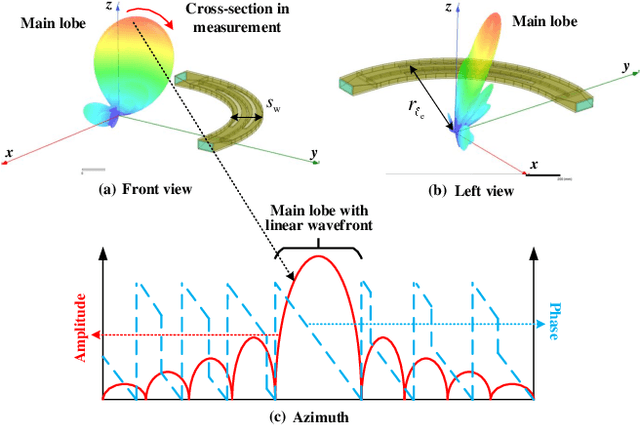
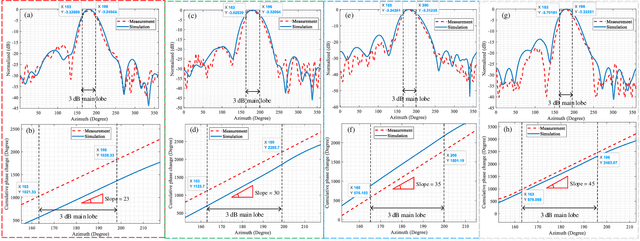


This research proposes a novel approach utilizing Orbital Angular Momentum (OAM) beams to enhance Radar Cross Section (RCS) diversity for target detection in future transportation systems. Unlike conventional OAM beams with hollow-shaped divergence patterns, the new proposed OAM beams provide uniform illumination across the target without a central energy void, but keep the inherent phase gradient of vortex property. We utilize waveguide slot antennas to generate four different modes of these novel OAM beams at X-band frequency. Furthermore, these different mode OAM beams are used to illuminate metal models, and the resulting RCS is compared with that obtained using plane waves. The findings reveal that the novel OAM beams produce significant azimuthal RCS diversity, providing a new approach for the detection of weak and small targets.This study not only reveals the RCS diversity phenomenon based on novel OAM beams of different modes but also addresses the issue of energy divergence that hinders traditional OAM beams in long-range detection applications.
Does Long-Term Series Forecasting Need Complex Attention and Extra Long Inputs?
Jun 13, 2023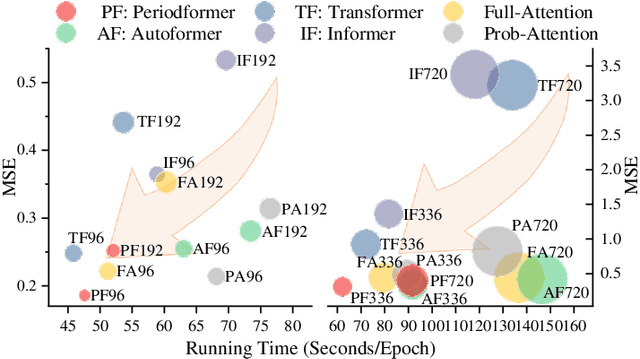
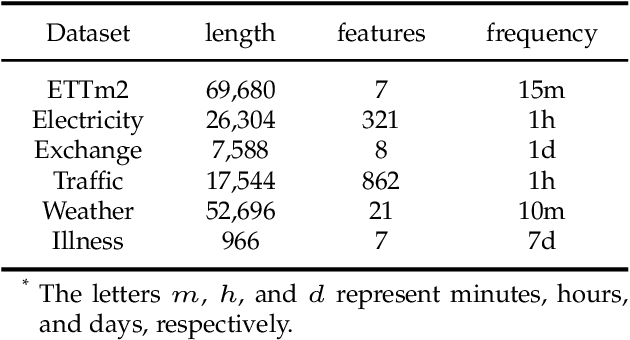
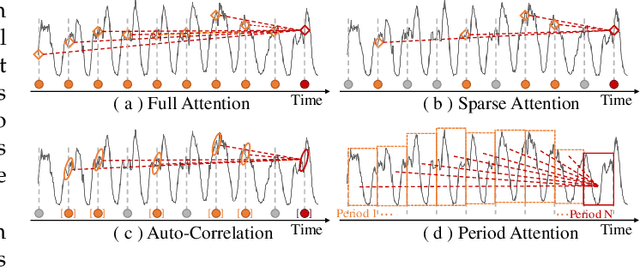
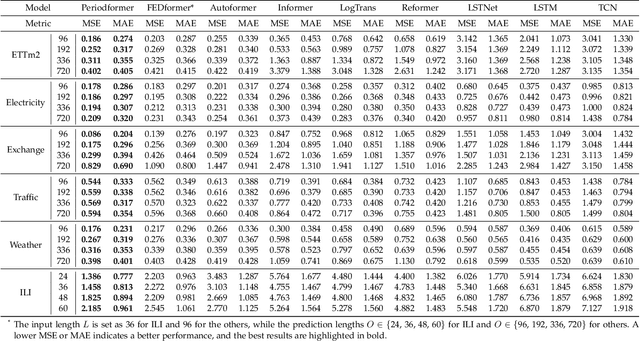
As Transformer-based models have achieved impressive performance on various time series tasks, Long-Term Series Forecasting (LTSF) tasks have also received extensive attention in recent years. However, due to the inherent computational complexity and long sequences demanding of Transformer-based methods, its application on LTSF tasks still has two major issues that need to be further investigated: 1) Whether the sparse attention mechanism designed by these methods actually reduce the running time on real devices; 2) Whether these models need extra long input sequences to guarantee their performance? The answers given in this paper are negative. Therefore, to better copy with these two issues, we design a lightweight Period-Attention mechanism (Periodformer), which renovates the aggregation of long-term subseries via explicit periodicity and short-term subseries via built-in proximity. Meanwhile, a gating mechanism is embedded into Periodformer to regulate the influence of the attention module on the prediction results. Furthermore, to take full advantage of GPUs for fast hyperparameter optimization (e.g., finding the suitable input length), a Multi-GPU Asynchronous parallel algorithm based on Bayesian Optimization (MABO) is presented. MABO allocates a process to each GPU via a queue mechanism, and then creates multiple trials at a time for asynchronous parallel search, which greatly reduces the search time. Compared with the state-of-the-art methods, the prediction error of Periodformer reduced by 13% and 26% for multivariate and univariate forecasting, respectively. In addition, MABO reduces the average search time by 46% while finding better hyperparameters. As a conclusion, this paper indicates that LTSF may not need complex attention and extra long input sequences. The code has been open sourced on Github.
Cooperative Beamforming Design for Multiple RIS-Assisted Communication Systems
Sep 30, 2022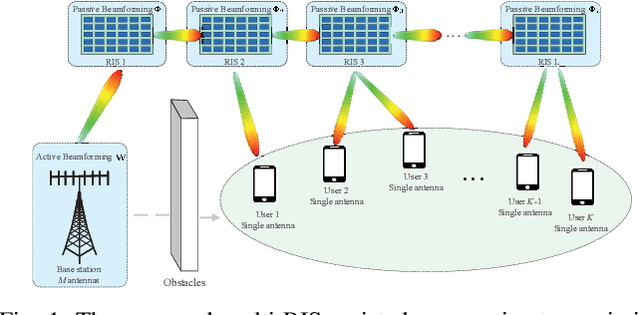
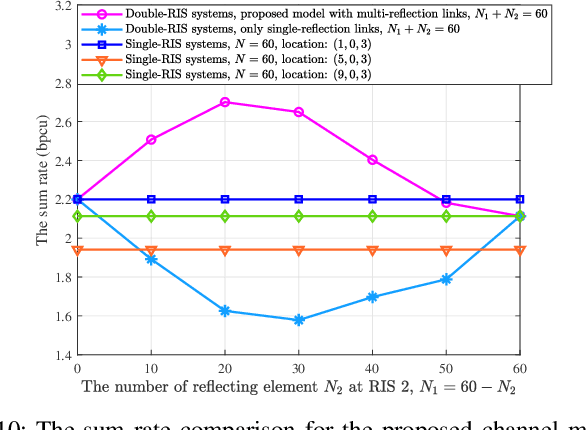
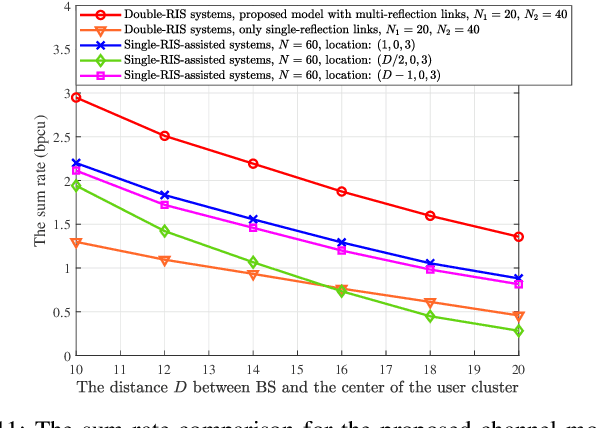
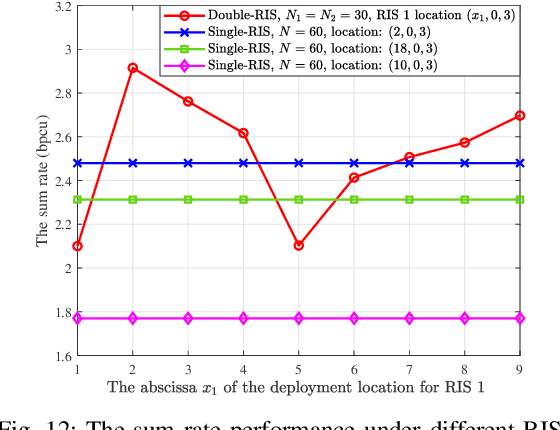
Reconfigurable intelligent surface (RIS) provides a promising way to build programmable wireless transmission environments. Owing to the massive number of controllable reflecting elements on the surface, RIS is capable of providing considerable passive beamforming gains. At present, most related works mainly consider the modeling, design, performance analysis and optimization of single-RIS-assisted systems. Although there are a few of works that investigate multiple RISs individually serving their associated users, the cooperation among multiple RISs is not well considered as yet. To fill the gap, this paper studies a cooperative beamforming design for multi-RIS-assisted communication systems, where multiple RISs are deployed to assist the downlink communications from a base station to its users. To do so, we first model the general channel from the base station to the users for arbitrary number of reflection links. Then, we formulate an optimization problem to maximize the sum rate of all users. Analysis shows that the formulated problem is difficult to solve due to its non-convexity and the interactions among the decision variables. To solve it effectively, we first decouple the problem into three disjoint subproblems. Then, by introducing appropriate auxiliary variables, we derive the closed-form expressions for the decision variables and propose a low-complexity cooperative beamforming algorithm. Simulation results have verified the effectiveness of the proposed algorithm through comparison with various baseline methods. Furthermore, these results also unveil that, for the sum rate maximization, distributing the reflecting elements among multiple RISs is superior to deploying them at one single RIS.