 Add to Chrome
 Add to Firefox
 Add to Edge
When Confidence Fails: Overconfidence in LLMs under Uncertainty and Missing Clinical Information
Aug 10, 2026
Large Language Models (LLMs) have achieved strong performance in medical question answering and clinical reasoning tasks. However, their reliability under uncertainty remains poorly understood which raises critical concerns for deployment in high-stakes clinical settings. In such environments, incorrect predictions are inherently risky, but confident incorrect predictions can be particularly harmful as they may mislead clinical decision-making. In this paper, we conduct a systematic behavioral analysis of LLMs under clinical information uncertainty. We propose an evaluation framework based on the MedMCQA dataset consisting of two complementary uncertainty settings. First, we introduce linguistic uncertainty cues through prompt modifications to simulate ambiguous clinical contexts. Second, we construct an answer removal setting, wherein the correct option is deliberately excluded mandating the model to recognize insufficient information and abstain. We analyze both model accuracy and confidence behavior using multiple calibration metrics including calibration gap, Expected Calibration Error (ECE), and Unsafe Confident Error Rate (UCER) across 500 medical questions. Our results reveal a consistent failure mode, i.e., although accuracy degrades under increasing uncertainty, model confidence remains misaligned with accuracy. This leads to a substantial increase in unsafe confident errors, indicating that model confidence remains largely insensitive to clinically meaningful information loss. Furthermore, we observe significant variation across models in their ability to abstain when the correct answer is unavailable, with some models persistently producing high confidence hallucinated answers. These findings expose critical limitations in the epistemic reliability of current LLMs and highlight the need for uncertainty aware evaluation methods prior to their deployment in clinical workflows.

Learning Color Grading, No Photo Sharing: Federated Aesthetic Preference Learning for Personalized Image Enhancement
Jul 30, 2026Personalized image enhancement should reflect individual aesthetic taste, yet learning such preferences commonly depends on private photos and ratings that are unsuitable for centralized collection. The task must infer preference from sparse, heterogeneous feedback and translate it into natural-looking color transformations on resource-constrained user devices. We introduce FedPAIE, a federated personalized aesthetic image enhancement framework for user-adaptive color grading without centralizing raw photos or ratings. FedPAIE trains a lightweight dual-cue aesthetic scorer, calibrates it into a personalized scorer on a small local support set, and freezes it to guide regularized adaptation of a lightweight CLUT enhancer from unpaired local photographs. Fidelity constraints and an excess-gap penalty regularize scorer-guided adaptation to limit proxy-score over-optimization while preserving content and natural appearance. Training remains lightweight throughout the pipeline: scorer learning updates at most 0.787M parameters, enhancer adaptation updates 0.265M, and inference retains only a 0.293M-parameter personalized enhancer. Experiments on MIT-Adobe FiveK and Flickr-AES demonstrate effective open-world personalization and a favorable balance between user preference and image fidelity. FedPAIE thus connects decentralized preference learning with efficient personalized image transformation without requiring paired user retouches.
AgenticAI-DialogGen: Topic-Guided Conversation Generation for Fine-Tuning and Evaluating Short- and Long-Term Memories of LLMs
Apr 14, 2026Recent advancements in Large Language Models (LLMs) have improved their ability to process extended conversational contexts, yet fine-tuning and evaluating short- and long-term memories remain difficult due to the absence of datasets that encode both short- and long-term conversational history. Existing conversational datasets lack memory grounding, overlook topic continuity, or rely on costly human annotation. To address these gaps, we introduce AgenticAI-DialogGen, a modular agent-based framework that generates persona-grounded and topic-guided conversations without human supervision. The framework uses LLM agents to extract knowledge graphs, identify topics, build speaker personas, and simulate topic-guided conversations from unstructured conversations. A QA module generates memory-grounded Question Answer (QA) pairs drawn from short- and long-term conversational histories. We also generated a new dataset entitled, TopicGuidedChat (TGC), where long-term memory is encoded as speaker-specific knowledge graphs and short-term memory as newly generated topic-guided conversations. Evaluations depict that AgenticAI-DialogGen yields higher conversational quality and LLMs fine-tuned on TGC dataset achieve improved performance on memory-grounded QA tasks.
CoRe-Fed: Bridging Collaborative and Representation Fairness via Federated Embedding Distillation
Jan 31, 2026With the proliferation of distributed data sources, Federated Learning (FL) has emerged as a key approach to enable collaborative intelligence through decentralized model training while preserving data privacy. However, conventional FL algorithms often suffer from performance disparities across clients caused by heterogeneous data distributions and unequal participation, which leads to unfair outcomes. Specifically, we focus on two core fairness challenges, i.e., representation bias, arising from misaligned client representations, and collaborative bias, stemming from inequitable contribution during aggregation, both of which degrade model performance and generalizability. To mitigate these disparities, we propose CoRe-Fed, a unified optimization framework that bridges collaborative and representation fairness via embedding-level regularization and fairness-aware aggregation. Initially, an alignment-driven mechanism promotes semantic consistency between local and global embeddings to reduce representational divergence. Subsequently, a dynamic reward-penalty-based aggregation strategy adjusts each client's weight based on participation history and embedding alignment to ensure contribution-aware aggregation. Extensive experiments across diverse models and datasets demonstrate that CoRe-Fed improves both fairness and model performance over the state-of-the-art baseline algorithms.
Federated Learning at the Forefront of Fairness: A Multifaceted Perspective
Jan 31, 2026Fairness in Federated Learning (FL) is emerging as a critical factor driven by heterogeneous clients' constraints and balanced model performance across various scenarios. In this survey, we delineate a comprehensive classification of the state-of-the-art fairness-aware approaches from a multifaceted perspective, i.e., model performance-oriented and capability-oriented. Moreover, we provide a framework to categorize and address various fairness concerns and associated technical aspects, examining their effectiveness in balancing equity and performance within FL frameworks. We further examine several significant evaluation metrics leveraged to measure fairness quantitatively. Finally, we explore exciting open research directions and propose prospective solutions that could drive future advancements in this important area, laying a solid foundation for researchers working toward fairness in FL.
When Large Language Models Meet Citation: A Survey
Sep 18, 2023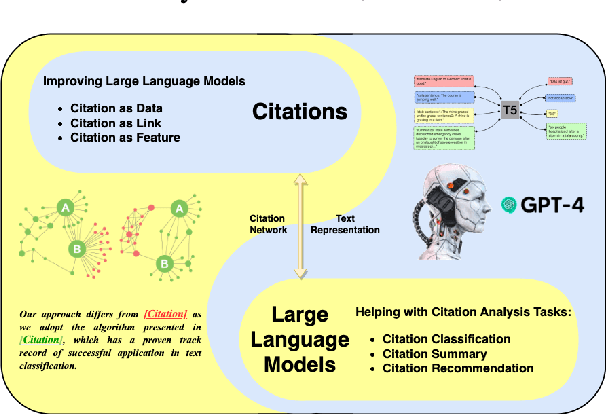
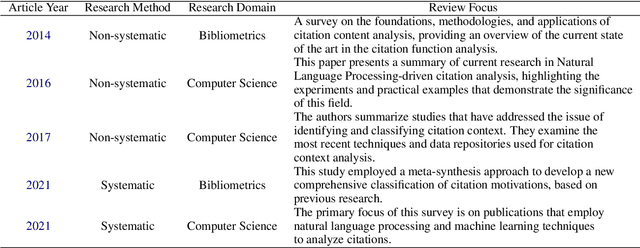
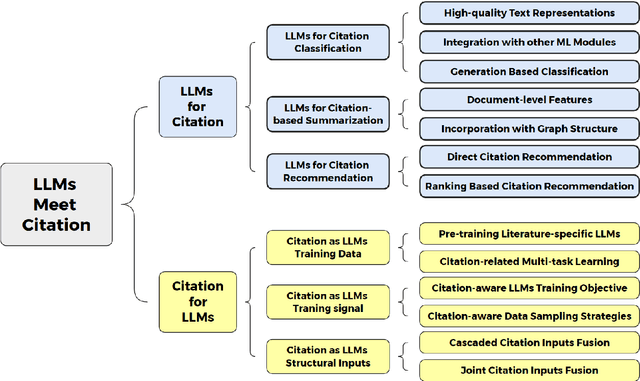
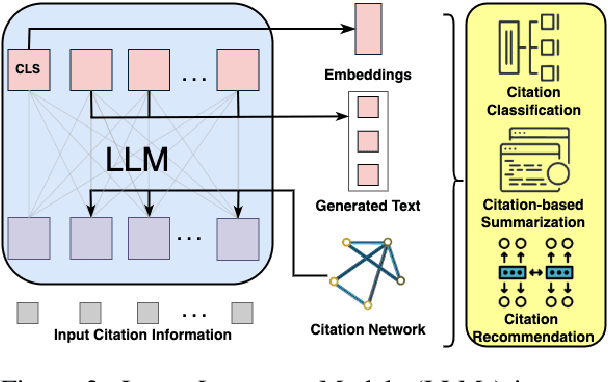
Citations in scholarly work serve the essential purpose of acknowledging and crediting the original sources of knowledge that have been incorporated or referenced. Depending on their surrounding textual context, these citations are used for different motivations and purposes. Large Language Models (LLMs) could be helpful in capturing these fine-grained citation information via the corresponding textual context, thereby enabling a better understanding towards the literature. Furthermore, these citations also establish connections among scientific papers, providing high-quality inter-document relationships and human-constructed knowledge. Such information could be incorporated into LLMs pre-training and improve the text representation in LLMs. Therefore, in this paper, we offer a preliminary review of the mutually beneficial relationship between LLMs and citation analysis. Specifically, we review the application of LLMs for in-text citation analysis tasks, including citation classification, citation-based summarization, and citation recommendation. We then summarize the research pertinent to leveraging citation linkage knowledge to improve text representations of LLMs via citation prediction, network structure information, and inter-document relationship. We finally provide an overview of these contemporary methods and put forth potential promising avenues in combining LLMs and citation analysis for further investigation.
Learning to Select the Relevant History Turns in Conversational Question Answering
Aug 04, 2023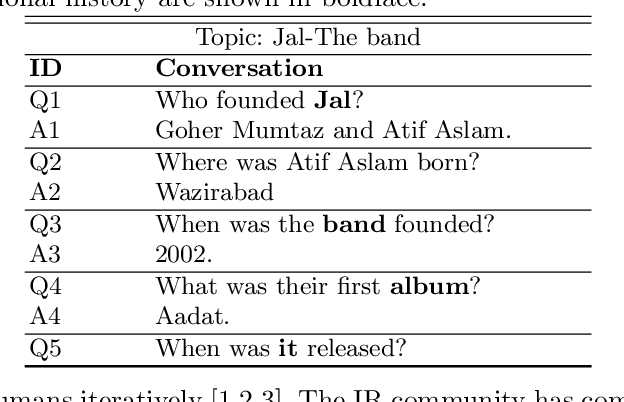

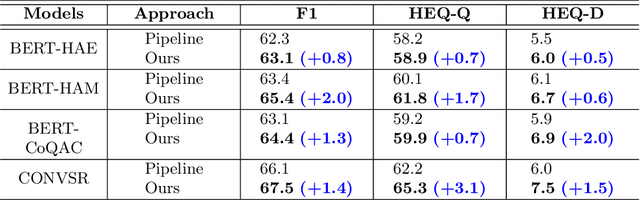
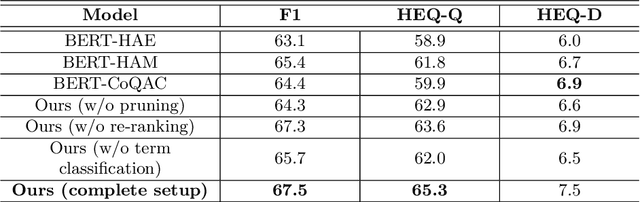
The increasing demand for the web-based digital assistants has given a rapid rise in the interest of the Information Retrieval (IR) community towards the field of conversational question answering (ConvQA). However, one of the critical aspects of ConvQA is the effective selection of conversational history turns to answer the question at hand. The dependency between relevant history selection and correct answer prediction is an intriguing but under-explored area. The selected relevant context can better guide the system so as to where exactly in the passage to look for an answer. Irrelevant context, on the other hand, brings noise to the system, thereby resulting in a decline in the model's performance. In this paper, we propose a framework, DHS-ConvQA (Dynamic History Selection in Conversational Question Answering), that first generates the context and question entities for all the history turns, which are then pruned on the basis of similarity they share in common with the question at hand. We also propose an attention-based mechanism to re-rank the pruned terms based on their calculated weights of how useful they are in answering the question. In the end, we further aid the model by highlighting the terms in the re-ranked conversational history using a binary classification task and keeping the useful terms (predicted as 1) and ignoring the irrelevant terms (predicted as 0). We demonstrate the efficacy of our proposed framework with extensive experimental results on CANARD and QuAC -- the two popularly utilized datasets in ConvQA. We demonstrate that selecting relevant turns works better than rewriting the original question. We also investigate how adding the irrelevant history turns negatively impacts the model's performance and discuss the research challenges that demand more attention from the IR community.
Keeping the Questions Conversational: Using Structured Representations to Resolve Dependency in Conversational Question Answering
Apr 14, 2023Having an intelligent dialogue agent that can engage in conversational question answering (ConvQA) is now no longer limited to Sci-Fi movies only and has, in fact, turned into a reality. These intelligent agents are required to understand and correctly interpret the sequential turns provided as the context of the given question. However, these sequential questions are sometimes left implicit and thus require the resolution of some natural language phenomena such as anaphora and ellipsis. The task of question rewriting has the potential to address the challenges of resolving dependencies amongst the contextual turns by transforming them into intent-explicit questions. Nonetheless, the solution of rewriting the implicit questions comes with some potential challenges such as resulting in verbose questions and taking conversational aspect out of the scenario by generating self-contained questions. In this paper, we propose a novel framework, CONVSR (CONVQA using Structured Representations) for capturing and generating intermediate representations as conversational cues to enhance the capability of the QA model to better interpret the incomplete questions. We also deliberate how the strengths of this task could be leveraged in a bid to design more engaging and eloquent conversational agents. We test our model on the QuAC and CANARD datasets and illustrate by experimental results that our proposed framework achieves a better F1 score than the standard question rewriting model.
GCN-based Multi-task Representation Learning for Anomaly Detection in Attributed Networks
Jul 08, 2022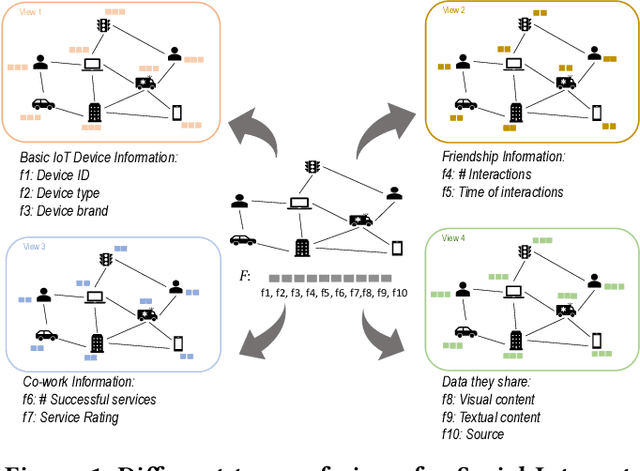
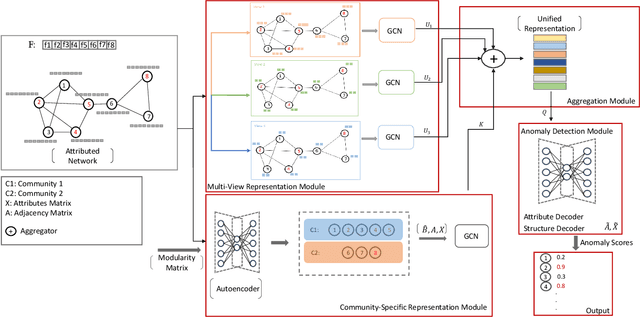
Anomaly detection in attributed networks has received a considerable attention in recent years due to its applications in a wide range of domains such as finance, network security, and medicine. Traditional approaches cannot be adopted on attributed networks' settings to solve the problem of anomaly detection. The main limitation of such approaches is that they inherently ignore the relational information between data features. With a rapid explosion in deep learning- and graph neural networks-based techniques, spotting rare objects on attributed networks has significantly stepped forward owing to the potentials of deep techniques in extracting complex relationships. In this paper, we propose a new architecture on anomaly detection. The main goal of designing such an architecture is to utilize multi-task learning which would enhance the detection performance. Multi-task learning-based anomaly detection is still in its infancy and only a few studies in the existing literature have catered to the same. We incorporate both community detection and multi-view representation learning techniques for extracting distinct and complementary information from attributed networks and subsequently fuse the captured information for achieving a better detection result. The mutual collaboration between two main components employed in this architecture, i.e., community-specific learning and multi-view representation learning, exhibits a promising solution to reach more effective results.
A Survey on Participant Selection for Federated Learning in Mobile Networks
Jul 08, 2022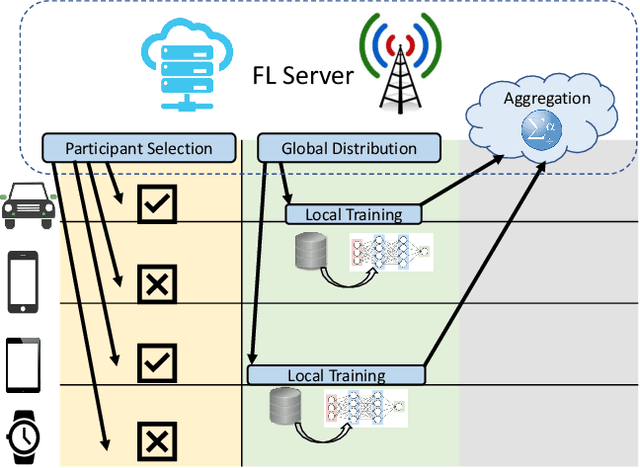
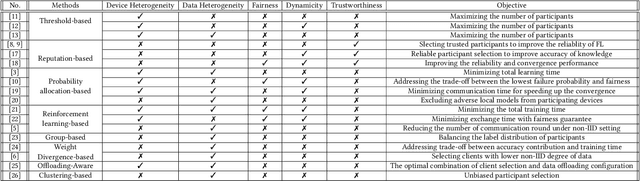
Federated Learning (FL) is an efficient distributed machine learning paradigm that employs private datasets in a privacy-preserving manner. The main challenges of FL is that end devices usually possess various computation and communication capabilities and their training data are not independent and identically distributed (non-IID). Due to limited communication bandwidth and unstable availability of such devices in a mobile network, only a fraction of end devices (also referred to as the participants or clients in a FL process) can be selected in each round. Hence, it is of paramount importance to utilize an efficient participant selection scheme to maximize the performance of FL including final model accuracy and training time. In this paper, we provide a review of participant selection techniques for FL. First, we introduce FL and highlight the main challenges during participant selection. Then, we review the existing studies and categorize them based on their solutions. Finally, we provide some future directions on participant selection for FL based on our analysis of the state-of-the-art in this topic area.