 Add to Chrome
 Add to Firefox
 Add to Edge
Learning Color Grading, No Photo Sharing: Federated Aesthetic Preference Learning for Personalized Image Enhancement
Jul 30, 2026
Personalized image enhancement should reflect individual aesthetic taste, yet learning such preferences commonly depends on private photos and ratings that are unsuitable for centralized collection. The task must infer preference from sparse, heterogeneous feedback and translate it into natural-looking color transformations on resource-constrained user devices. We introduce FedPAIE, a federated personalized aesthetic image enhancement framework for user-adaptive color grading without centralizing raw photos or ratings. FedPAIE trains a lightweight dual-cue aesthetic scorer, calibrates it into a personalized scorer on a small local support set, and freezes it to guide regularized adaptation of a lightweight CLUT enhancer from unpaired local photographs. Fidelity constraints and an excess-gap penalty regularize scorer-guided adaptation to limit proxy-score over-optimization while preserving content and natural appearance. Training remains lightweight throughout the pipeline: scorer learning updates at most 0.787M parameters, enhancer adaptation updates 0.265M, and inference retains only a 0.293M-parameter personalized enhancer. Experiments on MIT-Adobe FiveK and Flickr-AES demonstrate effective open-world personalization and a favorable balance between user preference and image fidelity. FedPAIE thus connects decentralized preference learning with efficient personalized image transformation without requiring paired user retouches.

SmoothTurn: Learning to Turn Smoothly for Agile Navigation with Quadrupedal Robots
Mar 13, 2026Quadrupedal robots show great potential for valuable real-world applications such as fire rescue and industrial inspection. Such applications often require urgency and the ability to navigate agilely, which in turn demands the capability to change directions smoothly while running in high speed. Existing approaches for agile navigation typically learn a single-goal reaching policy by encouraging the robot to stay at the target position after reaching there. As a result, when the policy is used to reach sequential goals that require changing directions, it cannot anticipate upcoming maneuvers or maintain momentum across the switch of goals, thereby preventing the robot from fully exploiting its agility potential. In this work, we formulate the task as sequential local navigation, extending the single-goal-conditioned local navigation formulation in prior work. We then introduce SmoothTurn, a learning-based control framework that learns to turn smoothly while running rapidly for agile sequential local navigation. The framework adopts a novel sequential goal-reaching reward, an expanded observation space with a lookahead window for future goals, and an automatic goal curriculum that progressively expands the difficulty of sampled goal sequences based on the goal-reaching performance. The trained policy can be directly deployed on real quadrupedal robots with onboard sensors and computation. Both simulation and real-world empirical results show that SmoothTurn learns an agile locomotion policy that performs smooth turning across goals, with emergent behaviors such as controlling momentum when switching goals, facing towards the future goal in advance, and planning efficient paths. We have provided video demos of the learned motions in the supplementary materials. The source code and trained policies will be made available upon acceptance.
Consistency Calibration: Improving Uncertainty Calibration via Consistency among Perturbed Neighbors
Oct 16, 2024Calibration is crucial in deep learning applications, especially in fields like healthcare and autonomous driving, where accurate confidence estimates are vital for decision-making. However, deep neural networks often suffer from miscalibration, with reliability diagrams and Expected Calibration Error (ECE) being the only standard perspective for evaluating calibration performance. In this paper, we introduce the concept of consistency as an alternative perspective on model calibration, inspired by uncertainty estimation literature in large language models (LLMs). We highlight its advantages over the traditional reliability-based view. Building on this concept, we propose a post-hoc calibration method called Consistency Calibration (CC), which adjusts confidence based on the model's consistency across perturbed inputs. CC is particularly effective in locally uncertainty estimation, as it requires no additional data samples or label information, instead generating input perturbations directly from the source data. Moreover, we show that performing perturbations at the logit level significantly improves computational efficiency. We validate the effectiveness of CC through extensive comparisons with various post-hoc and training-time calibration methods, demonstrating state-of-the-art performance on standard datasets such as CIFAR-10, CIFAR-100, and ImageNet, as well as on long-tailed datasets like ImageNet-LT.
A Benchmark Study on Calibration
Aug 23, 2023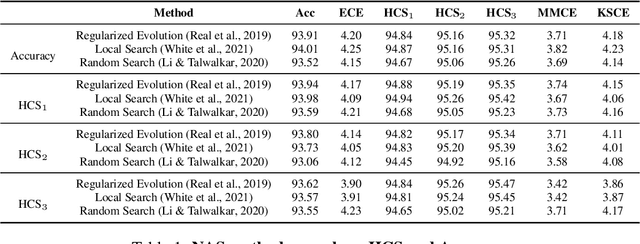
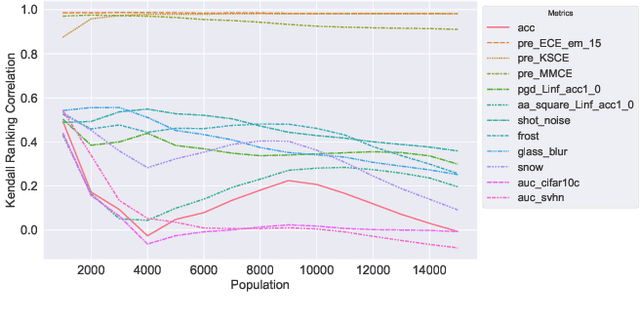
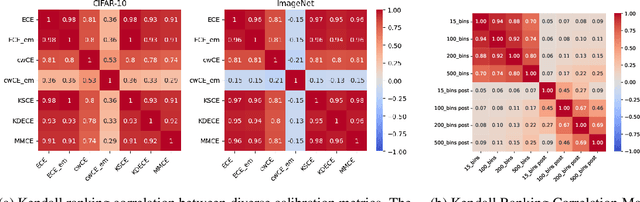
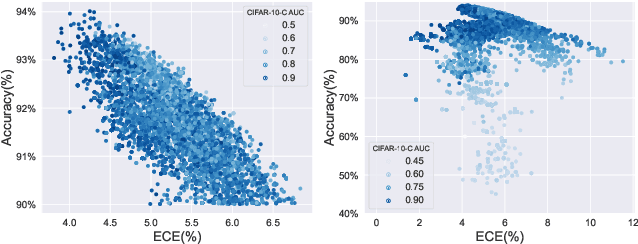
Deep neural networks are increasingly utilized in various machine learning tasks. However, as these models grow in complexity, they often face calibration issues, despite enhanced prediction accuracy. Many studies have endeavored to improve calibration performance through data preprocessing, the use of specific loss functions, and training frameworks. Yet, investigations into calibration properties have been somewhat overlooked. Our study leverages the Neural Architecture Search (NAS) search space, offering an exhaustive model architecture space for thorough calibration properties exploration. We specifically create a model calibration dataset. This dataset evaluates 90 bin-based and 12 additional calibration measurements across 117,702 unique neural networks within the widely employed NATS-Bench search space. Our analysis aims to answer several longstanding questions in the field, using our proposed dataset: (i) Can model calibration be generalized across different tasks? (ii) Can robustness be used as a calibration measurement? (iii) How reliable are calibration metrics? (iv) Does a post-hoc calibration method affect all models uniformly? (v) How does calibration interact with accuracy? (vi) What is the impact of bin size on calibration measurement? (vii) Which architectural designs are beneficial for calibration? Additionally, our study bridges an existing gap by exploring calibration within NAS. By providing this dataset, we enable further research into NAS calibration. As far as we are aware, our research represents the first large-scale investigation into calibration properties and the premier study of calibration issues within NAS.